Prakash Devineni
Fictional. Generated by AI — not a real person, and no likeness of one is intended.
53, nurse in San Francisco · rolled by @colin.hasbrook · card — no film
History
who has worn him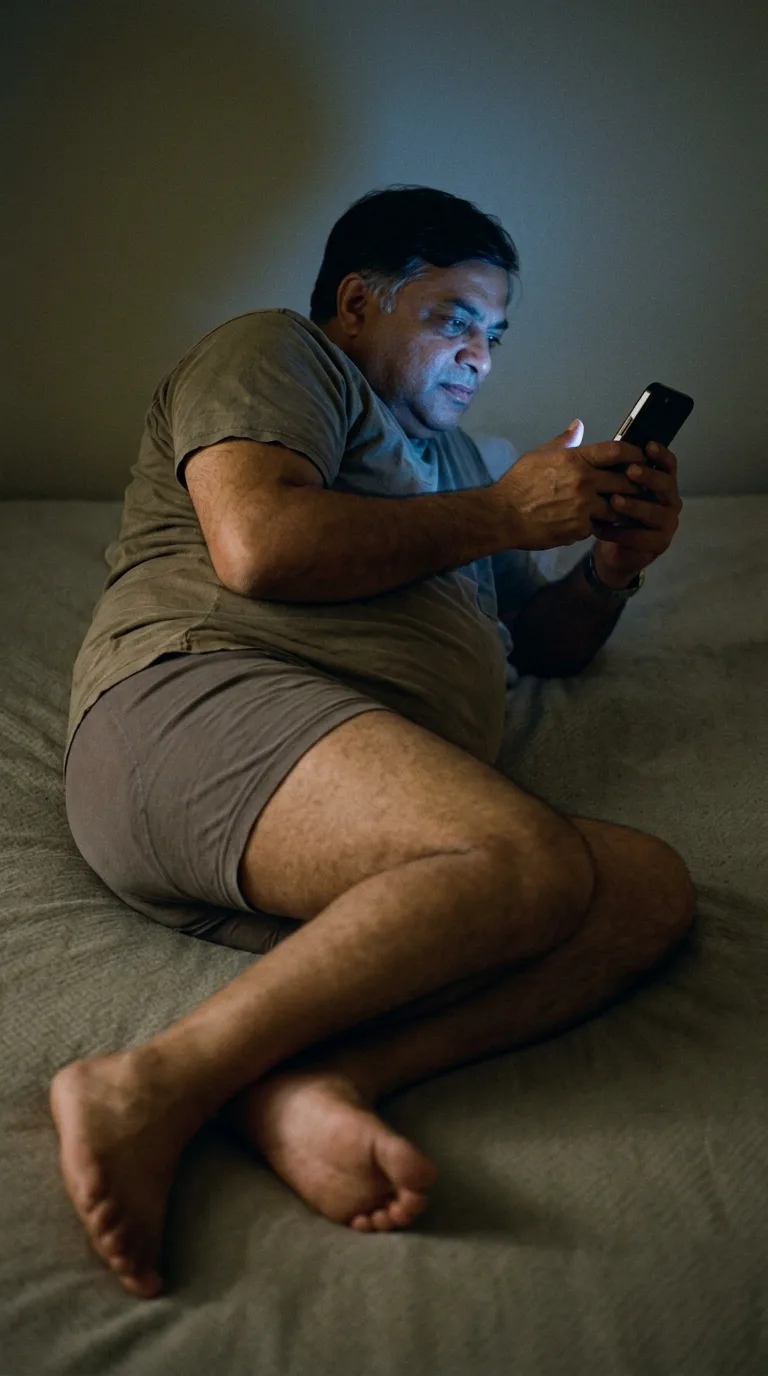
Rarest thing about him: South Asian — rare, 1 in 26
Season 0seed 970475932 · engine v10
Character card
lineage 2NZHHJ
His body-swap story
@colin.hasbrook, wearing Devendra Kohli, rolled the wheel on and woke up as Prakash Devineni, spent under a minute in him, then spun the wheel and woke up as Gary Steckler
---
Your knees ache first, before anything else, the way they always do by midday — Devendra's knees, sixty years of squatting in furrows and standing at fence lines, and you have had them less than a minute and already you hate them. You are sitting on the edge of somebody's borrowed cot in a somebody's borrowed house with the dirt of his fields still under his nails, and you spun once already today, less than a minute ago, and it did not take. You paid, you got the wheel, and it gave you back the exact same tired body with a beauty mark and gray hair and a hip that clicks. That is not a rule anyone will tell you, but you have spun enough to know: sometimes the wheel just isn't finished with you and it hands you yourself. You are not made to wait a decent interval. You are on your phone at the site again inside of forty seconds, because the whole reason you spun the first time is still sitting in your chest — a Monday that would not end, a body that would not stop reminding you it was old — and now there's a small, ugly satisfaction to trying immediately again, like slapping a vending machine. You pay. You spin. It catches.
—
The thumb moves before you do. That is the first thing: it is already scrolling, fast and sure, past a photo you didn't choose to stop on, and you are the one making it move now, mid-flick, mid-breath, on your side in the dark with a phone six inches off your nose and blue light lying flat across one cheek. You feel the weight settle into you all at once and unevenly — a gut resting heavy against the mattress, shoulders shorter and thicker than the ones you left, a body at rest that still knows, at some engine level, how to hold a line and a vein steady. The room smells of concrete and cold laundry. Somewhere above you, through a ceiling, floorboards creak with somebody else's weekday.
—
The shirt is not on you — this is bed, this is undressed, this is a gray T-shirt gone soft with washing and cotton boxers, and the shirt's absence gives you nothing, but the phone in your hand is warm from his palm and it opens like a door. A flash: him at the nurses' station, fluorescent light flattening everyone the same color, charting a med pass at some ungodly hour because nights are what they gave him this rotation, a coffee gone cold by his elbow that he will not finish because coffee sits wrong in him now, acid climbing his throat by four a.m. no matter what he eats. He is fifty-three years told twice a shift that he doesn't look it. He has heard it so many times it stopped being a compliment around year two.
Another flash, longer: a closet in a garage apartment, the driveway outside cut so steep his knees complain going down it in the rain, and him choosing this morning's scrubs off a hanger — blue top, navy bottoms, the same combination he has wheeled through a hundred times, sleeve first, right arm, left arm, the badge reel clipped last because if he clips it first it swings and hits him in the chest all shift and he has learned that the hard way more than once. Comfortable in his own competence the way only work clothes make a man comfortable. He irons nothing. He doesn't need to; the fabric is the kind that forgives.
Under that, further back: a wedding that didn't happen, a woman he almost married in his thirties who wanted Sacramento and children and he wanted neither badly enough to leave San Francisco, and it ended so undramatically that neither of them ever quite calls it heartbreak, and he has been, since, uncomplicatedly alone — dates a little, nothing sticks, doesn't mind it most days. He is not lonely so much as unbothered, which is its own kind of alone that nobody warns you about. He does not drink; watched an uncle come apart on it early enough that the taste never got a chance to mean anything to him. He has never smoked. His spine is spiritual in the vague comfortable way of a man who believes something is listening but doesn't much care what it's called, and Sundays he sometimes sits outside for ten minutes doing nothing in particular and calls that enough.
His hands, when the day loosens its grip on him, crack their own knuckles without asking permission, one after another, a habit from nursing school that outlived the nerves it was born to burn off. His stomach is quietly, chronically sour — has been for years, worse lately, and there's a bottle of something chalk-white on the nightstand he takes most nights and forgets some mornings. His body is soft in the way a desk-and-bedside life makes a body soft, dad-shaped without ever having been a dad, strong enough still in the forearms from turning patients that outweigh him twice over. He is, by any accounting that matters on paper, doing very well for himself — decades of shift differentials and careful, boring saving, nothing showy to show for it, a number in an account he doesn't look at often enough to enjoy it.
None of this belongs to you and all of it is, for this stretch of time, sitting where you are sitting.
—
You bring the phone down and turn your hand over in the blue light, palm up, like it might have an answer written on it. It doesn't. It's just a hand — thicker through the knuckle than the one you had ninety seconds ago, softer at the palm, a plain steel watch loose on the wrist. You crack the knuckles without deciding to, the whole hand at once, and something in you that isn't Devendra's and isn't quite yours either finds that satisfying.
"There you are," you say, to no one in the room, and your voice comes out lower than you expected and a little unfamiliar in your own throat, and you almost laugh at how easy that was.