Peter Vantassel
Fictional. Generated by AI — not a real person, and no likeness of one is intended.
37, sales manager in San Francisco · rolled by @connor.waskiewicz · card — no film
History
who has worn him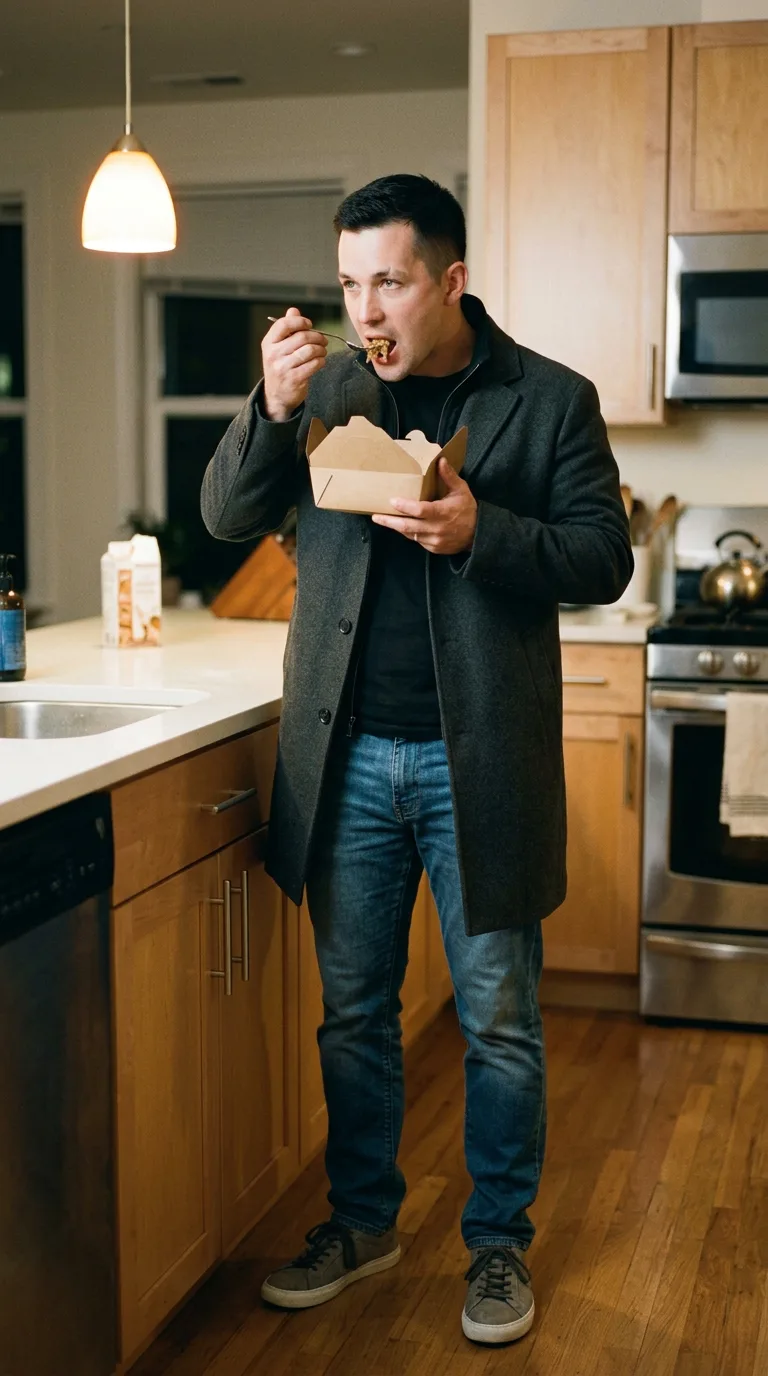
Rarest thing about him: Eating standing up at the counter — common, 1 in 31
Season 1seed 213445003 · engine v11
Character card
lineage 2NZHHJ
His body-swap story
@connor.waskiewicz, wearing Harold Steckel, rolled the wheel on and woke up as Peter Vantassel
Harold Steckel's knees ache before you even sit up. That is the first thing you notice, every time you come back into him after a break: the specific, grinding complaint of a fifty-three-year-old chauffeur's knees, the kind that has driven a Lincoln Town Car for other people's whole lives while his own idled in park. You are alone in the driver's seat of that Town Car, parked in his own gravel driveway, dashboard clock reading an hour that belongs to nobody but insomniacs and men who spin wheels. The last fare went home hours ago. The bottle of Windex and the microfiber cloth on the passenger seat are his, always his, and so is the ache in the lower back from decades of holding a door for people worth more than his house. You had him for less than a minute this second time — long enough to feel him settle into the seat like it was the only thing his body knew how to do anymore — before the itch started again, the one that has nothing to do with Harold and everything to do with you. Fifty-three years, gray hair, green eyes, a beard he keeps trim because a passenger complained once about scruff. He is fine. He is nothing. You open the site on the phone that is somehow always in reach no matter whose pocket you're in, and you pay, and you spin, because Harold Steckel's life, however briefly inhabited, is a life spent waiting for someone else to need a ride somewhere.
The fork is already coming back down to the counter when you arrive, and for a half-second you are only weight — compact, upright, a body that carries itself differently than Harold's, no ache in the knees, a leanness through the shoulders that feels almost like relief after all that gravity. Cold light off a window that shows you your own reflection and nothing beyond it: black, late, a pane of glass over the invisible drop of a garage cut into a hillside. The coat is still on. The container in your hand is warm through cardboard, noodles gone a little sticky, and the fork is resting where his hand left it a half-second before you got here, though you didn't feel him leave.
You shrug the coat off — his shoulders do it without asking you, a motion so practiced it happens before you decide to make it — and you sit at the counter on a stool that knows this exact weight, and here is where he starts arriving, not all at once but the way weather arrives, one front behind another.
The coat, draped now over the stool's back: gray wool, a little heavy for San Francisco but he liked how it looked in the elevator mirror at work, liked being the guy in the good coat among guys in fleece vests. Touching its sleeve on the way down gives you a flash of a tailor in the Mission measuring his arms, an offhand joke about divorce and needing new clothes for a new life, the tailor laughing too hard because the tailor didn't know yet how little of a joke it was.
The shirt against your back, light blue, the tie already gone hours ago — you get the whole morning through the collar and the cuffs still buttoned at the wrist: Peter standing in a closet that used to have two people's clothes in it and now only has his, choosing this shirt because the light in the conference room does something flattering to pale blue, checking the eyebrow scar in the mirror out of habit, the scar he got at nine falling off a bike, the scar that makes strangers ask if he was in a fight and he always says no, just a bike, and lets it go at that. He got dressed slowly that morning, unhurried, because there was no one to hurry for anymore. Sleeve, then sleeve, then the small vain adjustment of a collar, then the tie he'd take off by afternoon because ties are a costume and he's stopped believing in the show.
The counter under your forearms is granite, cold, and it gives you the kitchen itself: bought after the divorce, an under-house garage with a driveway cut so steep the delivery guys complain, a bay window he loved on sight because from the right angle at dusk you can see a slice of water between two other houses. He ate a lot of dinners standing exactly here. Alone counts as a marital status now, technically — divorced, no kids, an ex-wife who still calls sometimes about nothing, about a document, about a mutual friend's wedding, and he still feels something click into place and then immediately fall apart every time he hears her voice. The ring finger — you can feel the tan line even without looking, a paler stripe on the skin, a ridge only he would notice — remembers eleven years of a band that isn't there anymore, and the last months of the marriage, which were quiet the way a held breath is quiet, and then the actual end, which was almost boring, two adults being reasonable at a table with a mediator, the worst thing that ever happened to him arriving without the decency of drama.
The knuckles crack on their own — his hands doing it without him, the way they've always done it, a tic from some job before this one, before the glass conference room and the wall of charts and the quarterly numbers he is good at, genuinely good at, good enough to be worth what he's worth, though the money has never once made the apartment less quiet at midnight. A sales manager's hands: soft, uncalloused, made for handshakes and pens, and stronger than they look because he still, out of some old stubbornness, lifts weights three mornings a week in a gym two blocks from here.
The fork is cool in your fingers, angled the way a man angles a fork when he's not really tasting the food, when the food is just a thing that happens on the way to sleep. You finish the container in even mouthfuls because that's what his body was already doing and his body doesn't know yet that it isn't only his anymore.
You set the empty container down. You look at your hands — his hands, unlined for thirty-seven, a scar-free pair except for the ring finger's ghost — turn one over slowly under that cold kitchen light like you're checking it for a flaw the wheel might have left in, and you find none.
You lift your eyes to the black window, to the reflection that is his face and your attention behind it, and you say, quietly, to no one:
"There you are."