Rafael Cintron
Fictional. Generated by AI — not a real person, and no likeness of one is intended.
30, assembly line worker in Nashville · rolled by @connor.waskiewicz · card — no film
History
who has worn him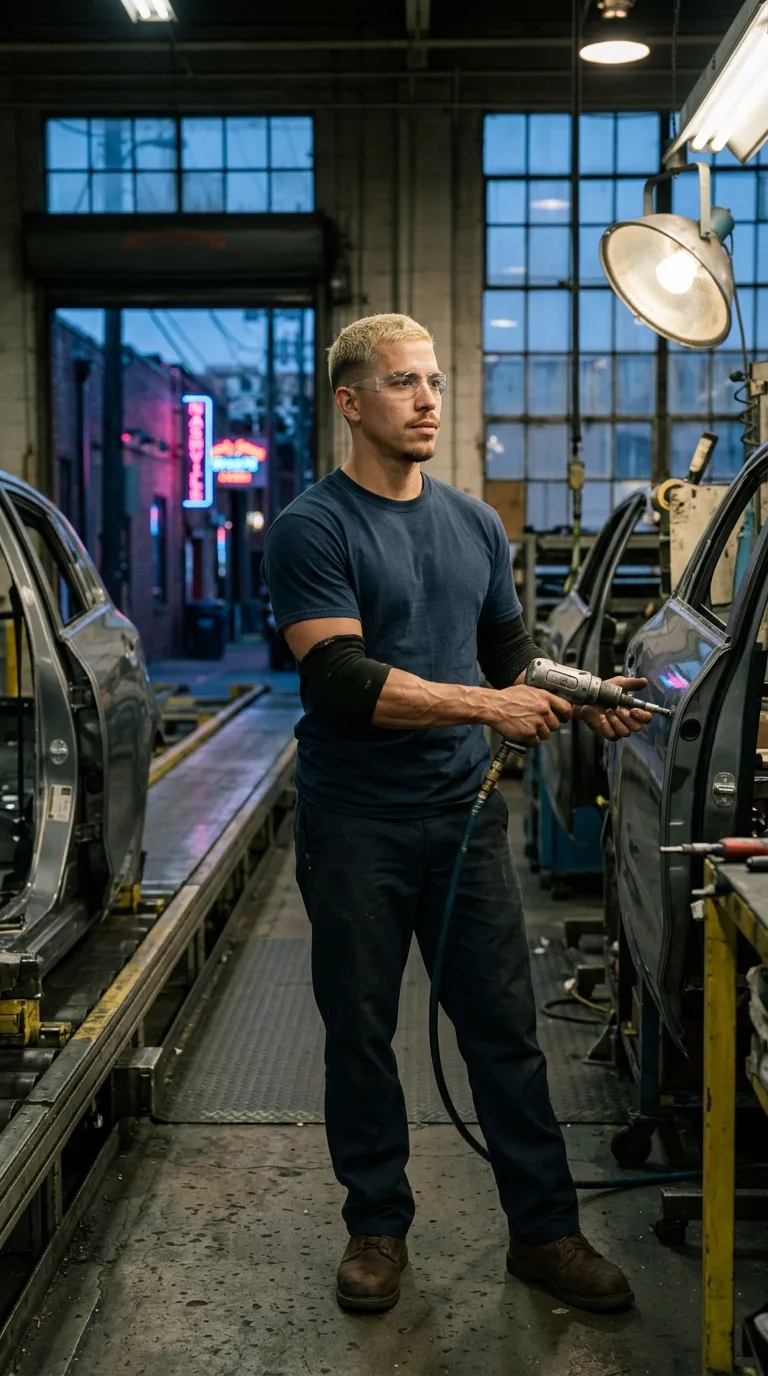
Rarest thing about him: Bleached blond — common, 1 in 54
Season 1seed 1494980067 · engine v11
Character card
lineage 2NZHHJ
His body-swap story
@connor.waskiewicz, wearing Peter Vantassel, rolled the wheel on and woke up as Rafael Cintron, spent 17 minutes in him, then spun the wheel and woke up as Leo Yazzie
---
Peter Vantassel's office has a window that faces the wrong way for sunsets, so what you get at the end of the day is just a graying of the light, the city going flat and administrative. Three days and eighteen hours in him and you already know the whole shape of his evening before it happens: the elevator, the garage, the drive home to a condo that isn't yours no matter how long you keep it, a woman who calls him something in a voice that assumes a person who isn't standing there anymore. He has a scar through one eyebrow from some story you haven't bothered to learn. He is fine. He is furniture. You made your decision around four o'clock, somewhere between a status meeting and the vending machine, the particular boredom of a body that has nothing left to teach you. Nine hundred and sixty-two men and this one barely registers as the six-hundredth kind of man you've been. You open the site on your phone under the desk like it's something illicit, though nobody has ever caught you, though nobody ever could. The wheel loads. You spin because spinning is the only decision you actually enjoy making anymore.
The rivet gun is already in your hand when you arrive, mid-squeeze, and the trigger finishes pulling before you understand you are the one pulling it. Wrong. You feel it a half-second late — the pressure gone off-angle, the bit biting crooked into the door seam — and then the correction comes on its own, muscle doing what muscle has done ten thousand times without you, easing off, resetting, seating it clean. Your hands, not decided by you yet, are already fixing what your arrival broke. Around you: the clang and hiss of a line running late in the day, blue dusk through tall factory windows, and past the open bay door a strip of alley lit pink and green by a honky-tonk sign you can't read the name of from here. The air smells like hot metal and cut oil. Something is strapped tight around your forearms — sweatbands, black, damp. A tool belt sits heavy and correct on your hips like it has always been there, and hasn't, not for you.
You check the next ten rivets like a man defusing something. Each one is fine. Each one was always going to be fine, this body knowing the door panel better than any thought could, and still you check, slow, because whoever is watching down the line — nobody is watching — might see the half-second where a stranger drove.
His clothes start talking before he does. The tool belt's weight against your hip is the first door: a memory of buying it secondhand off a guy named Ochoa who was leaving for a plant in Kentucky, the leather already broken in soft, a good deal, Rafael grinning telling his wife — no. Not wife. The word that comes with it is girlfriend, and behind that a whole warm clutter: Marisol, three kids between them, the youngest not even his by blood but calling him Papi anyway and him never once correcting her. The sweatbands are older than the belt — a physical therapist's idea two years back when the tendon in his right elbow started singing on cold mornings, and it still sings a little, right now, a low complaint under the strapping that this body has learned to work through without flinching.
The shirt is where the morning comes back whole. Navy, thin from washing, the collar a little loose. You feel his arms go into the sleeves the way he did eleven, twelve hours ago before dawn — no, wrong direction; his clock runs late, second shift, this is a man who eats breakfast at four in the afternoon and calls it lunch and has stopped explaining that to people who ask why he's groggy at church on Sunday mornings. The shirt remembers Marisol handing it to him warm from the dryer, remembers her saying something about the electric bill, remembers him not really listening because he was watching the kids fight over the last waffle, remembers loving all three of them so plainly and completely it isn't even a thought he has, just a weather he lives in.
His body is thirty and knows it in the good way — the shoulders thick from years of the same overhead motion, the forearms corded, a callus map across both palms that the leather glove liner has smoothed rather than roughened. Knees fine. Lower back a little stiff on the left side from bracing against the line rail, an ache he does a specific twist to relieve without ever naming it a stretch. His jaw wants to work sideways — a tension habit — and his knuckles want cracking, want it right now actually, a small itch running down both hands that has nothing to do with you and everything to do with him, thirty years of this exact tell.
There's a flash of Sunday — a plain little church off Gallatin Road, Marisol's mother in the pew ahead, one of the boys asleep against your shoulder through the whole sermon, the particular gratitude Rafael carries around without ceremony, like a tool he uses so often he forgets it's separate from his hand. There's a flash of the honky-tonk out that bay door on a big night, maybe once a month, him laughing with two guys from the line, three beers in, never four, home by midnight because six a.m. — no, because the shift, because the kids, because Marisol waiting up with the porch light on.
You crack the knuckles of your right hand without deciding to. It is his gesture wearing your want the way the shirt is wearing his shoulders.
You look down at the rivet gun still live in your grip, then past it to the hand holding it — brown-knuckled, callused, a thin white scar of grease worked permanently into one thumbnail — and it is unmistakably not the hand you had this morning, and it is the only hand you have now.
"Whose kid is that," you say, out loud, to nobody, not even sure yet which of the three you mean, and the line keeps moving, and you have no idea how long you get to find out.