Paul Ashcombe
Fictional. Generated by AI — not a real person, and no likeness of one is intended.
53, power lineman in Coastal Maine · rolled by @colin.hasbrook · card — no film
History
who has worn him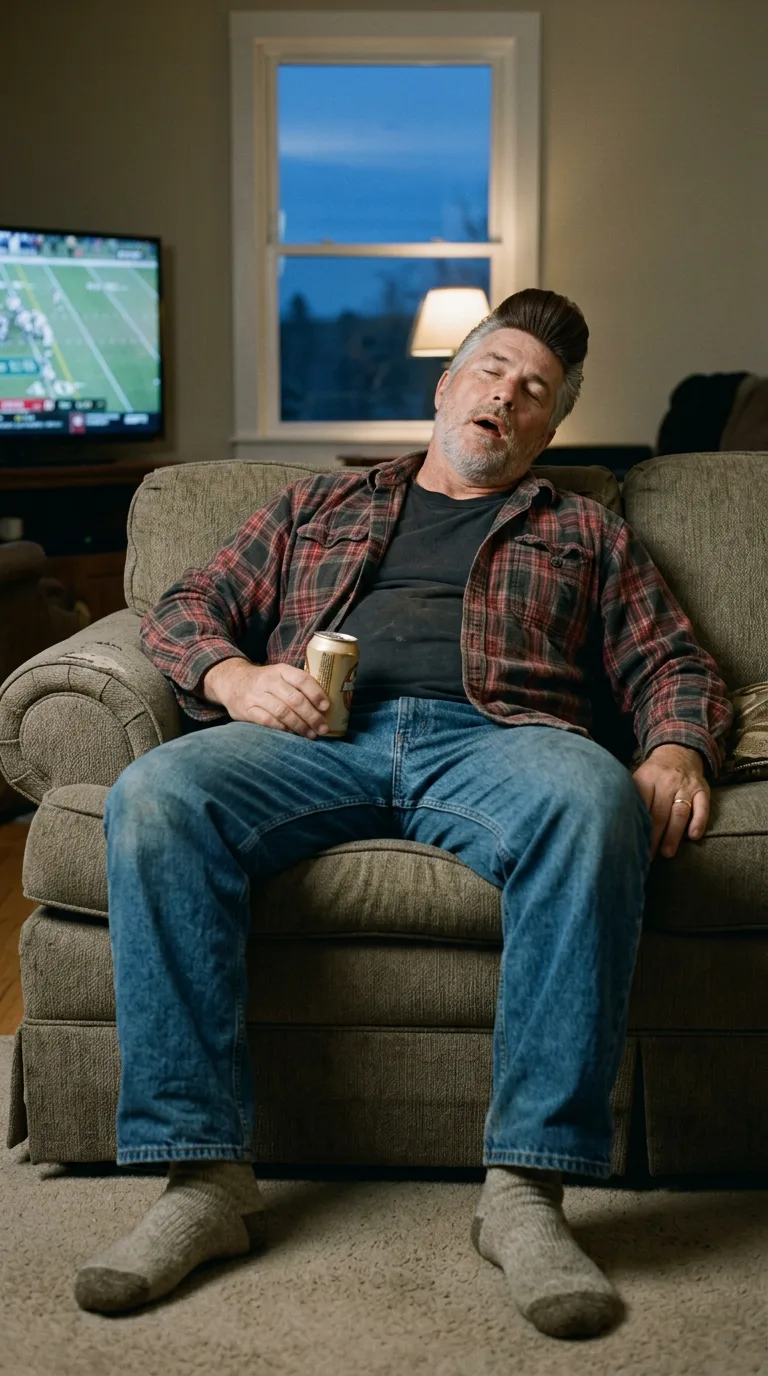
Rarest thing about him: Unitarian or liberal faith — uncommon, 1 in 165
Season 1seed 1025751078 · engine v11
Character card
lineage 2NZHHJ
His body-swap story
@colin.hasbrook, wearing Todd Kessner, rolled the wheel on and woke up as Paul Ashcombe, spent under a minute in him, then spun the wheel and woke up as Warren Piskorski
Todd Kessner's kitchen smells like other men's houses always do to you now — like nothing, like a life you are only renting. You are standing at his counter with his phone in his hand, and it has been forty seconds since a text came in from a woman named Denise asking if he's coming to dinner Sunday, and forty seconds is long enough to feel the whole shape of the thing: a soldier home from somewhere, a mother who still calls him her boy, a recliner that isn't yours, a war that isn't yours, a body that isn't yours and never was. Todd's fine. Todd is more than fine — young, straight-backed, a scar under one eyebrow that some sergeant gave him a story for. But you've had him less than a minute and you already know the whole flavor of him, the way you know the flavor of the last six hundred and ninety, and some nights that knowing arrives too fast and leaves you standing in someone's kitchen already bored of being safe. You set the phone down on the counter, face-up, screen still lit, like leaving a light on for him. Then you go to the laptop on his kitchen table, the one with a Buckeyes sticker on the lid, and you open vessel.cards, and you spin.
The recliner takes your weight before you know you have weight to give it. Warm can loose in your fingers. Mouth already open on a breath that isn't a word. Somewhere in front of you a stadium roars small and tinny through a television, and the roar is for a goal you didn't see, on a replay you are seeing now, for the second time, though this is the first time you have ever seen anything through these eyes. Your thumb finds the volume button on the remote without you asking it to, and lowers the sound with a small, practiced correction, like a hand that has done this ten thousand times drunker than this. You sit forward. The couch releases you an inch. Cold sea light through a window on your left, going navy at the edges, and inside, a lamp with a shade the color of weak tea.
The recliner isn't a recliner, you realize — it's a couch, plaid over your shoulders that isn't yours yet, and it becomes yours the way all of it becomes yours, through the hands. The can: aluminum going warm, a domestic lager, and touching it gives you a flash of a cooler on a dock, salt on the lid, a woman's laugh you don't have a face for yet. The flannel shirt against your back, worn soft at the elbows, gives you more: a closet with a rod that sags in the middle, a row of shirts he — Paul, you'll learn the name later, off a mug, off a checkbook — wears in rotation without thinking about it, and this morning, hours or a lifetime ago depending on whose clock you trust, pulling this exact one on over the t-shirt, right arm first because the left shoulder is the one that complains, cold high in the house because Barbara likes it that way and he stopped fighting her on thermostats around year fifteen. The jeans at your legs remember a truck cab, a coffee thermos wedged between your knees, gravel under tires on the way to a job site. Your feet in wool socks against the carpet bring back boots — steel-toed, gaff-hooked, buckled to the shin — and with the boots comes the pole: rain coming sideways, the bucket truck's hydraulic whine, forty feet up with a line in your black rubber gloves and your whole weight trusting a harness, thirty years of trusting it, the particular ache that lives now in both your knees and one hip and doesn't leave even in sleep. Your hands know things you didn't ask them to know — how a splice goes, how a wrench sits, the exact resistance of a bolt before it's tight enough. Your jaw finds a beard trimmed close, your own fingers finding it out of habit, and habit gives you a bathroom mirror, an electric razor's buzz, gray coming in at the roots faster than the dye can keep up, an hour spent monthly in a chair at a shop called The Clip Joint getting the pompadour built back up because Barbara likes it high, always has, said so on their second date thirty years ago and he never let it go short again.
Barbara. The wedding band on your left hand is warm from your body already, and it gives you a wedding — small, a white-shingled church gone gray with weather, her in her mother's dress taken in at the waist, him twenty-three and sunburned and sure. It gives you decades after: a house that also went gray, silver-shingled, lobster traps stacked in the dooryard that they never once used for lobster, just let sit there because a man before them left them and it seemed wrong to move them. It gives you no children, and the specific, worn-smooth shape of that absence — not a wound anymore, just a room in the house that stayed empty and got called something else, a den, a place for his tools. It gives you Denise — no, not Denise, that was Todd's — it gives you Carol, a girlfriend from before, decades gone, a summer on a different coast, a version of himself that still visits sometimes at 2 a.m. for no reason he'd admit to Barbara or to God, harmless as an old song. It gives you church on Sundays he only half believes but goes to anyway because the coffee after is good and the minister doesn't yell about hell. It gives you the can in your hand, one of three tonight, no more, because that's the deal you made with yourself after your own father drank himself into the ground before sixty.
Your thumbnail finds its way to your teeth without permission — an old, private, embarrassing habit, forty years old, that Barbara has given up asking him to quit — and biting down on it brings the last, smallest flash: this morning, sitting on the edge of the bed, pulling wool socks on over feet that ache before the day even starts, thinking, not for the first time, that fifty-three feels different than fifty was, heavier somehow, softer somehow, and being grateful anyway, plainly, wordlessly grateful, for a body that still climbs the pole every day it's told to.
You look down at the hand. Freckled, thick-fingered, the nail bitten ragged at the thumb, the band catching lamplight. You turn it over once, like checking it's real, and it is — heavier than Todd's, softer at the middle, older in a way that isn't unkind.
You lift your eyes to the dark window, to your own reflection ghosted over the cold Maine evening, and you say, to no one, in his voice and not yours: "There you are."