Owen Matsuda
Fictional. Generated by AI — not a real person, and no likeness of one is intended.
29, trucker in Western Kansas · rolled by @colin.hasbrook · card — no film
History
who has worn him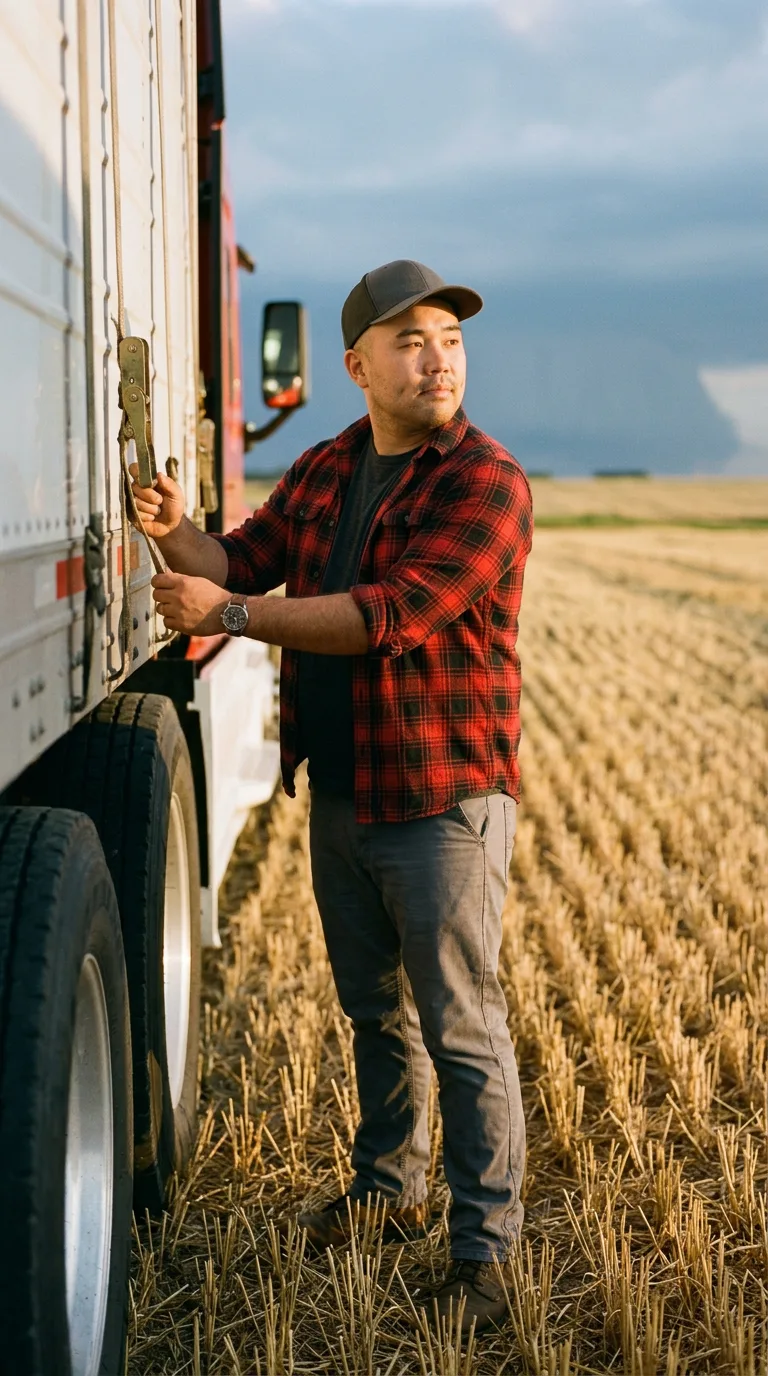
Rarest thing about him: Millionaire — $1M to $3M — epic, 1 in 133
Season 0seed 1644496815 · engine v10
Character card
lineage 2NZHHJ
His body-swap story
@colin.hasbrook, wearing Neil Chandra, rolled the wheel on and woke up as Owen Matsuda, spent under a minute in him, then spun the wheel and woke up as Gary Petrakis
You have three minutes in Neil Chandra's body and already you know it's not going to be enough. You're standing on a half-finished roof in Anchorage, early afternoon light flat and gray through cloud cover, a nail gun heavy in a hand that isn't calloused the way it should be for a thirty-year-old roofer — soft, almost, like this body doesn't do this every day the way the memory-flashes coming off the tool handle insist it does. You feel a knee that aches when you shift your weight, feel a back that will hurt worse tomorrow than it does today, and you feel, underneath all of it, the specific flatness of a life that is fine. Girlfriend named in a photo you haven't looked at yet on a phone in his pocket. A beer in the fridge for tonight, maybe two. Nothing wrong with any of it. That's the problem. Three minutes was enough to know there's nothing here you want to keep learning. You climb down, sit in the truck, open the site on the cracked phone screen with hands that still feel borrowed, and you spin.
The rhythm breaks.
Your hand — his hand, thick-fingered, sun-browned at the wrist and pale above the cuff — is on a trailer latch, mid-pull, and it does the pull wrong: too soft, missing the catch, the lever skidding off the pin. You feel the correction happen almost before you decide it, slow this time, deliberate, the way you'd walk someone else's dog on a leash you don't trust yet. The latch seats. You do it again. And again — ten more times, checked, each one, on a motion this body has done ten thousand times without looking. Wind is coming up off the stubble field in long pushes. The sky to the west has gone the color of a bruise, a thunderhead stacked up black and swollen, and the light everywhere else has turned that thick amber-yellow that means the barometer's falling fast. It should be morning light by the job — start of a run, first checks at first light — but this is the far end of a day, evening pooling gold-dark across cut wheat, and something in you notes the wrongness the way you'd note a wrong hour on your own kitchen clock, and files it, because it never matters, not really. Time is just where he happens to be standing.
The shirt is what opens first — red-black plaid, warm at the shoulders from a day of sun even with the storm coming, the cuffs rolled twice, and it comes back to you not as an image but as a whole morning: standing in a bedroom with pale blue light through half-closed blinds, an body already awake before the alarm, shoulders that ache in the specific low way of a man built a little heavier than he means to be. Buttoning it one-handed while the other hand holds a mug. A voice from the hallway — hers — asking if he took the good thermos or the one that leaks, and him saying the leaky one, on purpose, like it's a joke they've had for two years, and it landing exactly the way it always does. Sleeves rolled to the forearm because the cab gets hot by ten even with the AC fighting the plains sun. The shirt was hers before it was fully his — a gift, an early one, when the relationship was still new enough that gifts meant something more than convenience — and some tenderness lives in the fabric that has nothing to do with the pattern.
The cap is next, sweat-salted at the band, and under it a scalp that never quite gets used to the way this haircut grows out — tight at the sides, left long on top, a look he picked because a barber in Dodge City talked him into it once and it stuck. Dimples come with a memory of being teased for them his whole life, of a mother who used to press a thumb into one when he was a kid and call it her favorite thing about him, unearned and permanent, showing even now, even with his face doing nothing at all.
The ring is the deepest one. It isn't a wedding band — no wife, no fiancée on record — but a ring all the same, plain, worn thin at the inside curve from years of exactly this: thumb turning it, absent, while he waits for a scale to open or a load to get checked. It came from a grandfather he barely remembers, passed down through a father who drove trucks before him, out of a different kind of hauling — grain, then freight, then this, an inheritance of routes and calluses more than money. And here is where the money surprises you, arriving sideways through the ring rather than through anything showy: statements he doesn't talk about, an account that grew fat on decisions he made early and never mentioned to anyone at the truck stops, diesel money turned into something else entirely, quietly, the way some men hide a hobby. He still eats gas station chili. He still wears boots until the sole splits. Nobody riding with him would guess. He likes it that way — the not-guessing is its own kind of pleasure, private, almost the only vanity he has.
Under all of it, the body: six-one, heavier through the middle than he was at twenty-five and not fighting it much, a strength in the shoulders and forearms that the softness doesn't erase, knees that pop getting down off the trailer step, a lower back that has opinions about long days. Big night out once or twice a month with buddies from the yard, otherwise nothing — no smoke ever touched these lungs, no craving sits in this chest. A body used hard and cared for adequately, not lovingly, the way you maintain something you expect to need for another thirty years.
The storm smell reaches you last — ozone and cut wheat and hot diesel — and with it, the girlfriend's name arriving whole and unbidden, the shape of her laugh, a fight they had in March that ended fine, the plain unremarkable fact of coming home to her, which he is, tonight, once this trailer's locked down and the weather's done with him.
You look at your hands. Thick fingers, a thin band of gold-toned metal catching the last yellow light before the black rolls over it. You turn the hand over once, like checking it's real, and lift your eyes into the wind toward the clouds stacking up over the stubble field.
"Storm's gonna beat me home," you say, to no one, in his voice, and you don't know yet if that's a problem you'll still have tomorrow.