Gary Petrakis
Fictional. Generated by AI — not a real person, and no likeness of one is intended.
49, sanitation worker in Los Angeles · rolled by @colin.hasbrook · card — no film
History
who has worn him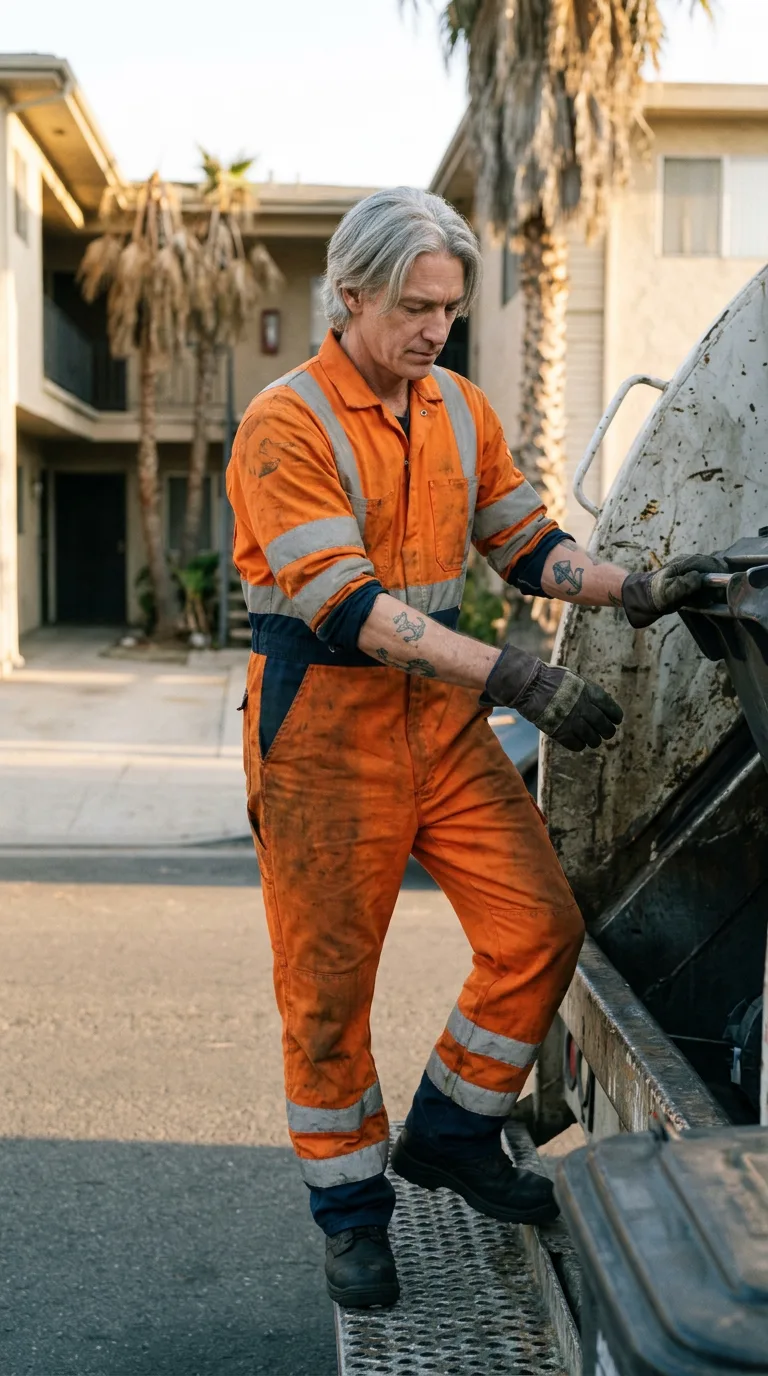
Rarest thing about him: Dating — rare, 1 in 14
Season 0seed 2097925587 · engine v10
Character card
lineage 2NZHHJ
His body-swap story
@colin.hasbrook, wearing Owen Matsuda, rolled the wheel on and woke up as Gary Petrakis, spent under a minute in him, then spun the wheel and woke up as an unnamed body
---
You're sitting in Owen Matsuda's body in a rest stop parking lot outside Colby, Kansas, and the dashboard clock says the sun is going down on a Friday nobody's paying you to work through. Dimples. A dad bod that carries itself like it apologizes for corners. You've been him for forty-some seconds and already the wanting has moved past him like water past a rock. That's the tell, the only tell you ever get: not disgust, not disappointment, just the sense that you're early for your own life and this isn't it. Owen's phone is face-down on the seat. There's a woman's name in it you haven't earned and never will. You don't open the app to look at him. You open it to leave him.
The wheel spins somewhere that isn't a place, and then you're not sitting anymore, you're standing, and there's weight in your shoulders that wasn't there a half-second ago and a smell of hot asphalt and green dumpster and eucalyptus, and your hand is on a steel handle ridged with grime, mid-pull, and the lever you meant to throw you throw wrong — too soon, the bin catching the lip crooked — and you correct it, slow, deliberate, like a man rethinking a word he's said ten thousand times. You do it again. Correctly. Then the next one. And the next. Checked, all of them, on a route that stopped needing checking before the dimpled trucker back in Kansas was old enough to drive.
The gloves come first — leather gone stiff with old sweat, fingers curled slightly at rest, like they remember a shape. A flash: these gloves, four years old, a Christmas-adjacent purchase from a wife who isn't a wife anymore, bought because the last pair split at the seam over the thumb and she said *you'll lose a finger, Gary,* not unkindly, back when unkind wasn't yet the tone they used with each other. That flash closes as fast as it opens, but the hands keep the memory even after the mind lets go: how to grip the bin lip so it doesn't bite through leather, how to time the swing to the truck's hydraulic groan, how to read a container's weight before it clears the ground, purely by the angle the handle wants to fall.
The coveralls — orange, taped in reflective silver gone dull with wash and city grit, navy insert at the waist — remember themselves onto you sleeve by sleeve, a rerun of six-fifteen this morning: the apartment courtyard quiet except a sprinkler ticking somewhere, the girlfriend Renata still asleep with one bare foot out from under the sheet, and you — him — sitting on the edge of the mattress working your left arm into the sleeve first because the right shoulder's been catching lately, some tendon thing he's decided not to have looked at. Zipper to the sternum. Boots by the door already broken into the specific bend of his own feet, twenty-two years of pavement in the soles. A toothpick from the box on the dresser, into the corner of the mouth out of habit, not hunger — he quit chewing tobacco the year Dana was born and this is what filled the shape of it.
Dana. The name comes with the smell of the truck's vinyl seat, a girl now nineteen and unimpressed with him in the specific, loving way daughters get unimpressed, and behind her a boy, younger, quieter, who calls on Sundays and not other days, and Gary doesn't push it because pushing never once in his life got him anything but a closed door held a little firmer. There's an ex-wife in there too, Carla, who left not with drama but with a slow leak of a marriage nobody patched, and there's Renata now, warm, uncomplicated so far, a woman he is trying — cautiously, at forty-nine, having learned exactly how much a bad decision costs — to be good to.
There's a tattoo on the forearm, small, blurred at the edges the way cheap ink goes after enough Los Angeles sun — an anchor, or something meant to be one, done at nineteen by a friend's cousin with a needle and a promise, and every single day since he has looked at it in the mirror and thought *should've thought that through.* The regret is small and old and almost fond by now, the way you get fond of a mistake that never cost you anything but a little pride.
Twenty-two years of six a.m. starts. A body that knows precisely where its own strength lives — in the low back, in the forearms, in the specific economical roll of the shoulders that keeps a man doing this work at forty-nine instead of blowing out a disc at thirty. No drink in him, no smoke, hasn't in years, made that call sober-minded the way he makes most calls, and it shows in how clean the exhaustion sits: honest tired, not chemical tired.
The truck idles behind you, patient, indifferent. Dry palms lean into a late sun that hasn't figured out yet that a stranger just walked into one of the men holding it up.
You look down. Grease-blackened gloves, your hands inside them now, flexing once, testing the fit like a coat you're deciding whether to keep on.
You take the toothpick out from between his teeth, look at it like you've never seen wood before, and say, to no one, to the dumpster, to the truck, to the palms: "Okay. Let's see what today's got left in it."
Whatever's next for him, it isn't decided. Not by you, not yet, not for however long this lasts.