Nicholas Broda
Fictional. Generated by AI — not a real person, and no likeness of one is intended.
31, cop in Small-town Ohio · rolled by @colin.hasbrook · card — no film
History
who has worn him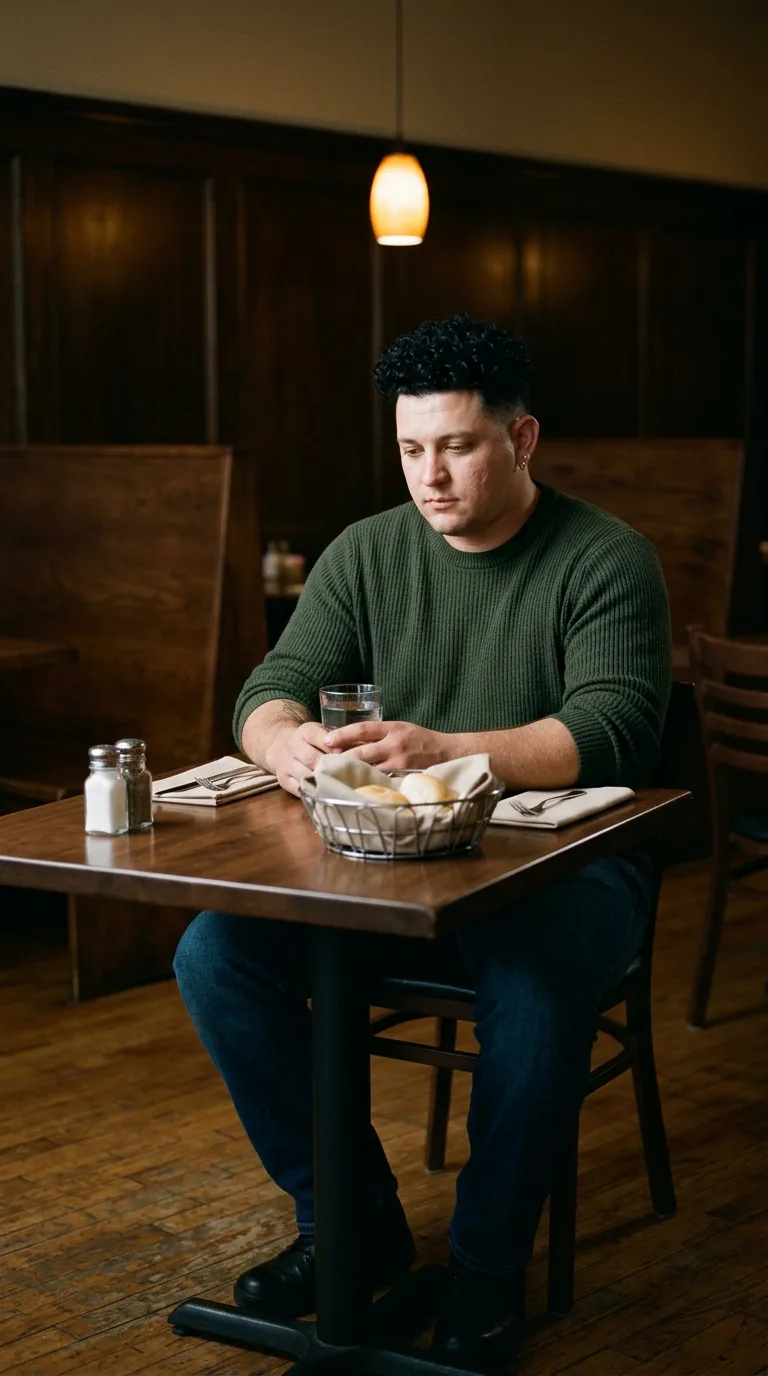
Rarest thing about him: Dyed black — epic, 1 in 77
Season 0seed 131269670 · engine v10
Character card
lineage 2NZHHJ
His body-swap story
@colin.hasbrook, wearing Dale Kowalczyk, rolled the wheel on and woke up as Nicholas Broda, spent 41 minutes in him, then spun the wheel and woke up as Marcus Odom
You have been Dale Kowalczyk for forty seconds, and already you hate the tooth.
You keep touching the gap with your tongue, the missing front one, and it is somehow the thing that decides you. Not the height, though 6'5" in a farmhouse kitchen means ducking under the light fixture over the sink. Not the gut, though it sits on you like a sandbag you didn't ask to carry. It's the tooth. It's Monday, mid-morning, you're standing in his kitchen in his boots by the door with dirt still on them, and out the window there's a field that isn't yours and never will feel like it, and somewhere in him — thin, underneath, already fading the way they all fade — is a woman's name he says like a bruise he presses on purpose. You didn't come here for his sadness. You came, six hundred and sixty-four times ago, for something else, and you still don't have a word for it except that the wanting came back, the way it always does, quiet as a tap on the shoulder, and you went to the site on his phone with his thick thumbs and paid with his money he does not have and spun.
The wheel doesn't care that it's the same Monday. It doesn't care about clocks at all.
The glass turns a quarter under your fingers and stops.
You are sitting down. You are small — the table is at a strange height, your knees almost touching the underside of it — and across from you a woman is not saying anything, and a bread basket sits between two settings, untouched, and you have just heard yourself say a sentence you did not build, something about *I just think we want different things*, and it came out pitched to carry, a voice louder than the room, and two women at the next table glance over and look away fast, the way people do when they've caught a stranger's failure in progress. Your hand is on a water glass. The glass is still moving very slightly from the turn you gave it without meaning to.
You did not mean to. That part is new. That part is him, the residue of him, still in the muscle for one more second before it's only yours.
Then it comes in through the glass first — cold, wet ring of condensation against your palm — and you get a flash of another glass, another kitchen, Nicholas Broda at nineteen doing dishes at his mother's sink while she said the Broda men marry young or not at all, don't you dare be a not-at-all, and he'd laughed it off and here he is at thirty-one, still not-at-all, and something in that flash tastes like shame he learned to carry so early he forgot it was shame and started calling it just how I am.
The sweater comes next — green, ribbed, worn soft — and it gives you the morning: him standing in front of the mirror in the apartment above the hardware store, turning sideways, deciding the sweater hides more than the button-down, deciding tonight matters more than it should for a second date arranged by his sister's coworker, deciding — sleeve by sleeve, right arm first because the tattoo always goes in stiff, the praying hands catching on ribbed knit — that he was going to be different tonight, funnier, looser, a man who has his life more together than he does. He'd stood at that mirror turning the small silver hoop in his left ear like a worry stone. He does that when he's nervous. He was nervous getting dressed for a woman he'd now failed in front of for forty straight minutes.
The chair under you gives you the job — not this second, but all of it at once, dusk-colored, the parking lot behind the station, leaning on the hood of the cruiser while the light goes orange and then gray, radio traffic low and constant as breathing, the badge weight settling into a shape on his hip he stopped noticing years ago. He is good at the parts that are mostly waiting. He likes the town for its one stoplight, the way everyone already knows his name before he says it, the way the closed diner still has flowers someone leaves in the window box every spring though nobody's opened the door since he was in high school. He became a cop because his uncle was one and it was the only door he saw open, and he stayed because leaving felt like admitting something about the money — the debt underneath everything, the number he does not say out loud even to himself, the collection calls he lets go to voicemail with the sound off.
The floor under his boots gives you church, gives you kneeling, gives you a hand — his own — resting flat on his forearm over the tattoo like he's checking it's still there, the cross and the praying hands he got at twenty-three the week his father's heart gave out, a promise he's kept better than most of the ones he's made since. He believes, plainly, without needing to defend it, that somebody is watching all of this and keeping score kindly. He believes it while he's failing at small talk. He believes it in the patrol car at 3 a.m. He believed it, once, lying next to a woman named Colleen for two years who is not sitting across from him now and who he still, four years later, thinks about when a country song comes on he doesn't skip fast enough.
The bread basket, when your hand — his hand, the short thick fingers, the tattoo turning under the low pendant light — finally reaches for it because the silence needs filling with something, gives you nothing at all. He never got to it. He was too busy failing out loud.
You look down at that hand now. Wide palm, the ink gone slightly soft-edged with age, the little hoop catching light when you tip your head, all of it foreign and already, faintly, starting to feel like the only hand you have.
You look up. The woman across from you is still waiting, water glass of her own untouched, her face arranged into the patient blankness of somebody deciding whether to be kind about leaving.
"Sorry," you say, in his voice, too loud again, and then softer, finding the register he'd have used if he'd had thirty more seconds of practice at being himself. "I don't know where that went. Can we — can I try that again?"
Somewhere behind your eyes, already thinning, is a farmhouse kitchen and a missing tooth and a field. You don't know how long you get to sit here not being Dale Kowalczyk. Nobody does. Not even you.