Nestor Villagrán
Fictional. Generated by AI — not a real person, and no likeness of one is intended.
53, administrative assistant in New York · rolled by @connor.waskiewicz · card — no film
History
who has worn him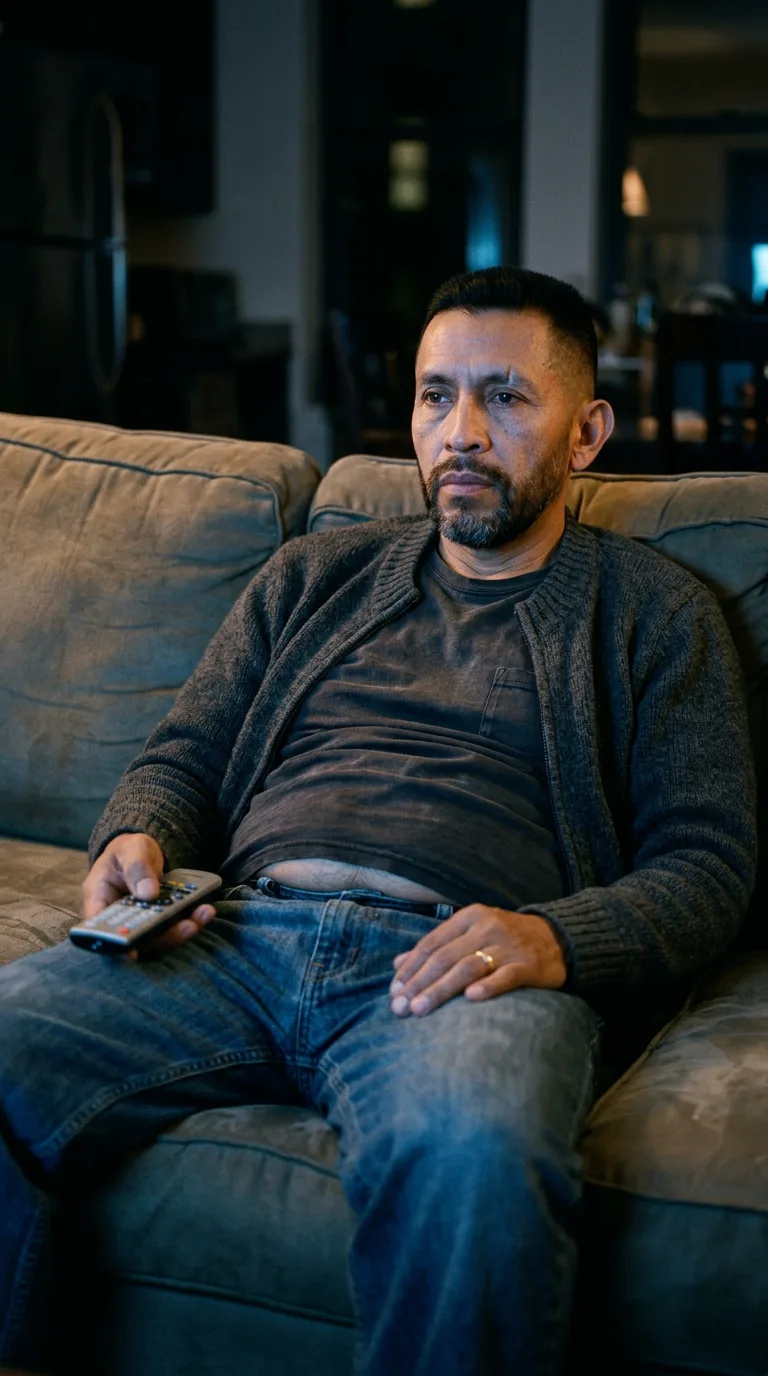
Rarest thing about him: Administrative assistant — common, 1 in 155
Season 1seed 467637343 · engine v11
Character card
lineage 2NZHHJ
His body-swap story
@connor.waskiewicz, wearing Gerald Poehlmann, rolled the wheel on and woke up as Nestor Villagrán, spent under a minute in him, then spun the wheel and woke up as Adrián Vasquez
The prosthetic arm is the problem. It has been the problem for six minutes.
You are Gerald Poehlmann — you have been Gerald Poehlmann for less than a minute, which is not enough time to learn a body, and it shows. The forearm ends in a hinge and a bank of dead plastic fingers that don't answer when you try to make a fist. You stand in his kitchen — his, not yours, none of them are ever yours — under a bulb with a moth ticking against it, and you understand with the flat, sinking clarity of somebody sobering up that this one doesn't work. Farmhand. Silver hair, green eyes, five-foot-nothing, a body built out of forty years of other men's fields, and one arm that stops at the wrist and picks back up as machinery. You spun a man who can't spin. Your thumb — his thumb, the real one — won't find the button through the screen without the app walking you through calibration first, and you are not going to sit here in Los Angeles on a Monday night teaching a stump how to type.
That's the whole reason, and it isn't dramatic, and you don't say it out loud because there's nobody in the room to say it to. You want your hands back. Both of them. You have had nine hundred and seventy men and you cannot remember most of their names, but you remember, distantly, what it is to reach for something and have it be there.
You open the site on the counter, one-handed, swearing softly at the keyboard, and you spin.
The television is mid-laugh-track, blue light rolling across a face that isn't yours yet, and then it is. The show cuts to a bright frame — a commercial, sudden and white — and in the half-second of that flare you arrive sitting up straight on a couch you have never sat on, in a room you have never seen, a remote already set down on the couch arm as if the man who owns this hand had simply decided, mid-laugh, to stop laughing.
You don't laugh at the rest of the joke. You don't know yet that there was a joke.
Weight settles first — different weight, softer through the middle, shorter through the arms, a body carrying itself a certain apologetic way even at rest. Both hands whole. You flex them without deciding to, and something in the left one answers with a small cold band of metal pressing back — a ring — and that's the first thing that comes through, before anything else does: not a memory, just a fact arriving as feeling, this is not a hand that has been empty in twenty-two years.
The couch under you is nubby, sun-worn on the arm where a forearm rests most nights. It exhales a memory when you shift on it — an argument, years back, about the leather one they almost bought instead, her voice saying we are not spending that on furniture we're going to ruin anyway, and his own voice saying nothing, the way it usually didn't, the way that was easier. The room smells like someone's dinner three hours cold and the plug-in thing on the wall gone stale. Under your — his — feet, a rug worn thin in the shape of these exact feet, planted this exact way, for eleven years running.
The shirt is the loudest thing. Not the sweater — that came off hours ago, this is undershirt now, worn soft, and the moment your shoulders settle into it the morning comes up whole: standing in front of the closet at six-forty, the green sweater already picked because it hides the gut better than anything else he owns, the striped shirt underneath buttoned from the bottom up out of habit, cuffs rolled once because the sleeves run long. Marisol's hairdryer going in the bathroom the whole time, a sound so constant in twenty-six years of mornings it stopped registering as sound. He'd stood at the mirror and cracked his knuckles, one hand then the other, the way he does when he's thinking and doesn't know he's doing it, and thought about the Ramírez file waiting outside Cabrera's office, and had not thought, even once, about anything being wrong, because nothing was.
The ring keeps talking. Beach wedding, cheap, perfect, her mother crying for reasons that were about her own marriage and not theirs. A girl named Teresa, before Marisol, who he still thinks of sometimes without meaning to — not with wanting exactly, more the way you touch a bruise to check if it still answers, and it always does, a little, and he has never told anyone that and never will. Two kids: a daughter at NYU he is quietly, unbearably proud of and a son who doesn't call enough and whose silence he has decided, out of self-preservation, not to take personally. Thirty-one years at the firm, going from mail room to the desk outside the partner's door, and he has watched four bosses retire into that corner office and known, without bitterness, mostly, that he was never going to sit behind that particular desk himself.
The remote is still faintly warm from his palm. Sunday mass yesterday, half-listening, more out of old loyalty than belief that's stayed sharp. A big night out with Marisol's sister and her husband three weeks back, too much wine, singing badly in a car with the windows down. No cigarettes ever, not once, a small stubborn cleanliness he's proud of in a life that hasn't been clean in every other way. The scar through the eyebrow — a bicycle, nine years old, Sunset Park, his mother screaming louder than he did.
The apartment around you breathes with two other people asleep down the hall, unaware anything happened, because nothing happened to them. Somewhere a clock is closer to midnight than eleven, which is odd only because a man who works a desk nine-to-five doesn't usually watch television alone in the dark this late — except tonight he did, because sleep wasn't coming, because some low hum of Monday dread about the Ramírez file had kept him up watching something he wasn't really watching, in a lightless room, until now.
You look down. Two hands. You turn the left one over slowly, watching the band catch the blue flicker still crawling off the muted TV, and you crack the knuckles once, out of a habit that isn't yours yet and already is.
"Okay," you say, to the empty room, to no one. "Okay."
You do not know how long you get to keep this one either. You never do.