Nathan Prusak
Fictional. Generated by AI — not a real person, and no likeness of one is intended.
28, line cook in Pittsburgh · rolled by @colton.weyburn · card — no film
History
who has worn him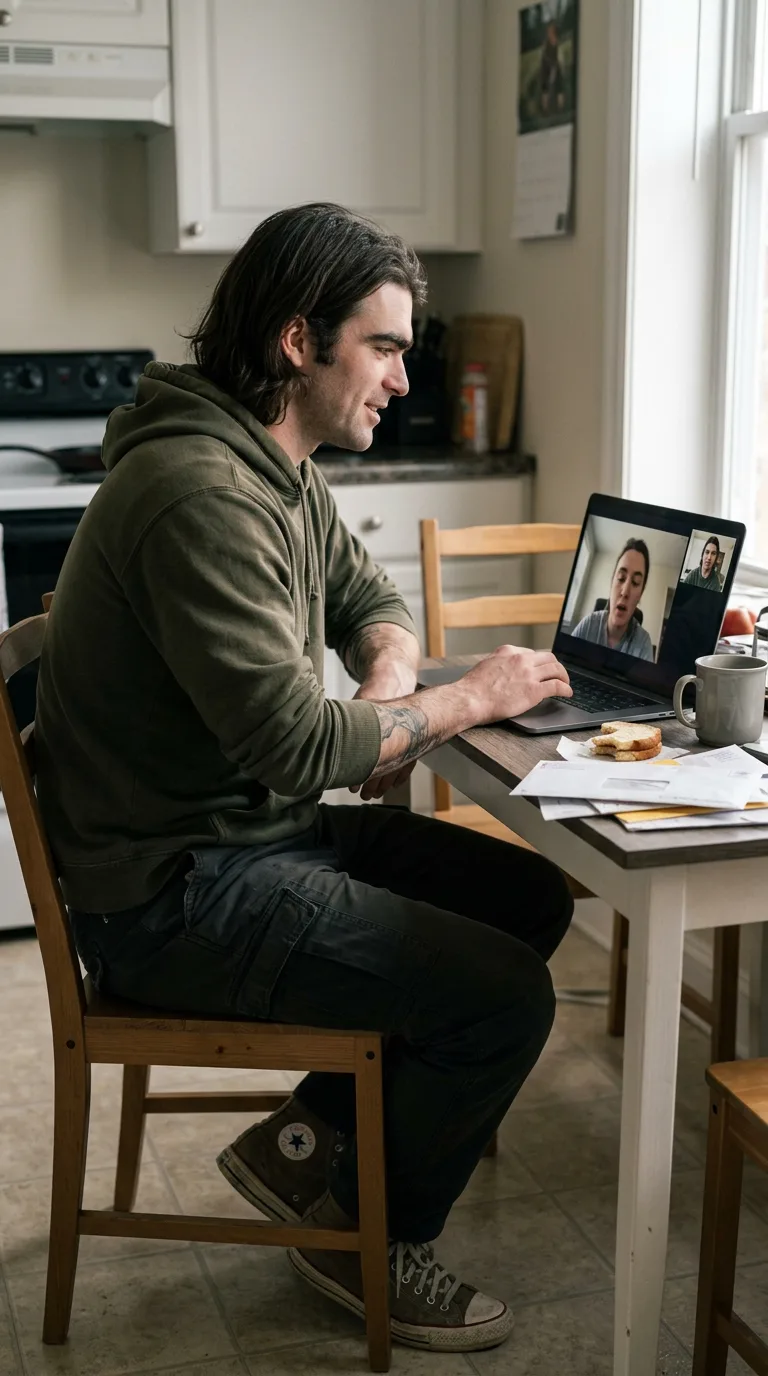
Rarest thing about him: A unibrow — rare, 1 in 51
Season 0seed 2108678127 · engine v10
Character card
lineage GSHCK1
His body-swap story
@colton.weyburn, wearing Kevin Dombrowski, rolled the wheel on and woke up as Nathan Prusak, spent 1 minute in him, then spun the wheel and woke up as an unnamed body
Kevin Dombrowski's knees ache going down the porch steps, which is the first thing you notice about being him again — the joints talking before the mind does, thirty years of shaft dust and cold mornings settled into the bone like silt. It is evening here, that particular Pittsburgh evening where the streetlights haven't decided yet whether to come on, and you are sitting on his porch swing with his phone in his thick hand, and you are bored in a way that has a shape to it, a specific shape, shaped like a barbershop nine minutes and one card ago.
You had been Colin Fenerty for two minutes only. Two minutes is nothing — you barely got the scissors in your hand before you spun again — but in those two minutes you felt something you are still turning over now, in Kevin's bald head, with Kevin's hazel eyes half-lidded against a sun he doesn't care about: you felt what it was to be feared a little, in a small clean way, by a kid who worked under you. Colin's boss. You remember the shape of the authority even though you didn't get to use it. You want to know where it led. You want to know who Colin Fenerty answered to, and whether that man's Tuesday evening is worth having.
You open the laptop balanced on Kevin's stomach. The site loads the way it always loads, patient, ordinary, a wheel on a plain page like a raffle at a church fair. You pay. You spin. Somewhere the wheel decides, and decides fast, and you feel the porch and the ache and the whole weight of Kevin Dombrowski let go of you all at once, like a coat dropped off the shoulders.
—
The kitchen light is buttery and low, late-day light through a window with a calendar taped beside it, and you are sitting, and there is a laptop in front of you with a face on it frozen mid-blink, eyes at half-mast, mouth caught open on a word that never finished. A timer runs in the corner of the little window, ticking seconds nobody is answering. There is a hoodie sleeve against your forearm, warm from a body's warmth that is now yours. There is a mug near your hand, the smell of it rising, not quite coffee, something malted. Your spine, when you move it, moves easy — a give in the hips you have not felt in six bodies — and the pain in it is not the deep grinding ache of Kevin's back but a duller thing, sitting between the shoulder blades like a hand pressed there.
You sit up. Dead centre into the little camera eye above the frozen face. "Hello?" you say, testing the air with a voice you have never used, lower than Kevin's, younger.
The frozen half-blink keeps not finishing on the screen. Nobody answers because there is, for the moment, no one there to.
—
The hoodie is the first door. It opens on a Tuesday six weeks gone — his — pulling this exact green fleece over his head in a locker room that smelled like bleach and burnt garlic, the last of a double done, his shoulders singing with the good kind of tired, the kind that means you fed two hundred people and none of them sent a plate back. Nathan Prusak. The name arrives with the smell of the kitchen, stitched into a memory of somebody calling it across a pass — "Prusak, eighty-six the halibut" — and under it, always, the low thrum of his lower back, a slipped disc from four years ago lifting a stockpot wrong, that never quite let go and never quite ruined him either. He works around it. His body learned to work around it the way water learns a stone.
The mug gives you coffee mornings — no, not coffee, he doesn't really drink it, this is cocoa, a habit from his mother's kitchen in Bloomfield that he never grew out of and never explained to anyone at work, who'd laugh. Sundays with his kids, seven and four, sticky hands on this same mug, a memory so warm it almost hurts going down: his daughter's face when she learned to blow on it first.
The chair. The chair gives you Danielle — the girlfriend, eight months now, the easy weight of her laugh through a phone speaker, a woman who doesn't flinch when he comes home smelling like fry oil and garlic and exhaustion. And under her, quieter, an old room: his ex-wife Meredith, the two of them at a different table once, a table that isn't this one, arguing softly so the kids wouldn't hear through the wall, and how it ended without ever really becoming a war, just a slow leak of two people going different directions. He still sends her flowers on their old anniversary. Nobody asked him to. He just does.
The laptop under your palm gives you the app itself, a favor for a friend who swears by it for "connecting," Nathan's amused, mildly stoned skepticism about the whole thing thirty seconds before he agreed to try it, because why not, because Danielle's on the frozen half of the screen right now trying to tell him something about her sister's wedding and the connection stuttered exactly on the worst possible word.
The apron — not on him now, hung on a hook in a memory that arrives anyway, ghosted through the shirt cuff still rolled to his forearm — gives you the whole architecture of his days: the heat of a six-burner range, the particular ache that lives in his feet by hour eight, hands that know a knife's balance without his eyes needing to check, the low code-language of a kitchen mid-service, chef's voice cutting through steam. Twenty-eight years old and his hands can already do more than his mind bothers to supervise. He carries the pain in his back the way he carries everything: quietly, without complaint, because complaining has never once made a shift go faster.
You feel all of it land in a body that is, compared to the ones you've worn, almost embarrassingly good — the athletic ease of him, the hair too long because haircuts cost time he'd rather spend with his kids, the unibrow he's stopped noticing in mirrors, hazel eyes that have cried more in a courtroom over custody than anywhere else in his life and came out fine on the other side.
—
You look at your hands. They are broad, scarred faint white along two knuckles from a lifetime of blades, restless already, drumming once against the table edge before you tell them to stop, and they won't quite. You lift your eyes off them into the laptop's little lens, into the frozen half-blink still waiting on the far end of a dead connection.
"Hey," you say, to no one who can hear it yet, testing this voice all over again like a coat that fits better than the last one. "Sorry — think I froze."
Somewhere out there is a barbershop in Philadelphia with a chair still turning over, empty. It'll keep.