Kevin Dombrowski
Fictional. Generated by AI — not a real person, and no likeness of one is intended.
43, miner in Pittsburgh · rolled by @colton.weyburn · card — no film
History
who has worn him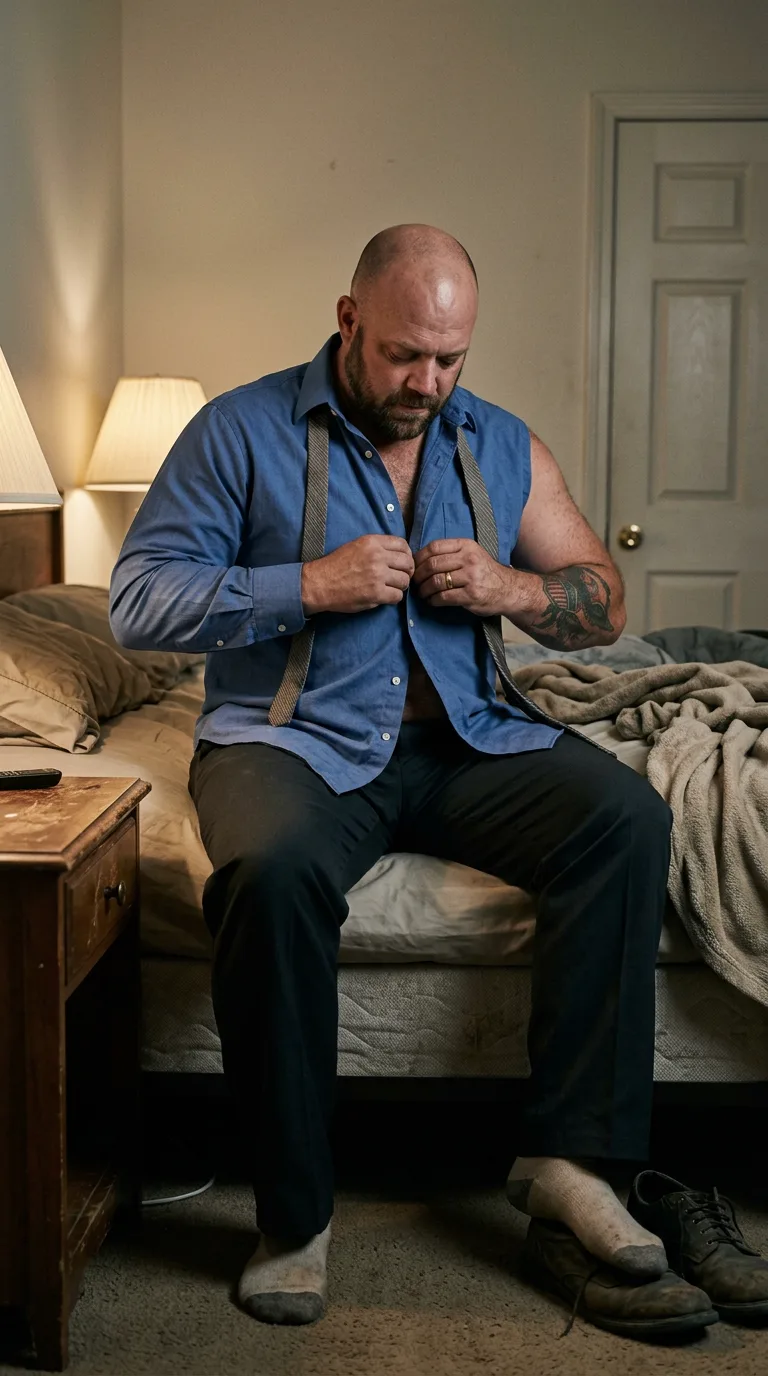
Rarest thing about him: One, forearm — rare, 1 in 12
Season 0seed 1025141503 · engine v10
Character card
lineage GSHCK1
His body-swap story
@colton.weyburn, wearing Marcus Guilbeau, rolled the wheel on and woke up as Kevin Dombrowski, spent 4 minutes in him, then spun the wheel and woke up as Nathan Prusak
You have been Marcus Guilbeau for one minute, and already the apron strings are cutting into a stomach that isn't yours by choice but is yours now, and the ticket rail is barking orders in a language of fry oil and rent, and you think: no. Not this one. A minute in and you already know the shape of the whole life — the double shifts, the manager who calls you "big guy" like it's an insult, the studio apartment that smells like someone else's cigarettes even though this body never smoked one. It's not that Marcus's life is bad. It's that you can already feel its ceiling, and you did not spin five times to feel a ceiling one minute in. Your phone — his phone — is in the black apron pocket, screen cracked, and your thumb, still learning this hand, opens the browser to the wheel without much ceremony. The kitchen is loud enough that nobody notices you go still at the register. You pay. You spin. Underwater, it says, when the card loads, not that you're looking at cards right now, only feeling the number in your chest like a held breath: something with weight to it, something worth having wanted.
The wheel does not ask why. It never does. It gives you weight instead — a lot of it, all at once, settling into a heavy frame mid-motion, fingers already at a button that is already wrong. You are sitting. There is a bed under you, a mattress with a give to it that speaks of years, and a tie hangs untied and slack around a thick neck, and for one full second you are only sensation: the cool air on a bare chest below an open collar, a bald scalp, a beard you didn't have thirty seconds and one whole body ago. Your hand — his hand — is flat against his own ribs, feeling them like a man checking he is still made of the same stuff. He is. You just aren't him yet.
The shirt gives it to you first. Chambray, worn soft at the collar from years of the same motion, and as your fingers walk the buttons back down and then up again, correcting what his own distracted hands got wrong a moment ago, something opens like a door left ajar: a woman's voice from a kitchen down the hall, calling that she put his lunch by the door, and the particular warmth of being married to someone who still does that fifteen years in. Deb. Her name arrives with the shirt, unbidden, the way his memories are supposed to — through what you're touching and nothing else. You feel, not your own feeling but his, folded into muscle memory: the low, steady comfort of a marriage that isn't loud anymore because it doesn't need to be.
The tie is harder — his hands don't really know ties, not really, not for a man who wears a hard hat five days a week — and that's its own small memory, sharp and almost funny: standing in front of a bathroom mirror at twenty-six, some other woman's hands reaching around from behind to fix his knot before a wedding that wasn't his own, laughing at him for never learning. Renee. Not Deb — an old ache, sanded down by twenty years into something you can hold without it cutting you, a name that still means something on nights when the house is quiet and Deb's already asleep and he doesn't examine why he thinks of her at all.
The tattoo on the inner forearm gives you the most — an eagle and shield in bold, faded American lines, and touching it (his own fingers grazing it while straightening a cuff) drops you into a night at twenty-two, a shop in the Strip District, the buzz of the needle and a friend from the mine laughing beside him, both of them broke and proud and twenty-two forever in that one memory even though the color has gone soft with time the way everything does. The wedding band is smaller, quieter, cool metal on his ring finger, and it gives you only warmth, no story, just fifteen years compressed into a single unremarkable Tuesday feeling: *this is fine, this is good, this is mine.*
Under all of it, the body itself keeps talking. Forty-three years in, and it says so in the low ache along the lower back that never fully leaves, in shoulders and forearms dense with a strength that has nothing to prove and everything to carry, in knees that know the cage and the descent and the particular fatigue of a full shift underground better than they know rest. There is a bottle of something in the medicine cabinet down the hall — his, prescribed, taken most mornings without much thought anymore, the kind of steadiness that came slow and stayed — and even without touching it you feel its edges in how calm this body is willing to be even now, mid-motion, hazel eyes blinking once in a dim bedroom that smells like someone else's detergent and a day already half over in feeling though the clock says otherwise. He works nights. That's the oddity sitting in the room with you — evening light outside failing toward a shift that starts when other men's ends — and it's his life's rhythm, not a wrongness, just his.
You look down at your hands — his hands, blunt-fingered, a faded eagle on the forearm, a ring you didn't earn and won't take off — and you turn one over slowly in the lamp light like you're checking the wiring on something you just bought.
Then you lift your eyes to find whatever's watching, and you say, low, almost to no one:
"Deb, I might be a little late tonight."