Colin Fenerty
Fictional. Generated by AI — not a real person, and no likeness of one is intended.
33, barber in Philadelphia · rolled by @colton.weyburn · card — no film
History
who has worn him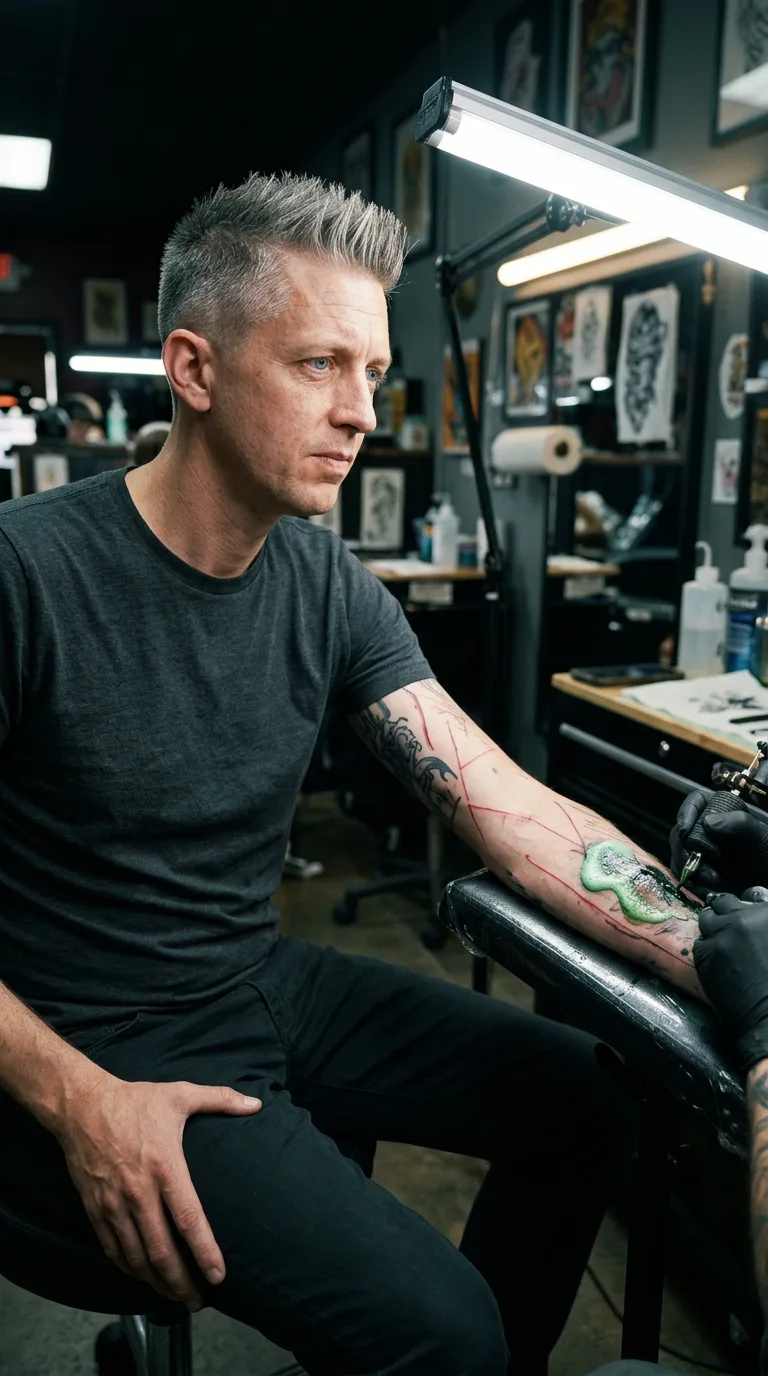
Rarest thing about him: Getting a tattoo — rare, 1 in 232
Season 0seed 439471443 · engine v10
Character card
lineage GSHCK1
His body-swap story
@colton.weyburn, wearing Vikram Saini, rolled the wheel on and woke up as Colin Fenerty, spent 2 minutes in him, then spun the wheel and woke up as Tyler Bracey
The knife is still warm in Vikram's hand when the boredom finally wins.
You've been him three minutes and that's already too long. The apron smells like blood and pork fat, the walk-in hums behind you, and somewhere out front a woman is asking for a pound and a half of ground chuck like it matters. It doesn't. You spun for a butcher in a town so small it doesn't have a stoplight, and you paid to be a small man with small hands doing a job you can already tell, from three minutes of muscle memory that isn't yours, he was good at and never once loved. There's a wife's name on a sticky note by the register — Priya, don't forget — and something in you flinches at the thought of learning what that means, of sitting still long enough for it to matter. You don't want small. You don't want careful. You want out of this apron and this cold room and this life-in-progress that was never yours to begin with. You set the knife down mid-cut, wipe your hand on Vikram's borrowed thigh, and go to the back office where the laptop is open to nothing in particular, and you type in the address you already have memorized.
The wheel spins on a screen smeared with someone else's fingerprints. You don't even wait to see where the money goes. You just want the drop — that half-second of nowhere between men — and then the light changes.
The power in the tattoo shop cuts out for two seconds. Fluorescent hum, gone. The needle stutters against skin, and when everything comes back on, you're the one holding still for it.
You're sitting. That's the first thing — a stool under a heavier weight than you're used to, long legs bent at an angle that isn't yours yet, feet planted wide on concrete. Your forearm is braced flat on a padded table, green soap gone slick and cooling on skin already half-covered in red and black linework, and a needle is buried in the meat of it, going. There's a tug-drag-buzz working itself into your skin in a rhythm that doesn't hurt so much as insist, over and over, and you don't flinch, because he — you — already stopped flinching two seconds before you arrived, like whatever was steering this arm through the pain simply stepped out and let it happen to the furniture.
Your head is turned away, out toward the shop, and you let it stay there a beat before some instinct — his instinct, still loose in the muscle — starts to turn it back toward the artist's hands. You are 6'2" of him, broader through the gut than you expected, gray-silver hair spiked up stiff with gel that's starting to give in the shop's heat. Your jaw, which was clenched a second ago in a way you can still feel the ghost of, has gone loose. You watch the needle work like it's a nail gun and the arm is a two-by-four.
The shirt is what opens him first — soft gray cotton, worn thin at the collar, snug across a stomach that's gone a little soft in a way the rest of him hasn't. Pulling it on this morning: a small apartment two blocks off a rowhouse street, marble steps worn into a shallow bowl by a hundred years of feet before his, and a girlfriend's voice from the bathroom asking if he's really doing this today, and him grinning into the mirror because yeah, he really is. Marisol. The name arrives with her voice already in it, warm and unimpressed, the kind of tired-fond she does when he tells her he wants more ink and she tells him he's thirty-three, not nineteen. He'd laughed. Pulled the shirt over his head one arm at a time, favoring the left because he already knew where today's needle was going.
The stool under you gives back a decade of standing eight, nine, ten hours behind a barber's chair — Fenerty's, on a corner with a striped pole older than the shop's fourth owner, hair confetti on linoleum that never quite comes clean. Your hands — his hands — know things you don't: the weight of clippers, the particular give of a fade guard clicking into place, the two-finger flick that clears a neck of loose hair before the straight razor even touches it. They ache faintly at the base of each thumb, a barber's ache, worn in from years of the same motion. When they're not working they crack their knuckles, one by one, an old tic that surfaces now, faint and involuntary, a code the fingers run on their own.
The chair back against your spine gives you the shop itself — not this one, a different one, the one where he learned, an old Greek guy named Pete who used to grab his wrist mid-cut and say slower, no one's paying you by the hair. Then further: the girl before Marisol, Devon, who he almost married and didn't, whose name still surfaces sometimes at two in the morning for no reason he'd admit to anyone, not even himself, not even now, and a low current of something under his ribs that a doctor and a small orange bottle have mostly quieted down to a hum. Sunday mornings in a pew he doesn't examine too closely, mouthing words he half believes, because his mother is there and it's easier than the argument. A can of Grizzly in the truck's cupholder he's not supposed to still be using. A whole ordinary life, unremarkable and his, built out of steady hands and a two-chair shop and a woman who loves him enough to roll her eyes at his tattoo instead of arguing about it.
The needle stops. The gloved hand lifts. Someone off to the side says something about how well he's holding up today, and you feel your face — his face — arrange itself into the easy, faintly checked-out look he wears for pain, the one that isn't quite a smile.
You look down at the arm. Red lines, green soap, black already going in ugly and permanent under the buzz. Your hand — broad-knuckled, pale, a plain band of tan where a watch usually sits — turns over once in the light like you're checking it's real, like it might not be.
"Huh," you say, to no one, to the tattoo artist, to the two seconds nobody in that room noticed. "Didn't feel that one at all."
You don't know yet how long you get to keep not feeling things. Neither does he. Neither does anyone.