Vikram Saini
Fictional. Generated by AI — not a real person, and no likeness of one is intended.
33, butcher in Small-town Ohio · rolled by @colton.weyburn · card — no film
History
who has worn him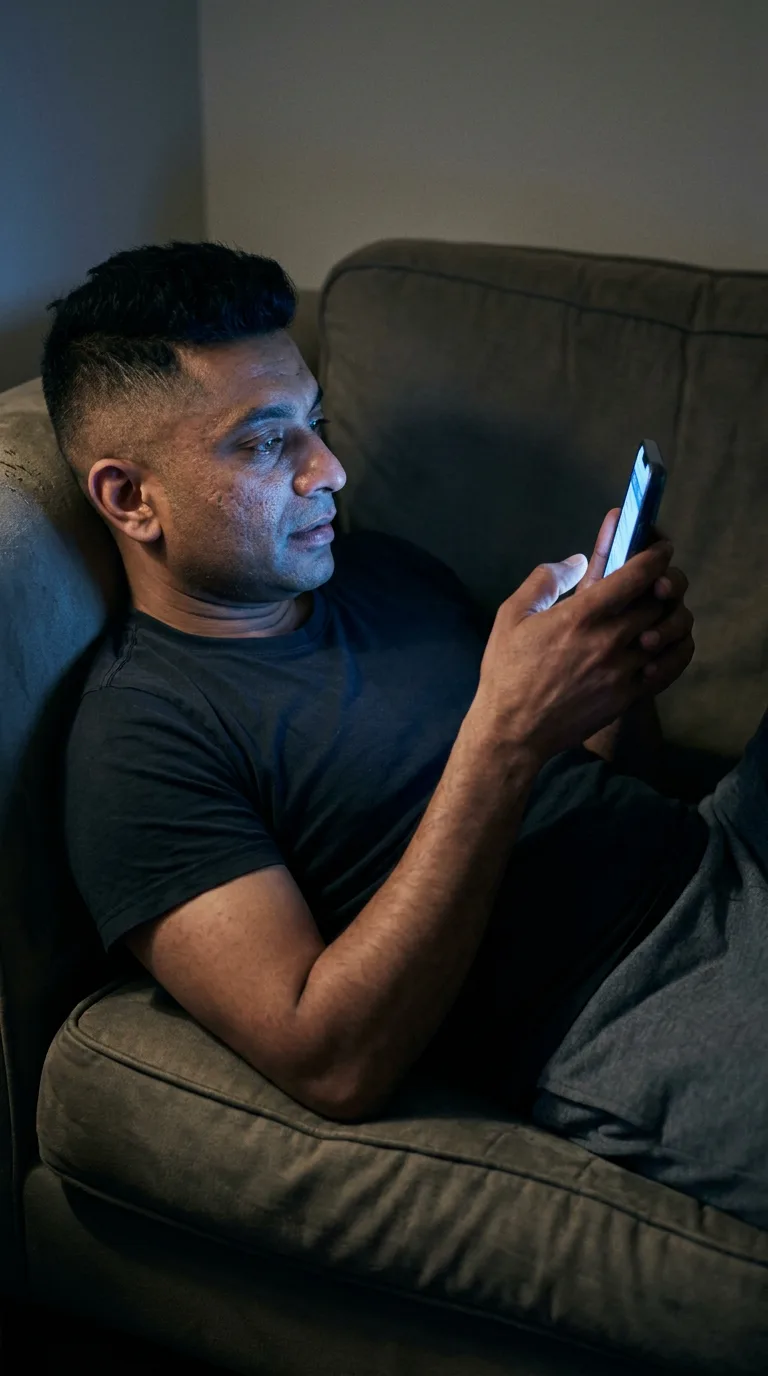
Rarest thing about him: Heavy drinker — rare, 1 in 35
Season 0seed 736095227 · engine v10
Character card
lineage GSHCK1
His body-swap story
@colton.weyburn, wearing Robert Kanaly, rolled the wheel on and woke up as Vikram Saini, spent 3 minutes in him, then spun the wheel and woke up as Colin Fenerty
Robert Kanaly's kitchen smells like drywall dust and the coffee he made himself at four this morning before the call came in — a burst pipe on Franklin, easy money, cash job. You're standing at his counter in his body, sixty-four years old, and the bad knee is already talking to you, a dull click when you shift your weight, and the scar through the eyebrow itches the way it must have itched for forty years, an old habit of a face healing wrong once and staying that way. You've been him one hundred and twenty seconds. That's all. You spun, you got a bald electrician with a gut and a good truck and about ninety thousand dollars sitting comfortable in savings, and you thought, fine, this'll do, I'll ride this a while — and then his phone buzzed on the counter with a text from a woman named Carol asking if he was still coming Sunday, and something about the flatness of standing in a stranger's obligations, a stranger's Sunday, made your thumb move before you'd decided anything. You don't hate him. You don't know him. That's the whole problem — two minutes in and already the wanting had come back, the itch under the itch, the specific greed of not this one, someone else, see what else there is. You open the site again on his phone, his thick finger on the glass, and you spin knowing you are erasing a man who was, up to that point, just standing in his own house doing fine.
The wheel turns. There is no in-between.
You are on your side in the dark. Small mattress, cheap frame that creaks when your hip settles, and the weight under you is lighter now, tighter, a smaller frame carrying itself differently — five-five instead of five-eleven, the gut gone, replaced by something denser and closer to the bone. The knee doesn't click anymore. Something else does, though — you feel it before you understand it, a leg jittering against the sheet, bouncing on its own, like it started before you got here and never got the message that you'd arrived. A phone glows six inches from your face. Your thumb is mid-scroll, stopped on something, and then it isn't stopped anymore — it moves, faster than he had it moving, flicking through the feed like it's chasing something instead of killing time. The room is warm in the particular way of a house with the AC off to save money. Somewhere outside, one stoplight is doing its slow red-yellow-green to no traffic at all.
The shirt is the first thing that talks to you. It's a soft gray T-shirt, worn thin at the collar, and lying against it in the dark you get a flash of this morning — no, not this morning, some morning, they've started running together — his hands pulling it over his head at 5:40 a.m., the smell of it already faintly like the shop no matter how many times it's washed, iron and fat and the cold-room chill that gets into cotton and stays. You feel the memory of his shoulders rolling into it, the small practiced economy of a man who has dressed in the dark a thousand times so as not to wake anyone, except there is no one to wake, there hasn't been in three years, and the flash carries that particular flavor of loneliness that isn't sad exactly, just quiet, just a fact of the room.
Your feet against the sheet know the walk from the register to the walk-in without needing your eyes — twelve steps, cold air hitting your shins on the eleventh. Your right hand, resting slack near the phone, remembers the boning knife better than it remembers most people's names: the specific give of tissue parting along a seam, the way you don't force it, you follow it, his father taught him that in a shop in Cincinnati that smelled exactly like this one does now, sawdust and bleach and the copper smell underneath everything that never quite scrubs out. You get an afternoon whole and unbroken — sixteen years old, standing on a milk crate to reach the block, his father's hand over his hand guiding the blade through a shoulder primal, saying *slow, it's not going anywhere*, and the pride of it, small and complete, the pride of being trusted with something that could cut you.
You get the shop as it is now, his, five years his, the trays he loads every morning before the town's even decided to wake up, the regulars who call him by name and don't know or ask why his hands sometimes won't stop moving even when the rest of him is still. You get the pills in the medicine cabinet, small and unremarkable, and the appointment every six weeks with a doctor forty minutes away in the city that isn't really a city, and the relief of them working, mostly, most days, enough that he doesn't think about it as an ongoing thing so much as a weather he's learned to dress for. You get the bottle on the counter downstairs, two fingers gone from it tonight already, and the cigar box in the truck that his mother back in Cincinnati doesn't know about, wouldn't approve of, the temple on Sundays and the small guilt he carries about all of it in a way that never quite becomes doing anything different.
You get the loneliness last, because it's the one that's been waiting under everything else, patient — no wife, no one who almost was, an ex who doesn't even rate a name in his own memory because there wasn't enough there to leave a mark. Thirty-three years old and single in a town of four thousand people and one stoplight, comfortable money in the bank from a business that will never make him rich, and nights that go like this one: on his side, phone up, thumb moving, looking for something he couldn't name if you asked him, the leg bouncing the whole time like it's trying to walk somewhere the rest of him won't go.
You look at your hand. It's smaller than the one you had two minutes ago in a kitchen in Los Angeles, darker, the nails cut close and practical, a thin white line across one knuckle that isn't a scar so much as a memory of a slip that never broke skin. You turn it over in the blue light of the phone, and the leg is still bouncing, and you let it.
"Okay," you say, out loud, to no one, your voice lower than you expected, still finding the room. "Okay."
You don't put the phone down.