Nathan Ostrowski
Fictional. Generated by AI — not a real person, and no likeness of one is intended.
30, surgeon in Denver · rolled by @marco.villagrana · card — no film
History
who has worn him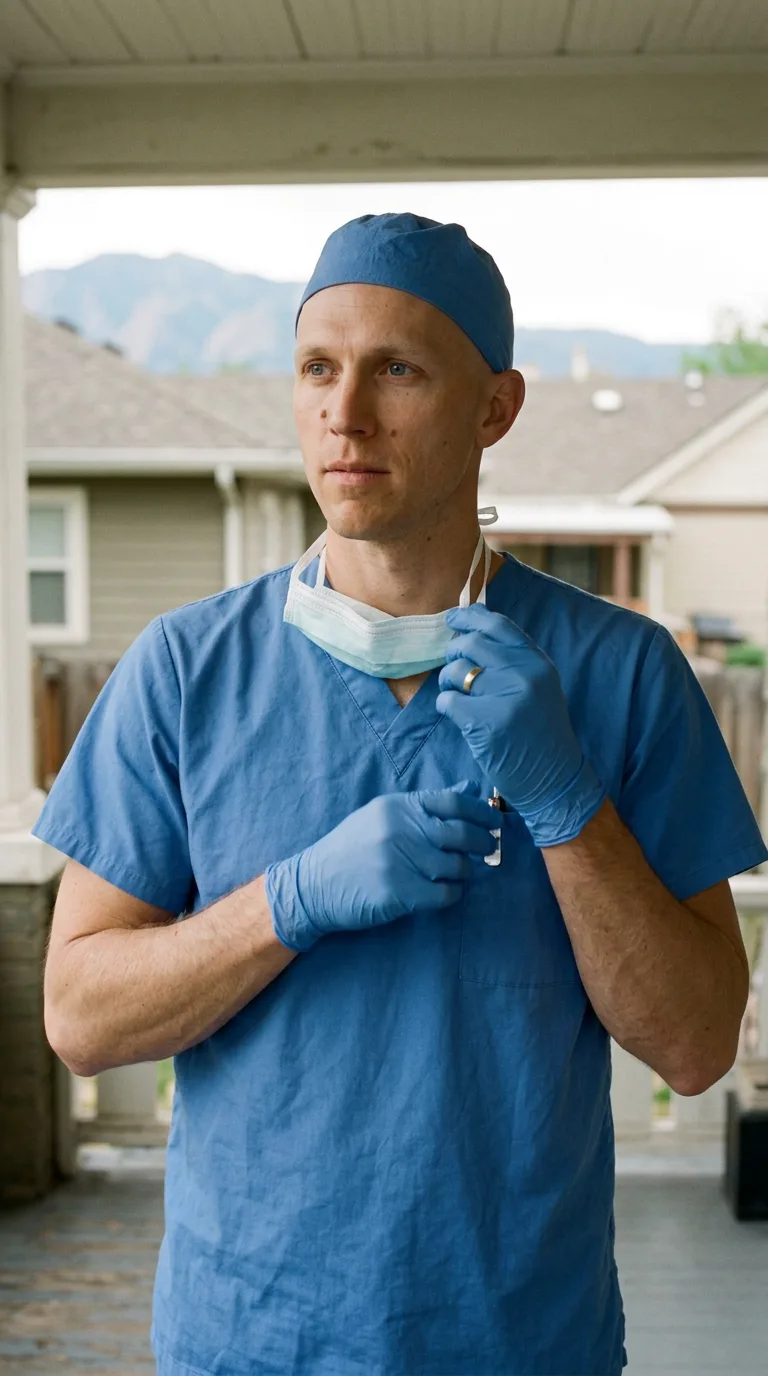
Rarest thing about him: Surgeon — uncommon, 1 in 183
Season 0seed 1371906087 · engine v10
Character card
lineage LJL8SV
His body-swap story
@marco.villagrana, wearing Craig Wetherell, rolled the wheel on and woke up as Nathan Ostrowski, spent 3 minutes in him, then spun the wheel and woke up as Ben Okonkwo-Reyes
---
Craig Wetherell has been you for three minutes, and already you know you're not staying.
You are sitting in his kitchen chair, in his rented half of a duplex that smells like other people's cooking through the wall, and his phone is face-down on the table because you already looked, once, at the string of unanswered texts from a woman he has apparently been failing for months in small installments. His knees ache the specific ache of fifty years walking other people's stairwells for a job that pays him in exhaustion and a pension he'll never collect on schedule. His freckled hands feel thin. Un-athletic. Borrowed clothes that were already borrowed before you got here. Three minutes was enough. You want out of this one the way you want out of a waiting room.
You open the site on his phone with his thumbprint, which works because bodies come with their thumbprints, and the wheel is already spinning before you've finished deciding, which is its own kind of honesty.
—
The rhythm breaks for half a second.
Your hand — his hand, the one holding the needle driver — does the pass wrong, some small pronation error a first-year would catch, and then does it again, slow, correct, deliberate, like a man checking his own work for the first time in a decade. Under the mask your breath goes shallow and controlled. The next ten throws come out the same way: checked, each one, on a closure that stopped needing checking years ago. Nobody in the room notices. The scrub nurse hands you the next instrument without looking up. Fluorescent light. Someone's monitor beeping its patient, steady rhythm, unconcerned. You are standing in a body that is 5'8" and dense with a muscle you did not put there, bald under the cap, and your field of vision has a mole at the edge of it, high on the cheek, that isn't yours to feel self-conscious about, except now, apparently, it is.
The gloves come first. Latex, tight, the specific tackiness of them against skin that has scrubbed in ten thousand times, and through that thin barrier something arrives that isn't yours: the memory of a hand — this hand — steady over a chest cavity at 3 a.m., the particular pride of it, clean and wordless, the only thing in his life that has never once let him down.
The doors swing shut behind you on the way out, hours later in his memory, seconds later on the clock, and that swing — the weight of the door, the particular give of the hinge — brings back the whole rest of it, unbidden, the way none of it asked permission.
The scrub cap: putting it on this morning, alone in the bungalow bathroom, the mirror giving him back a face he has stopped really looking at, the mole he covers sometimes with makeup for family photos because Amy used to joke about it and now doesn't joke about much of anything. The mask, looped and unlooped a hundred times, his fingers finding the strings without his eyes. The wedding band — he'd almost left it in the dish by the sink like always, then put it on anyway, out of a habit that used to mean something and now is just a thing his hand does, turning it, turning it, while he waits for elevators, while he waits for anesthesia counts, while he does not think about anything at all.
The mountains were out this morning, behind the rooflines of the street, clear in a way Denver only gets a few dozen mornings a year, and he'd stood on the porch snapping the second glove on and not looked at them, because he was thinking about the number. The number that follows him into every operating room now like a smell he can't scrub off: six figures under, a house that outgrew what two incomes could carry once one income started going quietly toward somebody else's rent, a woman four months gone from his life who still calls sometimes late, who he still, God help him, picks up for. Amy doesn't know the number. Amy knows some of it. His daughter is two and doesn't know anything yet, which is the only mercy in the whole arrangement.
He is thirty and his back already complains after a long case, a low ache along the lumbar that a younger version of him would have laughed off. His forearms are strong in the specific way of a man who holds retractors and holds nothing else steady in his life. He drinks two fingers of something most nights, standing at the counter, not performing it for anyone, just doing the thing that lets the day close. He quit cigarettes six years ago and still, in moments like this — gloved, gowned, doors swinging — his hand remembers wanting one.
None of it is dramatic. That's the thing that comes through clearest, through the mask string and the ring and the cheap hospital-issue clogs: no single catastrophe, just a man thirty years old already so far behind himself he doesn't say the number out loud to the person sleeping next to him, doesn't say much of anything out loud anymore, just closes incisions clean and drives home to a porch with mountains behind it and turns a ring on his finger like it might come loose and explain something if it did.
You stand in the hallway outside the OR, mask hanging by its strings around his throat, and you look down at his hand — blunt, sure, a thin white line across one knuckle from some old kitchen accident that isn't yours either — and you turn it over once, the way he does without thinking, and you feel every hour of the last ten thousand it's spent inside somebody's chest.
You lift your eyes to whoever's holding the phone in the break room mirror, or maybe there's no phone, maybe you're just looking at nothing, at the wall, at the middle distance where the wheel still is, waiting, patient as debt.
"Hell of a rhythm to walk in on," you say, to no one who could possibly understand it, and mean it two ways at once.