Nathan Ishida
Fictional. Generated by AI — not a real person, and no likeness of one is intended.
26, firefighter in Los Angeles · rolled by @colin.hasbrook · card — no film
History
who has worn him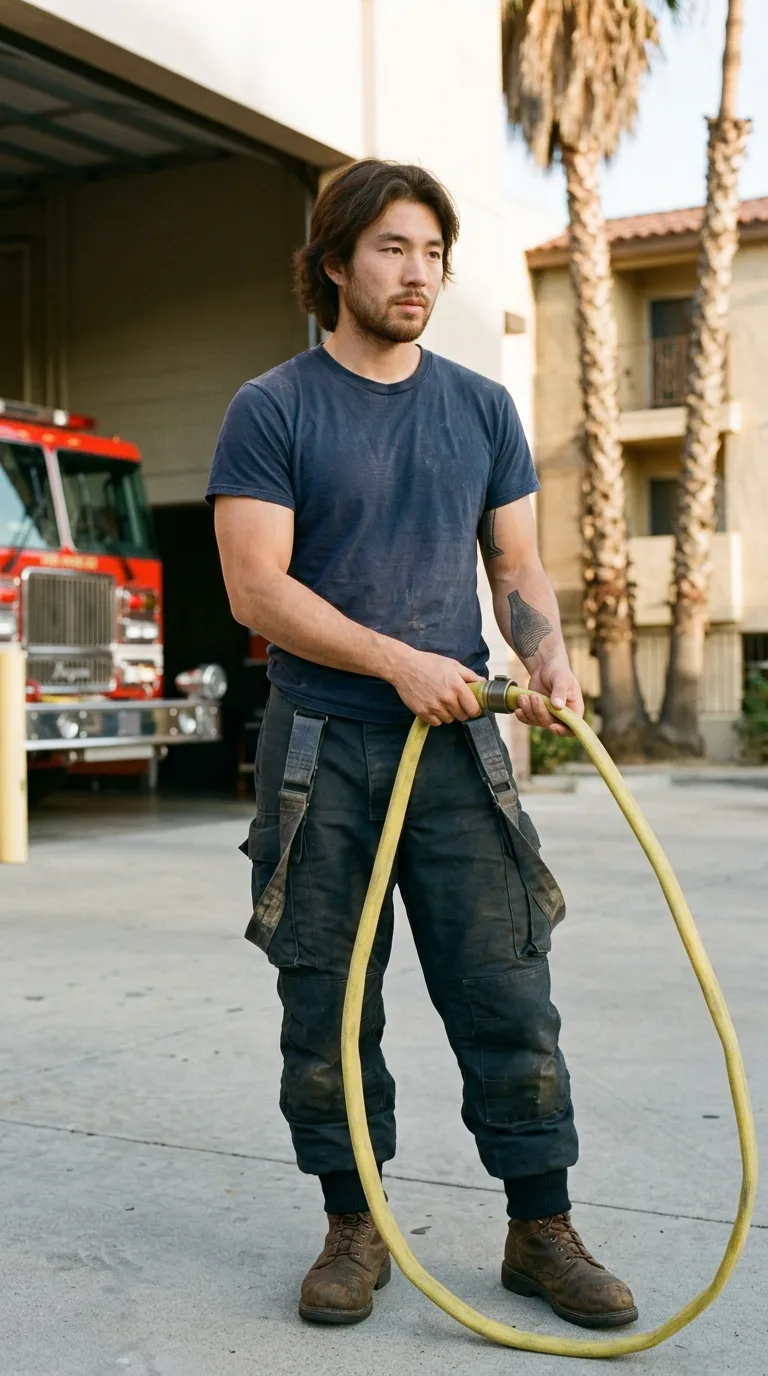
Rarest thing about him: Mixed — rare, 1 in 26
Season 0seed 1529036281 · engine v10
Character card
lineage 2NZHHJ
His body-swap story
@colin.hasbrook, wearing Terrell Boykins, rolled the wheel on and woke up as Nathan Ishida, spent 1 hour in him, then spun the wheel and woke up as Grant Osweiler
You are standing in a garage in Pahrump with grit under your nails that are not yours, chewing a toothpick that belongs to a man named Terrell Boykins, and you have been him for forty seconds and already you know the whole problem: he is fine. Big, easy, a beauty mark under one eye, glass dust still ghosting the creases of his palms from a window he set that morning. Thirty years old and nothing wrong with him. That is exactly it. You spun for this — width of shoulder, a trade with weight in the hands — and you got it, and now you are looking at a stack of tempered panes leaning in their rack and feeling nothing you didn't already feel two bodies ago. The wanting comes back fast these days. It came back before you finished tying his boots this morning. Two hundred and ninety-seven men and the only thing that has never once repeated on you is the first ten seconds. So you go to the site on his phone, thumb still learning the case of it, and you spin again standing right there in his garage, toothpick between his molars, not even sitting down for it.
The hose is heavier than you expect and already moving, already three-quarters looped in a hand that is smaller than the one you just had, olive-brown and callused at the base of each finger, and your — his — weight drops two inches and forty pounds between one loop and the next. The motion doesn't stop. That's the strange mercy of arriving mid-task: the body finishes the loop on its own, on ten thousand identical loops of memory, before you've caught up enough to interfere. Then the eleventh loop comes out wrong, hose kinking against itself, and you correct it slow, watching your own — his — hands do it like you're grading them.
Palms first. They know this hose the way a tongue knows a tooth: the give of it, the exact heft before it starts to feel unruly, the two-handed catch that keeps a coil from whipping. There's a callus at the base of the right thumb that flares when you press it, and with the flare comes an underneath of a hundred identical afternoons — hose laid out on hot apron concrete, hose racked, hose dragged off the rig at 2 a.m. with rain coming sideways off the 10, though it never rains here, it's the desert calls that stick, mutual aid runs out past the county line, red dust in the folds of the mask. The shirt is next — navy cotton gone thin under the arms, salt-stiff at the collar, and it gives you the morning it went on: him standing in the apartment's one mirror, propping the frame with his shoulder because the door doesn't hang right anymore, dragging this same shirt down over a torso that is lean rather than large, 5'8" of him, compact, every ounce doing a job. He'd pulled it on one-handed while the other hand held a bottle of water he wasn't planning to finish before noon, because last night ran long and the hangover is a low tide he's used to standing in. The toothpick — his toothpick, plain wood, unfiltered relief for a mouth two years off cigarettes — is already between your back teeth without you choosing it, the way it always is with him, a habit installed so deep it doesn't ask permission.
The boots on his feet know the apron's slope, a give in the left one where the leather cracked at the ankle a year ago and never got replaced because why spend the money. And it comes with the boots, unbidden, the fact of the money — his, a lot of it, more than a firefighter's salary should throw off, some of it his father's before him, most of it just sitting there while he lives like a man who doesn't have it, boots re-soled instead of replaced, a truck he loves more than is reasonable. Two kids come through the same door as the boots — not faces first but weight, the exact drag of a five-year-old asleep on this shoulder, a smaller one still working out that shoulders are for climbing. A girlfriend arrives through the smell of the apron's collar, her perfume ghosted into fabric he hasn't washed since Sunday, easy and current and not the ache. The ache is someone else, a name that surfaces through nothing physical at all, just there the way weather is there — a woman from before the girlfriend, before even the first kid, gone three years and still somehow the one his chest reaches for on the bad nights, the drinking nights, though he'd never say her name out loud to anyone who asked. You didn't touch anything to get that one. Some things in a man don't need a key.
His crew is behind you at the rig, and their voices are in the memory too, worn-smooth jokes, a captain who calls him by his last name only, the particular fatigue of a body that has done this shift a thousand times and does not need supervision to coil a hose — which is why the wrongness of the last ten loops sits so oddly in the muscle, like a man catching his own hand shake and not knowing why.
You get to the bottom of the loop, hose gathered, and you look down at his hands — narrower than the ones you left in Nevada, brown-gold, a thin white scar-less youth to them despite the calluses, twenty-six years old and none of the wear yet permanent. You turn one over. In it is a hose handle worn smooth by a decade of hands that were his and are now, for as long as this lasts, yours.
You lift your eyes to the apron, the palms, the rig red and patient behind you, and you say, out loud, to no one:
"Wrong hand."