Terrell Boykins
Fictional. Generated by AI — not a real person, and no likeness of one is intended.
30, glazier in High-desert Nevada · rolled by @colin.hasbrook · card — no film
History
who has worn him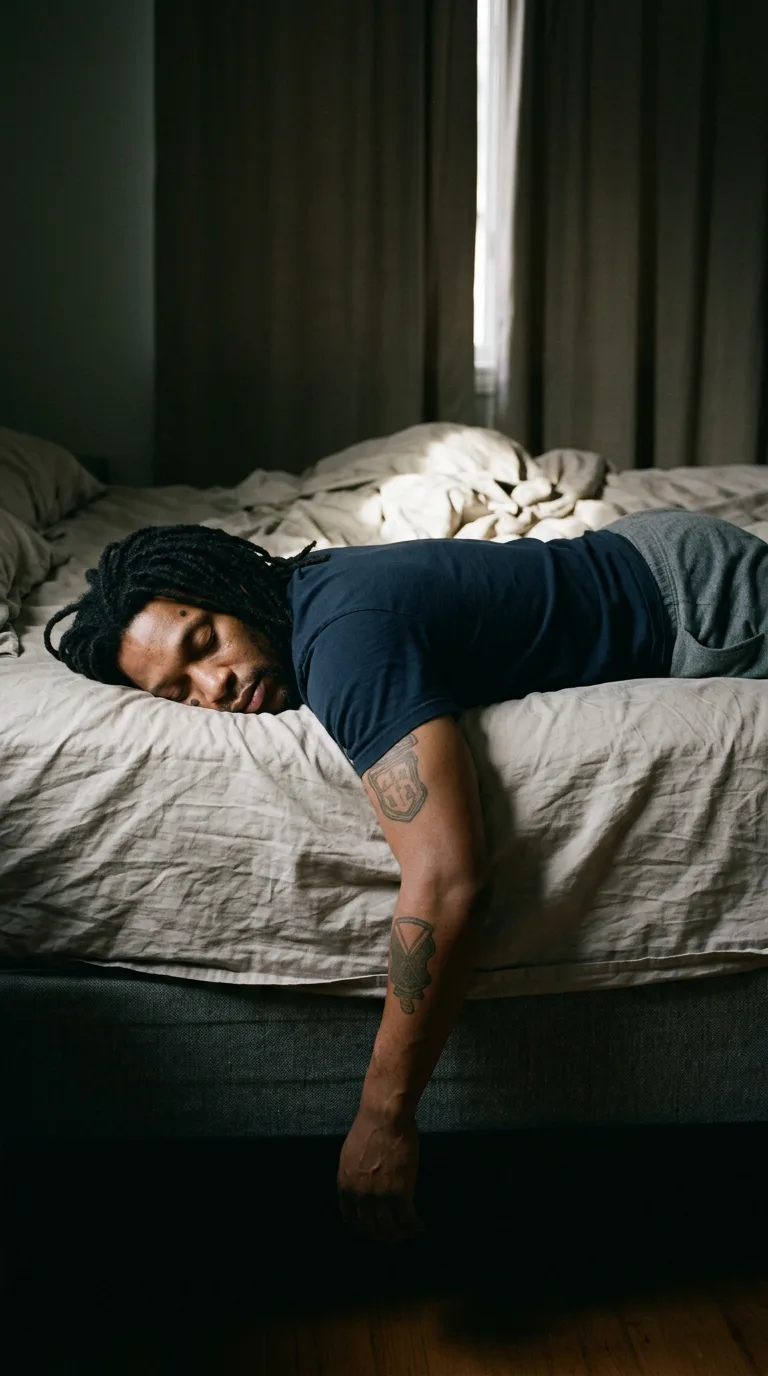
Rarest thing about him: Bisexual — epic, 1 in 29
Season 0seed 1432921696 · engine v10
Character card
lineage 2NZHHJ
His body-swap story
@colin.hasbrook, wearing Danilo Fuentes, rolled the wheel on and woke up as Terrell Boykins, spent 1 minute in him, then spun the wheel and woke up as Nathan Ishida
Danilo Fuentes has been you for less than a minute, and already the shoulders feel wrong.
You're standing in his kitchen — his kitchen, the freckles across his forearms still strange to you, the bald scalp cool under the ceiling fan — holding the mail satchel he never quite put down, and you know already this isn't the one. Forty-seven is fine. Fine is the problem. You spent two hundred and ninety-six bodies learning that fine is the fastest way to feel every year of not being anyone. His knees ache going up porch steps. His wife left before you got here, which you know from a drawer full of her handwriting he never threw out. None of that is yours to fix and none of it is yours to want. You set the satchel on the counter, and the last thing Danilo Fuentes ever does with his own hand is open a laptop to a page with a wheel on it.
You spin.
—
The breathing changes first — ragged, then even, one long pull of desert-dry air through a nose that isn't Danilo's — and the arm that had been hanging dead off the mattress edge lifts on its own, folds up onto a chest that is broader now, warmer, younger by seventeen years. You are face down in sheets that smell like somebody else's fabric softener. Streetlight, or what's left of daylight, comes through a gap in curtains too thin for the room they're in. You roll onto your back without deciding to. It is not a posture this body knows. Somewhere outside, sagebrush ticks in a wind that has heat still in it, though the light says the day is closing.
He is asleep at an hour that isn't sleep's hour, and the body under you carries that wrongness in its own bones before you have a name for it — a tiredness set into the shoulders like something scheduled, like a man who works when other men are getting home.
Your hands — his hands — are open at your sides on top of the blanket. You turn one over. Calloused across three fingers in a way that doesn't match a mail carrier's grip at all. A worker's palm. And touching it, just that, skin on skin, gives you the first flash: glass, a whole pane of it, floating on a suction lifter six inches off a curb, his voice saying to somebody off-frame, easy, easy, walk it don't carry it.
You are lying in a bed that is not made for two people who both got home at reasonable hours. That much comes through the sheets themselves — a smell laid into the fabric, someone else's shampoo, someone else's want for this room to be nicer than a single-wide on blocks can be. Fabric softener, and under it, an ashtray that hasn't held an ashtray in years because he switched to the vape for her sake, mostly, and still keeps one in his jacket pocket for the nights the glass doesn't go in clean and his hands won't stop shaking with the adrenaline of a near-miss.
The half sleeve on your right arm — his right arm — brushes the sheet, and that's a door too: ink under skin, a unit crest, memory arriving not as picture first but as posture — standing at something, some formation, heat that wasn't Nevada heat, younger, leaner, before the shoulders filled out into this current width. Then the tattoo artist's chair, years later, the buzz of the needle going into skin already thick with old sun. He got it finished the same month his daughter was born, because he wanted both years on his arm where he could see them, though only one of them is skin now — the other lives in a photo on the nightstand you haven't opened your eyes to see yet.
The mole on his cheek you cannot feel from the inside, but you know it's there the way you know your own tongue is in your mouth — it is the first thing anyone says about him at a bar, at a jobsite, in a doorway: man, you got a mole right there, and he always says I know, my mama's too, like that settles something.
The mattress under your back gives you the trailer itself: the particular give of a floor that isn't quite level, the AC unit's rattle he keeps meaning to fix and never has because parts are ninety minutes each way in this county. A woman's voice somewhere just outside the bedroom door — not urgent, just moving through her evening, and the sound of it alone brings up a whole year: her laugh at something on the porch step, her hand flat on his chest at 2 a.m. after a bad dream he wouldn't name for her, the two of them deciding, without much ceremony, that this was the arrangement now, this trailer, this desert, each other.
The shirt — no, there isn't a shirt yet, he's bare-backed against the sheet, but the memory of shirts comes anyway, sleeve by sleeve, from nowhere but his own habit: gray tee over the long-sleeved thermal even in June because the glass edges don't care what season it is, tucking the sleeve cuff down over his wrist guard, the leather glove going on last, always the right hand last, some superstition he'd deny having. The belt with the glass cutter clipped to it, worn smooth at the loop. Boots that know the exact give of a storefront sidewalk before the tar's gone soft in the afternoon.
He works nights sometimes, that's the crossed wire in this hour — a rush install for a store that couldn't stay boarded up through a business day, and he'd come home when the sun was still deciding whether to commit to setting, and slept like this because there was nothing else in him left to do but sleep, face down, one arm off the edge like it didn't belong to him anymore either.
There's a boy somewhere in this trailer or near it — small, his, a laugh through a wall — and that arrives last and heaviest, no single memory but the whole shape of the feeling: Sunday mornings in a church three towns over, the kid on his shoulders after, an unremarkable joy so complete he never thought to name it as anything but Tuesday.
—
You lift the hand off the blanket and look at it in the low gap-light — the calluses, the mole's shadow moving as you turn your head, the ache already sitting low in a back that stood on a lift-truck lip most of the day. Thirty years old and none of them are the years you have any memory of living.
You say, out loud, to the empty room, "Wrong bed."
Then you laugh, once, short, not unkind — because it isn't wrong, it's just new, and you have no idea yet how long you get to call it that.