Marlon Stackhouse
Fictional. Generated by AI — not a real person, and no likeness of one is intended.
44, warehouse picker in San Francisco · rolled by @ernesto.villaroel · card — no film
History
who has worn him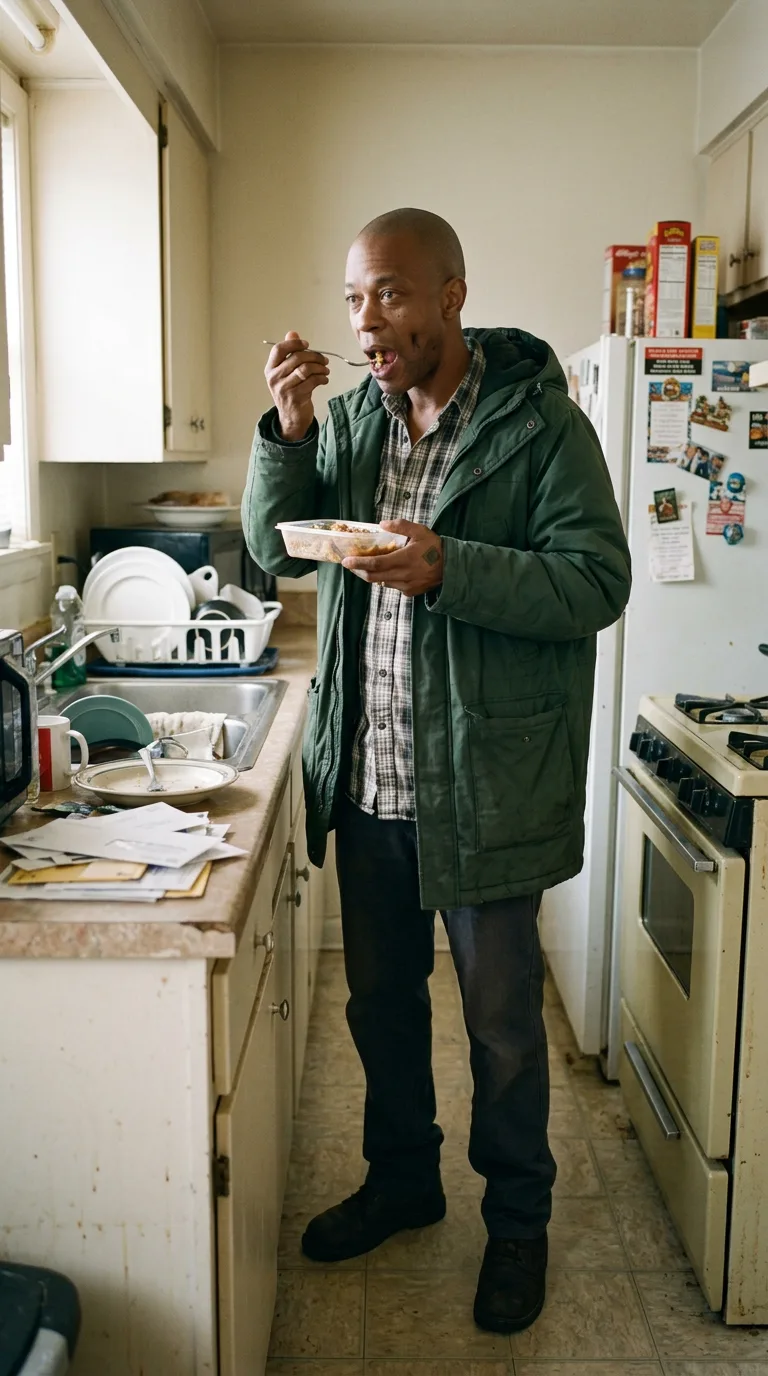
Rarest thing about him: Cigars only — rare, 1 in 28
Season 0seed 1537790138 · engine v10
Character card
lineage JWSE6J
His body-swap story
@ernesto.villaroel, wearing Gary Halvorsen, rolled the wheel on and woke up as Marlon Stackhouse, spent 3 minutes in him, then spun the wheel and woke up as Efraín Molla
You are standing in Gary Halvorsen's bathroom, and the light over the mirror is buzzing the way it does at two in the morning when nobody in Miami is awake to fix it. Gary's hands — silver hair on the forearms, a barber's calluses along the first two fingers — are braced on the sink. You have had him three minutes. Three minutes ago you had somebody else: a nineteen-year-old with a shaved head and a barista apron still slung over a chair, and before that a mother's kitchen, and before that the first one, who you barely remember now, who started this. Gary's face in the mirror is fine. Gary's face is nothing. You spun him up out of boredom with the boy — nineteen is a body that hasn't lived enough yet to be worth wearing, all reflex and no weight — and now Gary is the same problem wearing gray hair instead of none. You want the six minutes back, almost. Then you don't, because wanting the six minutes back is not the same as wanting the boy, and what you actually want, standing here at Gary's sink with Gary's tired late-shift eyes, is someone with some miles on him. Some children he doesn't call enough. Some money put away and no one to spend it on. You go to the site on Gary's phone, the one bookmarked under a folder Gary himself will never open again, and the wheel spins under your — his — thumb.
It stops on a man standing in a kitchen with a fork in his hand.
The fork is already coming down. That's the strange part, arriving mid-motion — not a jolt but a correction, like a foot finding a stair it expected to not be there. Coat still on the shoulders, heavier than Gary's cardigan, canvas-stiff at the collar. A container of something orange and starchy balanced in the left palm. The window over the sink is black, San Francisco black, no city glow because this window doesn't face the city, it faces up a slot of driveway at a fence. Cold. The kitchen smells like dish soap and something fried a day ago. You set the fork down because his hand does it before you've decided to, the muscle already midway through an old evening ritual, and you shrug the coat off your — his — shoulders, and sit at the little table because his body wants to sit before his mind, whatever's left of it, has caught up.
Then the coat is off and lying half over the chair back and your palm is flat on the table's edge, and that's the first touch, and it opens.
The table gives you nothing much — cheap laminate, a coffee ring worn permanently into the finish — but the shirt against your back, the plaid one under the coat, gives you a whole morning: buttoning it in a bedroom with boxes still taped shut in one corner, four months after the second bedroom emptied out, the ring already gone from the finger but the tan line still new enough to run your thumb over like a bruise that doesn't hurt anymore. Marlon Stackhouse buttoning a shirt alone. Marlon Stackhouse checking a phone with no messages on it and telling himself that was fine, that was what Saturdays were now.
The container in your hand is warmer at the memory than in fact — plastic forks, a break room, the vest hung on a hook with WHS Logan stitched crooked on the chest, and beeping. Always beeping, some forklift he never has to look at to place, three aisles over, pallet jack whining behind it. His feet know concrete before they know carpet: an ache set permanently into the arch, boots that have been resoled twice, a body that has spent twenty years learning exactly how to lift a case without asking his back's permission first, because his back stopped granting it around year twelve. Skinny arms, no bulk, but you can feel the specific competence in them, wrists loose, elbows soft, a picker's economy of motion. Deep grooves worn into his face by something that isn't quite a smile and won't go away even now, dimples sitting there at rest like a joke he's not in on anymore.
The tattoo on the inner forearm gives you the loudest flash: a unit insignia, a spade under it, a barracks in a season he'd rather not name, and under that, quieter, two names he doesn't have inked anywhere but says sometimes to the dark ceiling — his kids, who live with their mother now, who he calls on Sundays and sometimes she picks up and sometimes it's just the machine. The ex-girlfriend before all that, the one before the marriage even, who he still thinks of when a particular radio station plays a particular decade, who he has not spoken to in six years and would, if she called.
The garage door behind the kitchen wall — you can hear it now that you're listening for it, the specific creak of the neighbor's car easing up that steep driveway at whatever hour this actually is — tells you where you are: under a bay window, a rented square of concrete converted into someone's whole life, cold coming up through the floor no matter the season. A cigar box on top of the fridge, unopened three days, a habit that replaced a drink he quit without ceremony sometime in his thirties. Nothing dramatic in any of it. A man who eats standing up because sitting down alone at a table for one, some nights, is a decision he's not ready to make, except tonight — this second — his hand chose the chair for him before he had to choose.
You look down at your hands. Long fingers, dark against the white container, a groove around the ring finger pale as a scar that isn't a scar. Forty-four years old and thin all through, dimples set into a face that isn't performing anything, not for anyone, not at this hour, and you turn the right hand over slow in the buzzing kitchen light like it's new stock come in wrong on a shipment, like you're checking it against a manifest.
Then you lift your eyes to the black window, which is giving you back exactly what a camera would, and you say, quiet, mostly to the glass:
"Didn't know I was hungry."