Kevin Zhu
Fictional. Generated by AI — not a real person, and no likeness of one is intended.
19, barista in Denver · rolled by @ernesto.villaroel · card — no film
History
who has worn him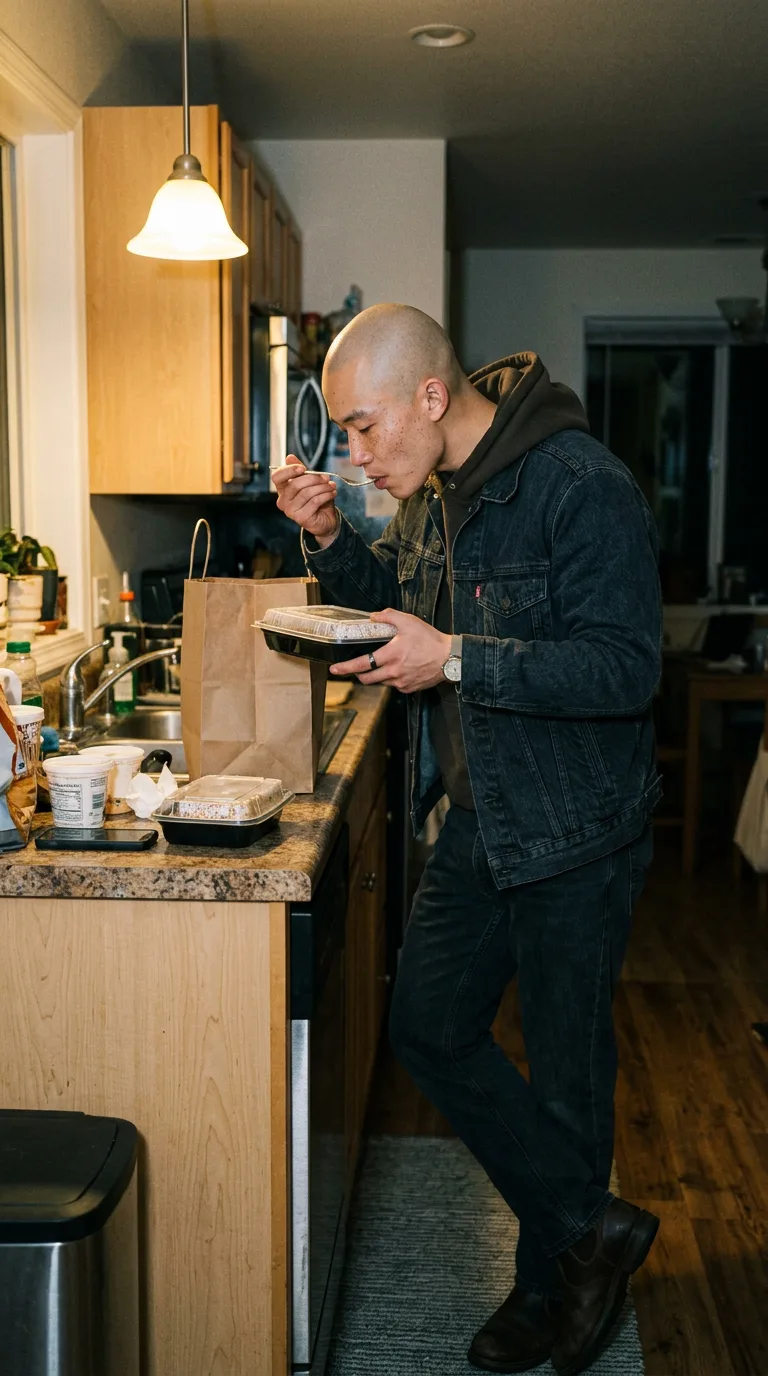
Rarest thing about him: Bald (shaved) — epic, 1 in 56
Season 0seed 1612197800 · engine v10
Character card
lineage JWSE6J
His body-swap story
@ernesto.villaroel, wearing Ernesto Villaroel, rolled the wheel on and woke up as Kevin Zhu, spent 3 minutes in him, then spun the wheel and woke up as Gary Halvorsen
Ernesto's knees ache sitting down, which tells you something about how they feel standing up. You're in his recliner in the dark, the Nashville house silent around a man who lives alone with a television he forgot to turn off, its blue light doing nothing for anyone. Eleven minutes ago you spun a wheel and became sixty, and became tired in a way that has nothing to do with the hour. Not bad, as bodies go — the dimples are doing something charming in the black mirror of the dead TV screen — but the lower back has opinions, and the left knee has more, and some part of you that is not Ernesto and never will be is already bored of both. You paid for a life and got a set of complaints. You get back up, which takes a second longer than you want it to, and you go to the laptop on the kitchen table, because boredom this soon after wanting something so badly has its own particular shame, and the only cure you know for that shame is to want again immediately. You open vessel.cards. The wheel is still spinning from last time, or it looks that way, colors bleeding into each other. You put in the card. You spin.
The fork stops on its way to your mouth.
It comes back down. Sets itself, with a small metal sound, on a granite counter that is not the counter you were just standing over. The coat — his coat, a jean jacket you didn't put on — slides off shoulders that are narrower than the ones you had a second ago, younger, and you are sitting before you decide to sit, folding down onto a stool with a body that does it without asking you. The container is still in your left hand. There is rice in it, going cold. You lift the fork again and it goes into your mouth on its own, evenly, like a machine that was mid-cycle when the operator changed. Outside the window over the sink it is black, mountain black, the particular dark of a city with the lights turned toward the peaks instead of the sky. You are not thinking anything yet. You are just eating, standing down into sitting, chewing, and somewhere underneath that a body nineteen years old is doing what bodies that age do without permission, which is sit still by bouncing a knee.
It starts before you notice you're doing it — right knee, quick, private, like it's keeping a rhythm nobody put on. You look down at the hand holding the fork. Small hand. Calluses along the pads of two fingers you don't recognize yet as steam-wand burns healed over into something like leather. A watch on the wrist, thin band, cheap and fine. No ring — wait, there was a ring in some photograph, some frame in your mind that isn't yours, gold-toned, thin — and that's the first flash, coming in through the metal of the fork itself, warm from your own hand: a coffee shop, low light, a regular sliding a card across the counter saying keep the ring on, man, it's good luck for tips, and Kevin laughing because it isn't a ring at all, it's a rubber band he wears for no reason he can explain to strangers.
The apron comes next, except you're not wearing the apron now, you're wearing the denim jacket, but your body remembers the apron's weight from ten hours ago, remembers tying it twice around because the strap's too long, remembers Marisol at the register yelling order up in a voice that carries over the grinder, remembers the particular ache across the shoulders by 2 p.m. that isn't from lifting anything heavy, just from standing in one five-foot square for six hours making other people's mornings taste right. That ache is still there right now, underneath the jacket, old and familiar, yours already in the way pain is faster than memory.
The hoodie under the jacket gives you the morning — his morning, the one that already happened, hours before this counter, before this container of cold rice: pulling it over his head in a room with a poster half peeled off the wall, the shirt bunching wrong at first so he had to yank the collar straight, the fabric already smelling like the dryer sheet his mother buys in bulk because she read something online about fragrance and headaches. He'd stood in front of the mirror in his bathroom — small mirror, medicine cabinet mirror, a crack in one corner he keeps meaning to mention to the landlord — and looked at his own face the way he does most mornings, checking that the freckles are still just freckles, not moles, not anything, a habit from a bad month two years ago when he convinced himself of a dozen diagnoses in a row until his mom got him into someone who gave him a name for what he had and a small orange bottle that made the mornings survivable. He'd touched two fingers to his cheek in the mirror. Still just freckles. Then the jean jacket over the hoodie because the app said thirty-four degrees, and his phone, and his keys, and out the door into a car that starts on the second try, always the second try, like it's shy.
The counter under your free hand is cold, laminate, somebody else's kitchen chosen because it was cheap and close to the light rail. A bungalow he rents half of, mountains behind the roofline invisible right now in the dark but there, always there, the reason he moved here from somewhere flatter three years ago and never quite explained to anyone why, except that a friend from a college he dropped out of after two semesters said Denver's good money in coffee and Kevin believed him and it turned out, mostly, to be true. Not rich. Nothing in the bank that would survive a bad month. But his. The stool under you creaks the way it always creaks, second groove from the left, and some Sunday-school part of him that never fully left says a small thing without words, a kind of grace before a meal already half eaten, out of habit more than belief, though the belief is in there too, quieter than it used to be, still real.
You are level now. Eating the last of the rice in even mouthfuls, looking at nothing in the dark window, exactly the way he was already going to before you arrived — as if the container was always going to end this way, evening after evening, and you've only stepped into the last of it. The knee keeps bouncing. Freckles catch the one lit bulb over the sink, pendant glass, warm and small in a room otherwise gone to shadow.
You set the empty container down. You look at your hand — his hand, small-knuckled, two calloused pads, no ring, the ghost of a rubber band he isn't wearing tonight — and you turn it over once, like checking it's real, like checking it's new.
You lift your eyes to the black glass of the window, which is doing exactly what a mirror does at night.
"There you are," you say, to no one who can hear it, in a voice nineteen years younger than the one you had eleven minutes ago.