Marlon Kahale
Fictional. Generated by AI — not a real person, and no likeness of one is intended.
51, tattoo artist in Houston · rolled by @colin.hasbrook · card — no film
History
who has worn him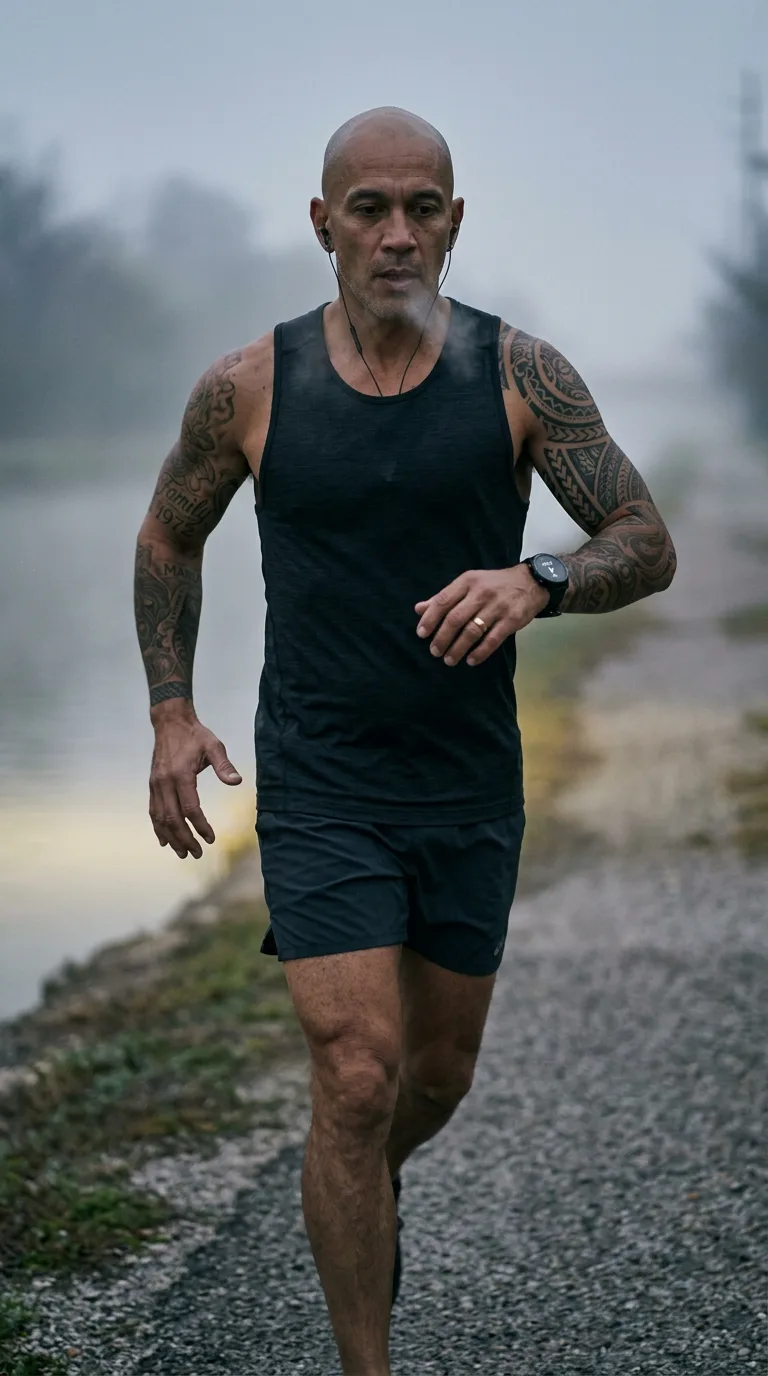
Rarest thing about him: Both earlobes — epic, 1 in 50
Season 0seed 858921414 · engine v10
Character card
lineage 2NZHHJ
His body-swap story
@colin.hasbrook, wearing Patrick Souza, rolled the wheel on and woke up as Marlon Kahale, spent under a minute in him, then spun the wheel and woke up as Peter Skoglund
You are two minutes into being a welder named Patrick Souza, and already you know it was a mistake. Not the body — the body is fine, small and quick, a face that has taken sparks close enough to freckle the cheekbones with old burns. The mistake is the apartment. Gray light through blinds, a hot plate with something congealing on it, a phone with one unread text from a number saved only as MOM. Two minutes of standing in someone else's kitchen in San Francisco, feeling the particular flatness of a life with nothing reaching back into it, no wanting anywhere in the rooms. You did not spin for this. You spun for the forty-eight hours before this, a boxer in Tucson whose jaw ached where it had been broken twice and reset badly, whose memories came in like weather, and you had liked being him, and then you got greedy the way you always get greedy, thinking there might be something even better one card away, and instead you got Patrick, and Patrick is nothing. Two minutes of nothing is enough. You go to the site with his hand on his own phone, the screen still warm from his pocket, and you spin again before you can talk yourself into patience.
The canal path arrives around you at a dead run.
There's no seam to it, no threshold — one stride is a small tired welder's stride and the next is longer, heavier, a man's full weight coming down through a heel that has run this exact gravel ten thousand times before. Your foot finds nothing where it expects the ground and for two steps you are falling without falling, the whole animal machinery of him correcting under you before you've located a single thought, and then you're upright, other foot, breath already matched to a rhythm you didn't set. Mist. The canal on your left, flat as tin under a sky just starting to go the color of a bruise healing. Earbuds feeding something rhythmic and half-heard into skull. A watch on the wrist buzzing once, insistent, telling you a split you never ran.
The tank top is the first thing that opens him to you — damp already, clinging along the spine, and with the wet cotton against your back comes a whole gray sense of routine, four miles four mornings a week, the doctor's voice from some appointment folded in there too: *you keep pounding pavement at your age with a spine like that, Marlon, you're going to be paying for it at sixty.* The name arrives with the ache — Marlon — and the ache is real, low in the lumbar, an old low thrum that never fully quiets, that he's learned to run through instead of around because sitting still hurts worse.
The shorts against your thighs give you the shop — fluorescent tube light, green vinyl chair reclined and empty between appointments, the particular smell of stencil ink and antiseptic wipes that lives permanently in this fabric no matter how many times it's washed. You are a tattoo artist. Your hands — steady, quick, a little arthritic in the last two knuckles of the right — know a machine's weight the way they know nothing else on earth, and for a second, running, you feel the phantom hum of it, needle against skin, the concentration that has no room in it for pain or worry, only line.
The watch band gives you the wife. Not her face yet, just her name arriving warm — Denise — and a morning three years back, sitting on the edge of the bed doing up this same watch while she stood at the mirror in a towel telling you about her sister's divorce, and you weren't really listening, you were watching the muscle in her shoulder move and thinking you'd been lucky, actually, twice-divorced friends notwithstanding, to have landed here at fifty-one with somebody who still made you want to watch her get dressed.
The earbud cords, brushing your jaw, give you Christine. An old name, an old ache different from the back — nineteen ninety-something, a girl with a laugh like a dropped plate, and the two of you breaking up in a parking lot that doesn't exist anymore, and some nights even now, married and happy, mostly happy, you catch her name floating up out of nowhere and wonder, briefly, disloyally, where she ended up. You never told Denise how often that happens. It isn't betrayal. It's just weather.
The tattoos come up out of the skin itself as you run, the ink somehow readable through touch, through the specific stretch and pull of forearm muscle at speed: FAMILY, 1972 — your father's birth year, done the week the old man died, done crying in the chair while somebody else held the machine for once — and MARLA, your daughter's name laid into your own arm in your own hand, because who else were you going to trust with it. Below the elbow the Polynesian panel, sharks' teeth and waves, your grandmother's family carried across the Pacific and into a Houston strip mall, done slow over four sittings, your own machine and somebody else's hand guiding yours through the parts you couldn't reach.
The studs in your ears, small and cool, give you a night decades gone, getting them done in somebody's garage, and your mother — Filipino-and-something on one side, a story that never quite finished being told to you — laughing at how much you'd wince.
The wedding band, plain, worn thin on the underside where it rubs, gives you the wedding itself in one long unbroken pull: a backyard, folding chairs, Denise's dress catching wind, your two kids too young to sit still for the vows, your best man drunk by six and beautiful with it, and you at the altar cracking your knuckles because your hands didn't know what else to do with all that feeling, the priest half-smiling at you like he'd seen it before.
The morning's own memory comes last, smallest, nearest — this shirt was never worn today, it's the tank top, pulled over your head in a dark bedroom while Denise slept, one earbud already in before the door, the other pushed home on the porch, the watch tapped awake, the cool wet air outside meeting a body that's fifty-one and hurts in three places and doesn't care, goes anyway, has gone almost every dawn for years, because it's the one hour that belongs only to him.
You are still running. The path unspools ahead into more fog, more gray water, and nothing in the morning has noticed a thing.
You slow, and look down at the arm swinging into view — ink, ring, the small hitch of pain riding low in your back with every footfall — and you turn the hand over once in the weak light like you're checking it's really attached.
Then you lift your eyes off it, off the tattooed forearm and the ring and the whole borrowed machinery of him, straight into the gray coming up off the water, and you say, out loud, to no one running beside you:
"Okay. Okay — keep going."