Mark Pilarski
Fictional. Generated by AI — not a real person, and no likeness of one is intended.
58, electrician in Small-town Ohio · rolled by @colin.hasbrook · card — no film
History
who has worn him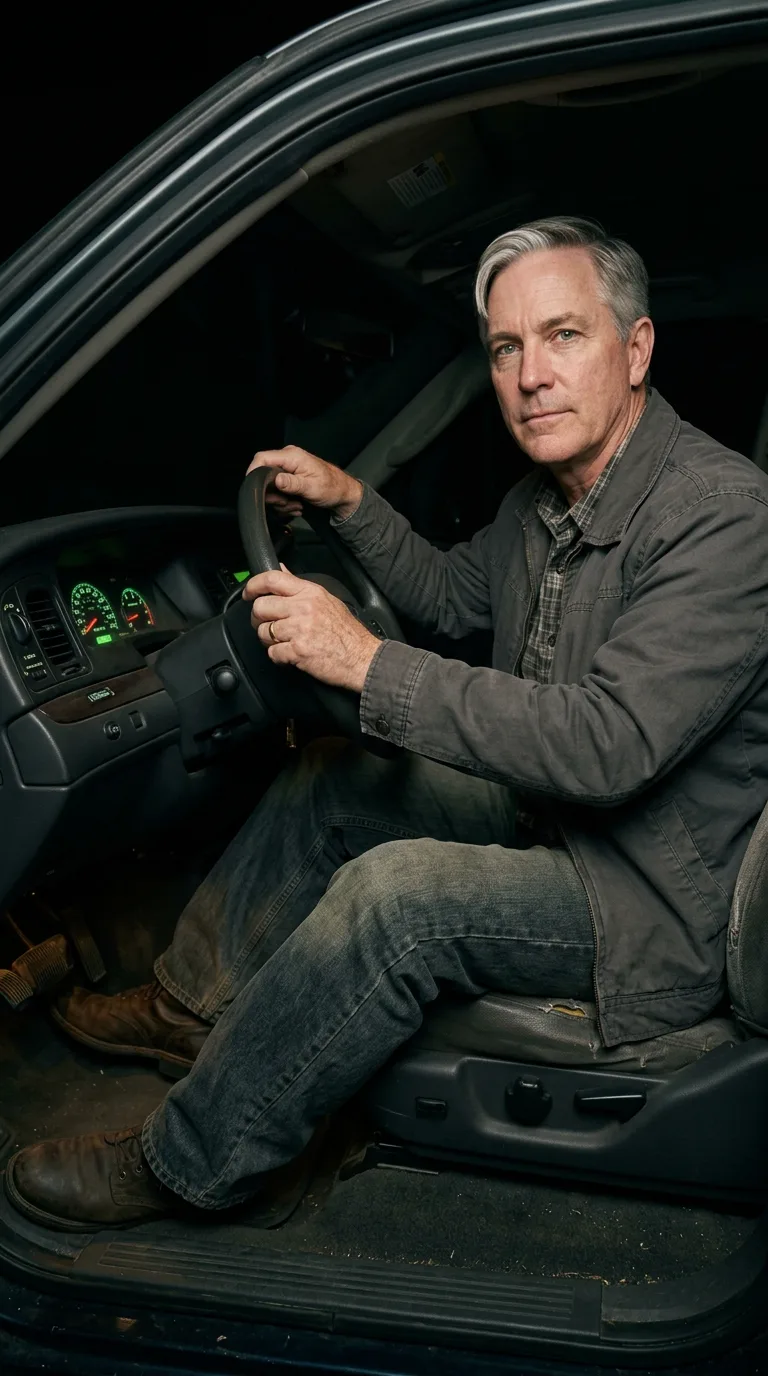
Rarest thing about him: A white streak in the hair — epic, 1 in 99
Season 0seed 2107116111 · engine v10
Character card
lineage 2NZHHJ
His body-swap story
@colin.hasbrook, wearing Marcus Odom, rolled the wheel on and woke up as Mark Pilarski, spent under a minute in him, then spun the wheel and woke up as Travis Denbo
You are standing in Marcus Odom's kitchen, and Marcus Odom's lazy eye is drifting toward the window like it always does when the rest of the face is trying to hold still, and you have been him for forty seconds, and already you know you made a mistake.
It isn't the money — the money is real, Eastern Kentucky money, the kind that buys a hill and puts a house on it and doesn't ask permission from anyone. It's that his hand went to his own back pocket out of habit that isn't yours, reaching for a phone that isn't there yet in this second because you haven't unlocked any of his memories, and something about the gesture — small, private, worn smooth by a thousand repetitions — tells you this man has been doing this exact motion for years and you are only borrowing it for a minute, and a minute is an insult to a life. You didn't take him to live him. You took him to leave him. That's the whole shape of your afternoon: pay, spin, discard, spin again, and somewhere underneath that a hunger that doesn't have a name you'd say out loud, just a rhythm — six hundred and sixty-six times before this one, and every time the same itch returns before the last body's even gone cold. Boredom dressed as appetite. You don't examine it. You go to the site.
The wheel doesn't care that you've barely arrived anywhere. It spins.
You come in on a highway shoulder-lean, hands at ten and two, dash light green on knuckles you don't recognize yet — thinner knuckles, ridged with old callus, a plain gold band on the left one. The car drifts a foot toward the centerline and you correct it in the same smooth motion the body already knew before you got here, muscle memory outrunning you into the turn, and both hands come off the wheel and resettle lower, wider, more comfortable, the way a man sits when he's three miles from a driveway he could parallel park blind. The turn signal clicks on for an exit that isn't his. Nobody notices. There is nobody else in the car to notice.
The shirt is against your back first — heavy cotton, a name patch stitched crooked at one corner, MARK in red thread — and it comes to you sleeve by sleeve, a whole morning arriving out of the fabric: standing in a bedroom with the shades still down, shrugging into this exact shirt while his wife's hair dryer runs behind the bathroom door, checking his own reflection not out of vanity but habit, patting the breast pocket for a pen that's already there. He buttons it one-handed, top to bottom, without looking, forty years of the same six buttons.
The belt gives you the tool pouch riding low on his hip, the weight of pliers he's owned since a job in Zanesville that flooded halfway through and ruined everything else he was carrying that day. His right hand still remembers the particular give of the red-handled ones, remembers stripping a wire without looking at it, remembers the smell of a panel box that's been open too long — hot dust, ozone, something almost sweet. He's good at this. Genuinely good, the kind of good that isn't modest about it, that shows up early and reads the blueprint twice and doesn't cut corners even on the ceilings nobody will ever see, because somebody's kid is going to be under that ceiling in twenty years and he thinks about that kind of thing without being asked to.
The wedding band gives you more than the shirt does. It gives you a courthouse in June, cheap suit, a woman named Diane laughing at something he said that wasn't even funny, and thirty-one years folded into a strip of gold that's a size too tight now and has been for a decade — he keeps meaning to get it resized and keeps not doing it because some stubborn part of him likes that it doesn't come off easy. It gives you two kids, grown, one in Columbus and one still close enough to come Sundays, and a chapel he sits in every week without drama or doubt because it settled something in him young and never had cause to unsettle. It gives you a cigarette he hasn't had in eleven years and still sometimes reaches for at a stoplight, and a heart that skips in a way he doesn't mention to Diane because mentioning it makes it real.
Green eyes. Gray-silver hair combed hard to one side, and under his fingers on the wheel — his fingers, now, whether you like it or not — the single white streak at the front that Diane touches sometimes without thinking, the way you'd touch a scar you loved.
You feel the ceiling job from yesterday still in his shoulders, a low ache from reaching overhead too long, conduit running above him in a half-built room that smelled like sawdust and cut copper. You feel fifty-eight years sitting in a body that still works, mostly, average build holding its own, a heart that carries a diagnosis he hasn't fully told anyone the weight of.
You feel, too, distantly, the last thing this body's borrowed occupant registered before you took the wheel from him entirely: nothing. No fight. No knowledge. Just three miles of dark road and a house at the end of it with a porch light Diane leaves on.
You look down at your hands on the wheel — his hands, spotted, strong, a white gold ring pressed into skin that's carried it three decades — and you turn the right one over slow, the way you always do, checking the fit of a life you didn't earn.
Then you look up, into the windshield, into your own reflected face with its wrong exit signal still blinking green in the corner of your eye, and you say, quiet, like you're only telling yourself:
"Three miles."