Marcus Tillery
Fictional. Generated by AI — not a real person, and no likeness of one is intended.
38, freight handler in Nashville · rolled by @colin.hasbrook · card — no film
History
who has worn him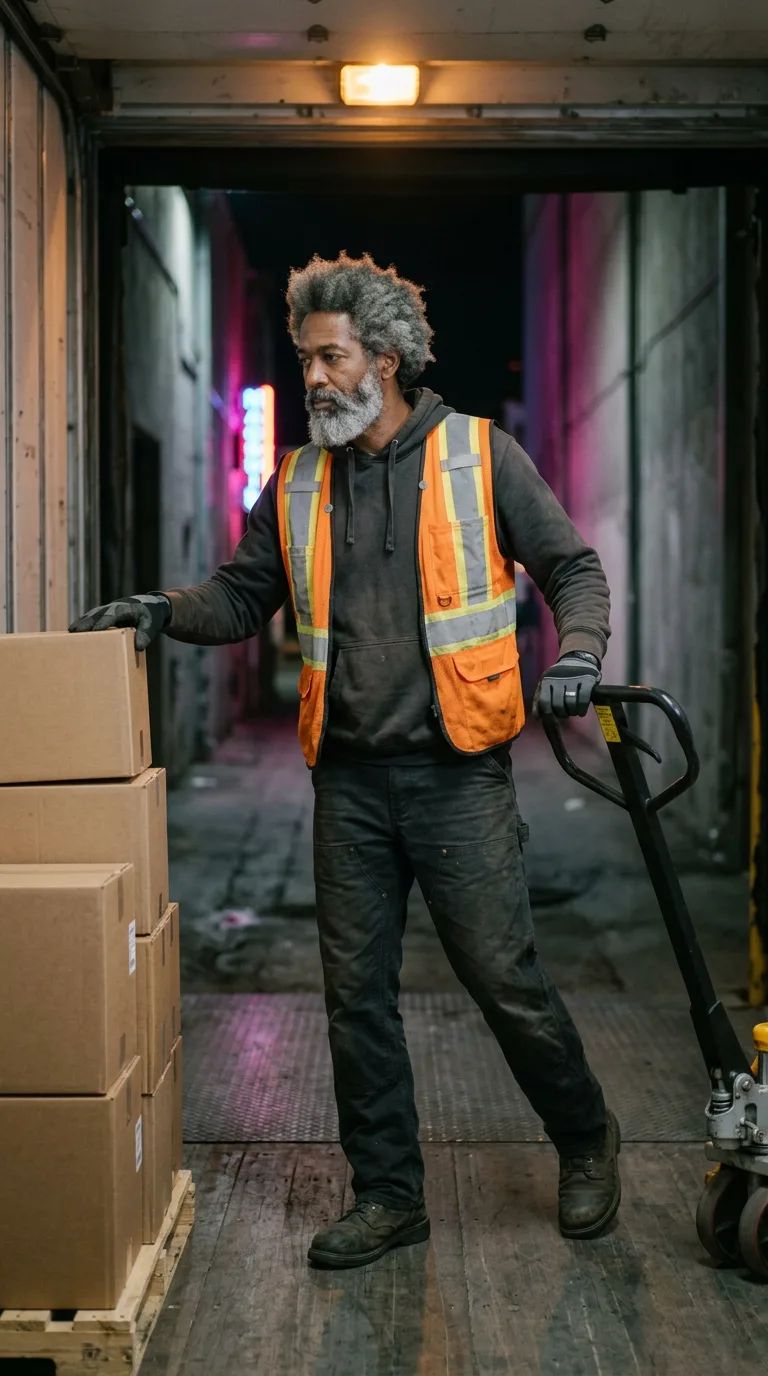
Rarest thing about him: Afro — common, 1 in 78
Season 1seed 809247580 · engine v11
Character card
lineage 2NZHHJ
His body-swap story
@colin.hasbrook, wearing Julian Marrufo, rolled the wheel on and woke up as Marcus Tillery, spent under a minute in him, then spun the wheel and woke up as Terrence Abasi
You are still Julian for another nine minutes, standing in the back room of a hardware store that smells like cut keys and WD-40, and the reason you are leaving him is stupid and small: the register drawer stuck this afternoon, jammed on its track, and you spent four minutes on your knees behind the counter with a customer watching, and something in you decided that this life, this narrow spine of a life, had shown you everything it had. Julian's hands are good hands, quick with a utility knife, freckled across the knuckles, but they are thirty-one years old and skinny and they have never once felt like enough weight in the world. Two hours and twenty-eight minutes is not long to wear a man before you get bored of him. You know that about yourself now, 852 spins in. You still open the site anyway, the wheel loading slow on his phone, and you spin it standing in his stockroom with the closed sign already flipped, and you go.
The pallet jack handle is cold steel under your palm and then it is warm, because it has been in a hand all evening and that hand is suddenly yours. You are bent at the waist, weight forward, one box lifted at the corner, and the motion that was smooth ten thousand times comes out wrong — you set it down on the wrong stack, a half-inch off true, and something in the shoulders that isn't you yet corrects it, slow, deliberate, like a man relearning his own name. The next box goes on checked. So does the one after that. Behind you the alley breathes neon, pink bleeding across wet cobblestone, and somewhere past the loading door a steel guitar is crying through a wall.
The vest is what gives you the first flash — the mesh orange strap against your collarbone, worn soft at the zipper pull from being grabbed the same way every single day — and it comes back not as a picture but as an ache, a Tuesday, a supervisor named Dale who runs his mouth about quotas at six a.m. shift-change, and the particular tired that lives in a man's forearms by hour nine. You are three hours into a shift that started at midnight, because this dock only loads at night, trucks rolling in when the bars two blocks over are still loud, and that is the crossed wire of it — evening where you came from, deep dead-of-night here, his body running on a clock that never once agreed with daylight.
The gloves are next. Cracked at the seam of the right thumb, and through that crack comes a whole marriage: a woman named Renee who has stopped waiting up because his hours don't allow it, who leaves a plate wrapped in foil on the counter most nights whether he's home to eat it or not, who married him nine years ago in her mother's backyard in a dress that wasn't white because neither of them saw the point in white. No children, and that had been a quiet thing between them for a while, a door they closed without slamming it, and now it's just how the house is — two people, no small feet, a marriage settled the way a foundation settles, not sinking, just finding its level. You feel, distantly and completely uninvited, how much he loves her. It sits in the chest like something structural.
The beard comes back through nothing but touch, your — his — jaw working itself the way it does without permission, two inches of salt-and-pepper he trims himself over the bathroom sink because barbers charge too much for a beard already this shape. The afro is a newer thing, four years maybe, since the gray came in fast and he decided fighting it was more work than growing it out. Renee likes it. Says it makes him look like somebody's uncle who tells good stories. He isn't, particularly, but he lets her have the joke.
Under the gloves your nails are bitten down close, a habit that isn't nervous so much as absent, something the hands do on break, on the walk to the truck, waiting on the dock supervisor's radio call — teeth working at a thumbnail while the mind's somewhere else entirely, on Renee, on the Titans game, on nothing. The wedding band is loose enough to spin on the finger when it's cold like tonight, and spinning it is another thing the hands do without asking permission of the man they belong to.
The boots, cracked leather, steel-toed, give you the walk to work — not a drive, four blocks, because the truck's been in the shop and he likes the walk anyway, likes the alley with its bassline leaking out of three different bars at once, likes being a Black man with gray hair grown wild walking past a mechanical bull rental at midnight and not one person looking at him twice, because Nashville at that hour belongs to everybody equally tired. He put this hoodie on nine hours ago in a dim bedroom, careful with the zipper so it wouldn't wake Renee, one sleeve then the other, the vest last, snapped at the waist, a routine so old his arms do it in the dark, literally, tonight, in the dark, not wanting to turn on the light.
A pack of cigarettes sits heavy in the vest's inner pocket against your ribs, half gone already, and the craving arrives with it, dull and familiar, an itch two hours old. Somewhere under all of it is the plain fact of the body — thirty-eight years old, an ache low in the back that a younger man wouldn't have, forearms that can move weight all night and still shake slightly reaching for a lighter after, a body that knows this exact motion, box to hand to stack, without any thought at all, until tonight, when for ten checked, careful repetitions, it had to think.
You straighten up. You look down at the gloves, then peel the right one back with your teeth the way his hands already know to do, and look at the fingers underneath — bitten nails, a thin white scar of nothing in particular, a ring that isn't yours, on a hand that is, now, for exactly as long as you decide it is.
"Didn't used to have to check my work," you say, to the empty dock, to the pink light, to nobody, and it isn't clear yet whether that's him talking or you.