Marcus Redding
Fictional. Generated by AI — not a real person, and no likeness of one is intended.
56, firefighter in Dallas · rolled by @colin.hasbrook · card — no film
History
who has worn him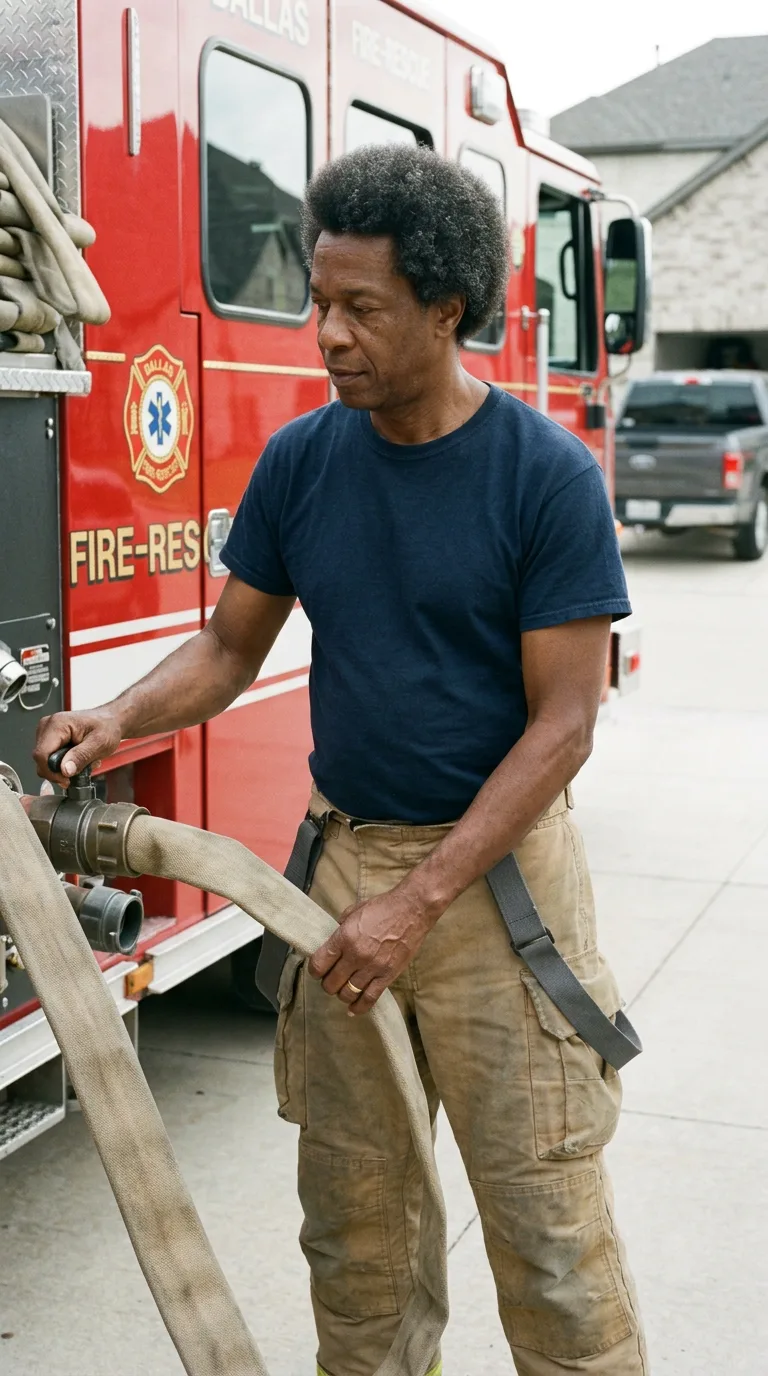
Rarest thing about him: Latter-day Saint — rare, 1 in 47
Season 0seed 1521489244 · engine v10
Character card
lineage 2NZHHJ
His body-swap story
@colin.hasbrook, wearing Eugene Matsuo, rolled the wheel on and woke up as Marcus Redding, spent under a minute in him, then spun the wheel and woke up as Andre Kittles
The apartment above the pool deck is quiet except for the hum of a vending machine down the hall, and you are Eugene Matsuo, standing at a window that isn't yours, in a body that isn't yours, forty-something seconds into a life you already know the shape of. Dimples. Muscular arms that carry a whistle-cord tan line. A lifeguard chair somewhere below that you sat in a thousand times as somebody else, before you were him, before you were anyone. It took you four hundred and forty-six spins to learn the lesson and you learned it anyway, tonight, standing here: it is never the body. It is what waits behind it. Eugene has good shoulders and a nice laugh line and absolutely nothing else you want to know about. You did not even open his wallet. You are already turning for the door, already thinking of the card catalogue behind your eyes, four hundred and forty-six men deep, wondering which one of them was doing something *interesting* at the exact moment you took him. You do not choose for reasons you would say out loud. You choose because the wheel is sitting there and Tuesday is long and Eugene, God love him, is finished the moment you've had this thought about him.
The hose is heavier than it looks and your hand is already wrong on it — knuckles overlapping the coupling instead of cupped under it, a grip a apprentice would use, not a man of thirty years. You correct without knowing you're correcting. The valve turns half a rotation, stops, backs up, turns again, slow and deliberate, like a man checking his own work for the first time since testing out of probie status. Behind you the engine idles, red and patient, DALLAS FIRE-RESCUE lettering catching the sodium light of a cul-de-sac gone quiet. A pickup truck sits nose-out in a driveway across the apron, ordinary, waiting for a man who lives here. The air smells like the inside of a diesel exhaust and cut Bermuda grass. Your knees ache before you've even decided to notice they ache, a low arthritic hum that has clearly been there through several presidents.
The t-shirt is what opens first — worn cotton dragging at your back with a memory that isn't a picture so much as a motion: an arm going up and through a sleeve in a locker room that smells like Nomex and coffee, a body turning fifty-six years old and still doing this, seven a.m., the shift bell not yet rung. Belinda's voice from the kitchen, three years married before either of them thought to call it settled, now thirty-one years gone by and she still says *you're gonna wear that shirt till it falls off you* every single wash cycle, and he says *it hasn't yet* every single time, and it is not a fight, it is a hymn they sing at each other, worn soft with repeating.
The bunker pants are next, and they come loaded — twenty-eight years of them, the suspenders' particular drag on shoulders that have carried far worse. A knee that blew out on a roof in Oak Cliff in 2009 and never quite forgave him, cortisone twice a year now, the doctor's raised eyebrow at "fifty-six" written on a chart like it's a diagnosis. He does not drink, never has, went two years without complaining about it once at his own retirement party for another man, water in his hand and nobody thinking twice, because that's just Marcus. He does not smoke. He has never needed to numb anything; the church took the numbing job a long time ago and never once asked to be relieved. Sacrament meeting Sunday, calling as a home teacher he takes more seriously than most men take their jobs, a testimony he'd give again if you asked, plain and unadorned as the ring on his hand.
The ring. Left hand, plain band, thirty-one years old this September, and it brings his wife whole — not a memory so much as a weather system, the smell of her shampoo in a bathroom in a subdivision built in 2015, both kids grown and gone but their height marked in pencil still on a closet doorframe nobody's painted over. A daughter in Fort Worth who calls every Sunday at six. A son at A&M who wants to be an engineer and calls never, which Marcus has decided not to take personally, mostly. None of it dramatic. None of it needing to be. A whole life assembled like a good hose lay — no wasted motion, nothing left kinked.
His hands know this coupling without him. They have known it through two wives' worth of other men's memory of holding something, though there was only ever the one wife, and they know it now with your fingers wearing his calluses, the valve giving under a grip built by ten thousand identical nights, most of them nothing happening at all, most of a firefighter's life being exactly that — the checking of things that don't need checking, until the one night they do.
You look down at the hand on the valve. Turn it over. It is not a hand you have ever had before — the wedding band catching the truck's work light, a knuckle swollen slightly with something that will ache worse tomorrow whether or not tomorrow ever comes for you in him. Somewhere behind this face is a testimony you didn't earn and a marriage thirty-one years thick and two children who will call this number tomorrow expecting their father's voice, and for right now, it is.
"Almost done here," you say, to no one, in his voice, because that's what he would say, and because you have not decided yet whether you are going to be the kind of man who says truer things than that.