Andre Kittles
Fictional. Generated by AI — not a real person, and no likeness of one is intended.
47, security guard in Miami · rolled by @colin.hasbrook · card — no film
History
who has worn him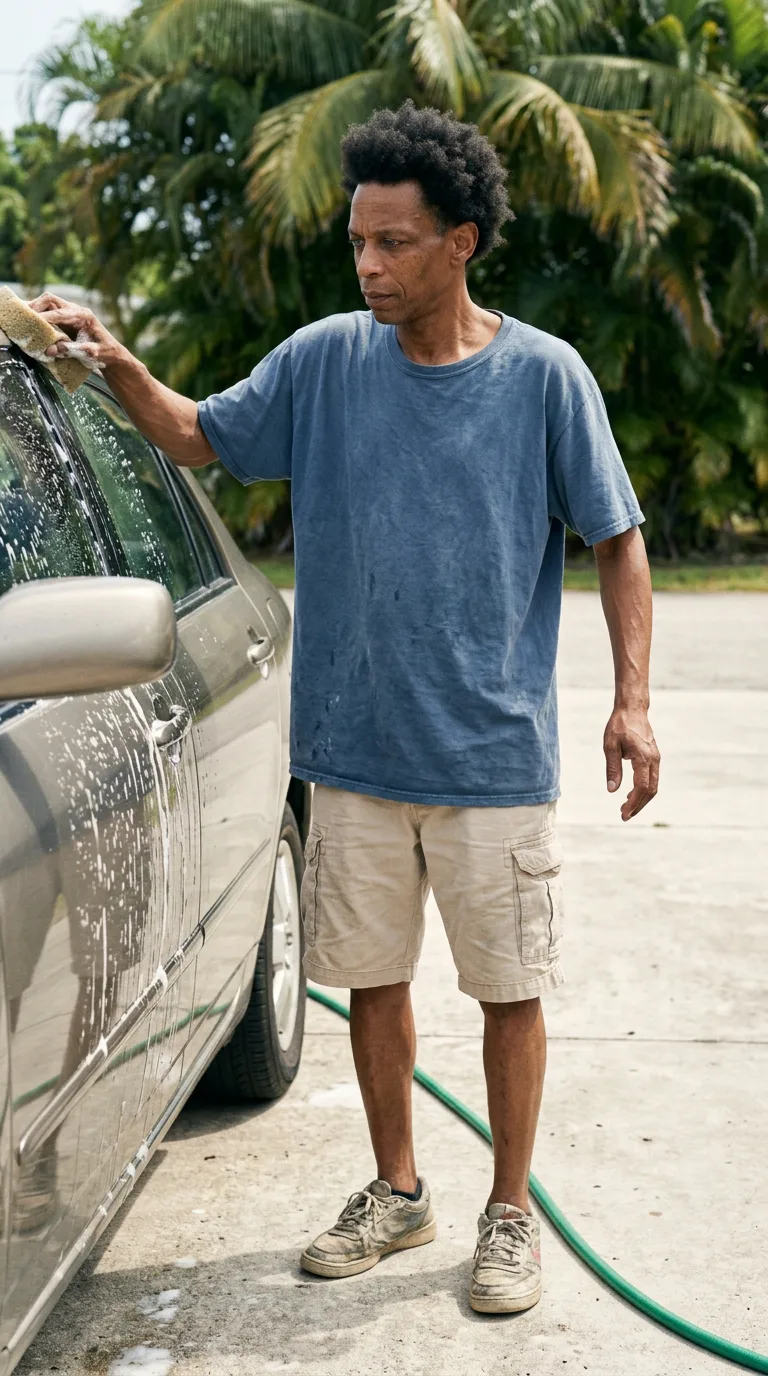
Rarest thing about him: Blue — legendary, 1 in 167
Season 0seed 580316893 · engine v10
Character card
lineage 2NZHHJ
His body-swap story
@colin.hasbrook, wearing Marcus Redding, rolled the wheel on and woke up as Andre Kittles, spent under a minute in him, then spun the wheel and woke up as Rafael Montoya
You are standing in a firehouse kitchen at eleven at night, in a body that isn't yours yet either, waiting on a pot of chili nobody's going to eat because the tone just dropped twice and everybody's already halfway out the door in their boots. Marcus Redding's knees ache going down the pole even though you didn't do the sliding, that ache just comes bundled with the body, and his chest does something wrong on the stairs after, a tightness that isn't yours but that you have to carry anyway, fifty-six years stacked into cartilage and scar tissue and a heart that works harder than it used to. You have been him fifty-one seconds short of a minute. That is not why you are leaving him. You are leaving him because the wheel is still open in your pocket, in his phone, the tab still loaded from before the tone dropped, and because fifty-six is heavy in a way that gets heavier every time you sit still in it, and because you have never once, in four hundred and forty-seven spins, let yourself find out what it is to stop right after arriving somewhere, to not even unpack a life before setting it back down. That, today, is the whole reason. Not disgust. Not boredom exactly. Just the itch of a door still standing open behind you. You spin.
The hose is running before you are, water sheeting warm and thin over pavement already gone silver with runoff, and your hand — his hand, now, only ever his — is dragging a sponge down a car door in the middle of a stroke that started before you existed here. Halfway down the panel your grip changes without your permission: thumb tucking under, wrist rolling in small tight circles instead of the wide arcs that were there a second ago, and behind you, for the first time all afternoon, the swirl marks in the soap stop laying themselves down. Sun is flat and heavy through royal palms. It is the middle of the night somewhere you can't picture yet, but here it is early afternoon, heat sitting on the driveway like a hand, and you are thin in a way Marcus never was, ribs closer to the shirt than they should be, knees that don't complain, a lightness in the legs that almost startles you after his weight.
The t-shirt is what gives it up first — worn-soft cotton gone dark at the collar with old sweat, and through it comes a Tuesday two years back, a woman's voice in another room saying his name like a period at the end of a sentence, Renata, done saying it kindly by then, the two of them dividing a house down to the silverware while the kids sat on the stairs pretending not to hear. Andre Kittles. The name comes in with the shirt, the way his own mother said it, three syllables stretched out on a porch in Liberty City on nights the AC unit rattled too loud to sleep through. The ring line comes next, a stripe of paler brown around a finger that used to have weight on it and now just has the ghost of a tan, and holding it is its own small ache, older than the divorce, something about a promise that didn't survive but that he still checks for out of habit, like a tongue finding a missing tooth.
The sponge in his hand knows this car better than he consciously does — the dent by the rear wheel well from a shopping cart in a Publix lot, the trick of getting suds out of the side mirror housing without leaving streaks, the exact pressure that keeps him from scratching the clear coat, learned over a decade of Saturdays when Saturdays still had structure to them. His body remembers standing overnight at a lobby desk on Brickell, twelve hours on his feet in a uniform starched stiff enough to hold a crease, badge catching fluorescent light, keys heavy at his hip with their small tired jingle every time he shifted weight heel to heel at four in the morning watching nothing move. He remembers the exact fatigue of that — not tired like sleepy, tired like hollowed, the kind that lives behind the eyes after enough overnights that days and nights trade places and never trade back. He works nights. Somewhere on the other side of the planet from wherever you came out of it is deep into one, the whole building he guards gone dark and quiet, which is why, here, in the sun, with a hose running warm over his knuckles, it is the dead middle of his night by every clock that matters to him even as the sun sits directly overhead — his shift ends, he drives home, and this, washing his ex-wife's old Camry that she still leaves in his driveway on Tuesdays because his is the only free hand for it, is what passes for daylight in his life, borrowed and thin and always slightly wrong-feeling in his skin, a man doing chores at what his body insists is two in the morning.
Cargo shorts remember nothing in particular, just khaki and pockets and the specific gone-soft fabric of ten years' wear; the sneakers remember standing, only ever standing, soles worn thin at the same two points from a decade of shifting weight at a desk. High cholesterol sits in him like a fact he's been told more than a thing he feels, a pill bottle in a bathroom cabinet, a doctor's voice saying watch the eggs. He quit smoking nine years ago in a gas station parking lot the week his daughter was born and never told anyone how much he still wants one at stoplights. He quit drinking without ceremony, just stopped noticing he wasn't doing it anymore. Church some Sundays, less than he used to, more than he says. Two kids who call, mostly. An ex-wife whose car he still washes because it is easier than saying no, and because some habits outlive the reason for them, and because — this comes in last, faint, almost too much to hold — some part of him still likes doing something for her that she'll notice.
You look down. His hand — narrower than Marcus's, younger by nine years, ribs of tendon standing up under thin skin, a sponge gone gray with old soap held loose in the fingers — turns over once in the light, palm up, like it's checking for something that isn't there anymore. Water is still running somewhere off to the side, wasted now, nobody guiding it. You lift your eyes off the hand and put them on whatever's watching.
"Guess I finished early," you say, to no one, in his voice, and you don't yet know for how long it's yours to use.