Marcus Ondelay
Fictional. Generated by AI — not a real person, and no likeness of one is intended.
19, social worker in El Paso · rolled by @marco.villagrana · card — no film
History
who has worn him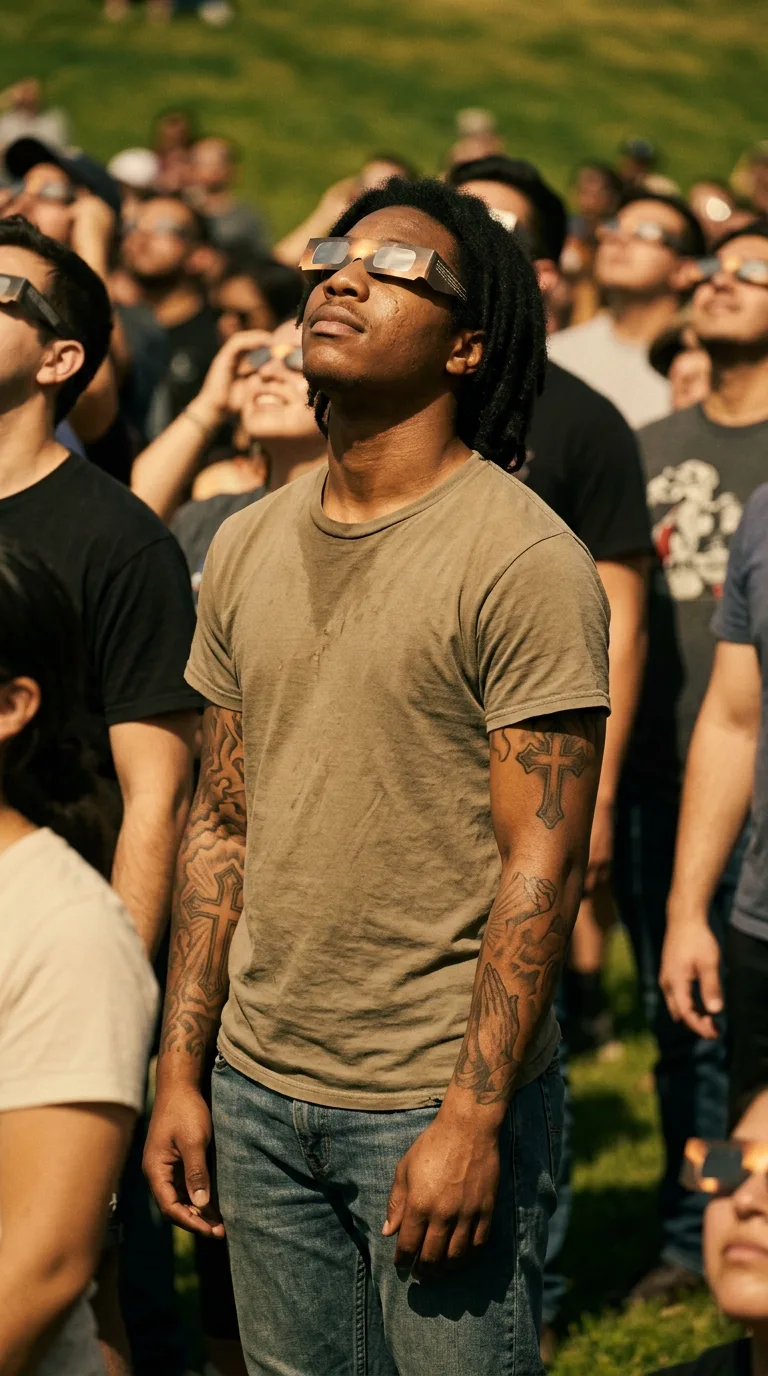
Rarest thing about him: Watching the eclipse with everyone else — rare, 1 in 316
Season 0seed 1256928008 · engine v10
Character card
lineage LJL8SV
His body-swap story
@marco.villagrana, wearing Isaac Reyna, rolled the wheel on and woke up as Marcus Ondelay, spent 5 minutes in him, then spun the wheel and woke up as Derek Cho
---
Two hours and eleven minutes is not long enough to love a body, but it's long enough to hate one, and by the time the sun starts going out over some rural Texas field you've had it with Isaac Reyna's hands. Freckled, chapped, twenty-one years old and already ruined at the knuckles from fence wire and feed sacks. You spun for a farmer and got a farm — the actual thing, unglamorous, a mother who calls twice a day and a debt that isn't even his and a body that aches in a way nineteen-year-old bodies don't. You stood in his dirt yard with everyone else's paper glasses on, watching the light go strange and old-film gray, and you thought: not this. Not another hour of this. Your thumb found the little groove in your back pocket where his phone lives, and past that a memory that isn't yours arrived and sat down in you anyway — his mother's voice, tired, asking has he called the bank — and that decided it. You don't want his life today. You want the wheel.
You spin standing right there in the field, mid-eclipse, Isaac's cracked phone screen inches from Isaac's face, and somewhere far off and two hours ahead of this exact instant, in El Paso, on a lawn full of strangers with their heads all tipped back the same way, totality lands.
The whole lawn makes one noise. You do not. The paper glasses come off in a hand that is not chapped, not tan the same way, longer in the finger, and the face they come off of tips down out of the burnt sky to find its own shoes — brown leather, worn at the toe seam — and you are standing in them.
The shirt gets you first. It's thin, a faded olive tee gone soft at the collar, and something about the give of the fabric across your shoulders opens a door: a mirror in a room with a turquoise wall glimpsed through a window's reflection, a hand — his hand, broad-knuckled, warm — pulling this exact shirt down over a chest still damp from a shower, this morning, hours before the eclipse, humming something with no tune. He'd stood there a second too long deciding whether to put on the good shirt for the eclipse party or this one, and picked this one because the good one was for Monday, for the Ibarra file, for whatever the walkway outside apartment 4C was going to ask of him this week. That's a flash of a whole life arriving sideways: Marcus Ondelay, standing on an open-air landing with a manila folder under his arm, knocking on a door that takes its time answering, the smell of somebody's dinner and somebody's cigarette drifting along the corridor, his own patience with people who are hard to reach worn into him like a callus he's proud of and never mentions.
The jeans are next, worn soft at the thigh from sitting in a county car half his week, and they give you the ache of a body that stands more than it should and sits wrong in office chairs — nineteen and already carrying a hitch low in his back from it, average build going a little soft at the middle from gas station lunches between home visits. Strong in the forearms, though, and you know why the second you feel the tug of the ink there: a full sleeve on the right arm, cross and clasped hands, laid into his skin two years ago in a shop off Alameda with a friend who's since moved to Austin and doesn't call. He got it not for God — there's no God in him, hasn't been since his abuela stopped taking him to Mass at twelve — but because the hands looked like his abuela's hands, folded, and he wanted something of hers on him that would outlast her. The needle line by his wrist still needling reminds him, whenever his sleeve rides up at a stranger's kitchen table, that fecha, that pain, an afternoon of gritted teeth and his friend laughing at him for flinching.
Your own eye is the last thing to arrive, and it arrives only as a faint pull, a looseness in the muscle on one side, the outward drift he's had since he can remember, that got him called things in middle school he doesn't repeat and that he stopped apologizing for around sixteen. People look a half-second too long at his face trying to find where he's actually looking. He clocked it once in a job interview and decided the hell with it, and got the job anyway — social work, a caseload that eats Sundays, this Sunday included, except today he'd traded his shift and gone to the park instead, paper glasses fished out of a coworker's glovebox, because the moon doesn't cross the sun in El Paso every year and he wasn't going to miss it standing over a case file.
The nicotine pouch still tucked in his cheek gives you the smallest thing: a habit picked up his first year on the job, something to do with his hands that isn't a cigarette, something his tíos would rag him about if they knew. Comfortable, this life, not rich — a decent salary, a paid-off truck, rent low because the turquoise house is his tía's and she likes having him close. No one waiting on him today besides everyone waiting on him tomorrow: 4C, and 6B, and the Ibarra kids.
You look down. His hands — Marcus's hands, not yours, never yours — turn palm up in the light of a sun just starting to come back, and you flex the fingers once like you're checking they still work.
"Damn," you say, out loud, to no one, to the lawn still cheering around you, "wrong eye's been doing that the whole time?"
Nobody hears it as strange. You have no idea yet how long you'll want to keep asking.