Marcus Feeney
Fictional. Generated by AI — not a real person, and no likeness of one is intended.
35, mechanical engineer in New Orleans · rolled by @colin.tarwater · card — no film
History
who has worn him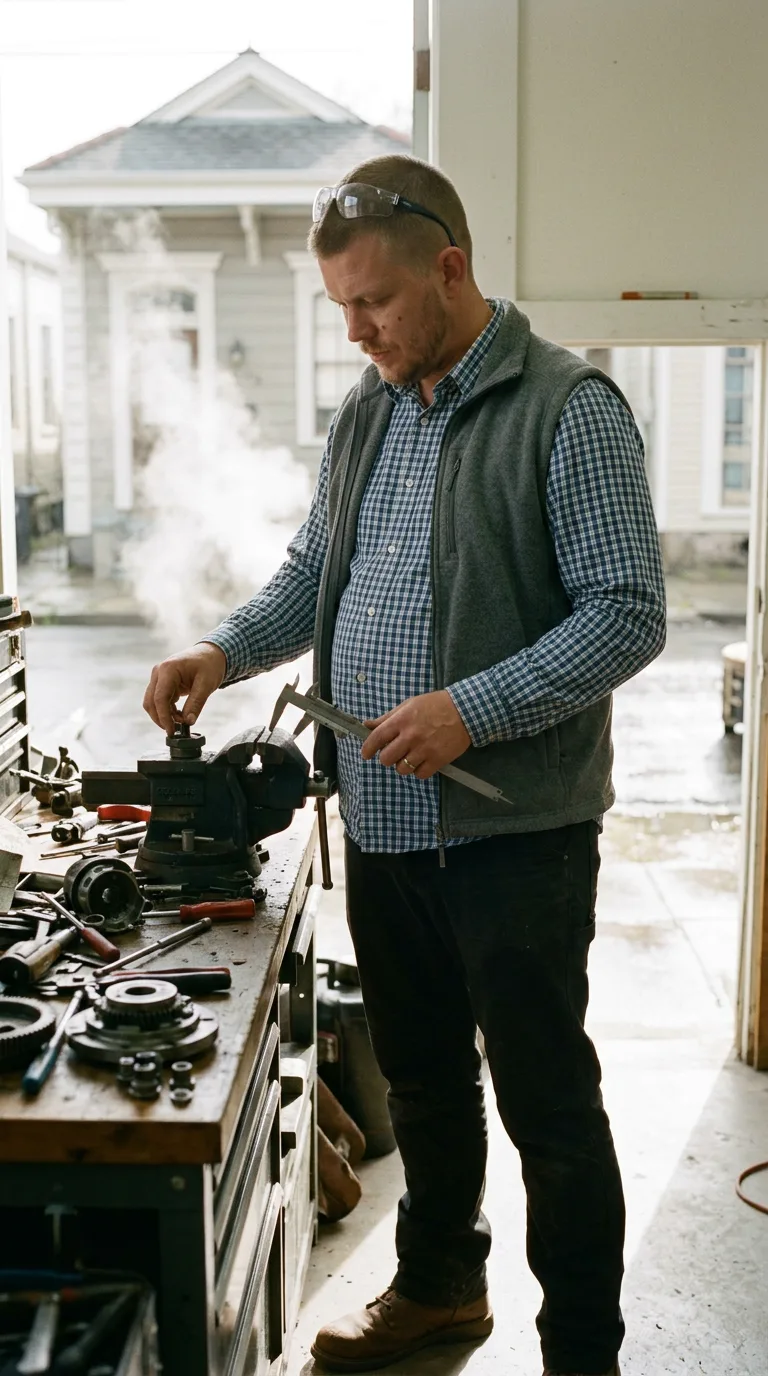
Rarest thing about him: Patchy beard — common, 1 in 30
Season 1seed 1684883137 · engine v11
Character card
lineage COEU7T
His body-swap story
@colin.tarwater, wearing Dennis Yamashiro, rolled the wheel on and woke up as Marcus Feeney, spent under a minute in him, then spun the wheel and woke up as Emilio Casares
The precinct locker room smells like bleach and old sweat, and Dennis Yamashiro's gold tooth catches the fluorescent light when you catch your own reflection in the metal door and don't recognize the tired around the eyes. Six days, sixteen hours. You know because you counted. A cop's body is a good one on paper — the badge opens doors, the gun is a kind of quiet nobody argues with — but the knees ache going up stairs, the blood pressure medication is a chalky orange bottle in the cabinet, and this morning a woman at a domestic call looked at you the way people look at cops in this city, which is to say like weather, like something to be endured. You spun the wheel eighty times looking for a feeling you had once and can't remember the shape of anymore, and Dennis Yamashiro's life, whatever it was before you, has gone thin and grey the way they always do by day four. There's a phone on the break room table. Vessel.cards loads fast on precinct wifi. Your thumb — his thumb, the gold tooth flashing in the black screen — finds the spin button before you've admitted you're going to press it.
The wheel turns and there is no click, no countdown, only steam.
Wet steam, close, curling up off asphalt in a slow grey ribbon past your shoulder, and your hand — this hand, thick-fingered, a plain gold band on the fourth finger — is closing around a caliper mid-motion, the jaws already set to a measurement you were about to check for the hundredth time. The garage door is up. Light comes in flat and white off the wet street. There's a shotgun house across the way, one room wide, its shutters the color of a bruise gone yellow. Your body is heavier than the one you left, softer through the middle, a gut riding low over the belt, and the motion your hand was making — thumb rolling the caliper's wheel — stutters. Goes wrong. You feel it go wrong before you understand why, a wrongness like a key turned backward in a lock, and you stop, and do it again, slow, correct. The part in the vise is a gear housing, half-machined, patient under the fluorescent trouble light clamped to the shelf above the bench.
The shirt is what opens first. Blue-and-white check, sleeves rolled to the forearm, and touching it — no, wearing it, the cotton already warm from your own borrowed skin — gives you a morning: buttoning it in a bathroom with a cracked mirror, the bathroom fan rattling, his wife's hairdryer going in the next room, a boy's voice somewhere down the shotgun hallway asking has anyone seen his cleats. Marcus. His name arrives with the shirt the way names arrive, sourceless and certain — Marcus Feeney, thirty-five, and this shirt is from a five-pack he buys without thinking about it because money stopped being a subject a long time ago, back when the company he helped start got bought and didn't need him to worry about anything again. He remembers, without wanting to, the specific pleasure of an engineering problem solved at two in the morning, the kind of night-shift hours a man keeps not because he has to anymore but because some part of him is still twenty-six and hungry and doesn't believe the money is real. The fleece vest next — gray, zip half up — and in it there's a colder memory, an ex-wife's voice on the phone, calm and done, the two of them dividing a life that had already quietly ended months before either of them said so out loud. No malice in it now. Just a fact, worn smooth.
The wedding band is the loudest thing in the room. It says a second wife, a woman who laughs with her whole chest, a wedding on a lawn in Bayou St. John with paper lanterns strung through live oak, and a daughter — six years old, sharp as a tack, who calls the shop "Daddy's noisy room" and is not afraid of any of it, not the vise, not the lathe, not the sparks. You feel, in the hand that wears the ring, an old ease: this hand has held that ring on and off a thousand times over parts too greasy to wear it near, has set it down on the workbench edge in a groove worn just for that purpose, has picked it back up without looking. The boots under your feet know this concrete floor down to its slope, its damp patch by the door, the exact place a bolt rolled under the shelf eight months ago and is probably still there. Your leg is already bouncing, has been bouncing this whole time under you, a tremor with no name attached, present since he was a teenager doing math homework and never left. Nicotine wants a cigarette in a way that has nothing to do with need and everything to do with rhythm — a pack a day, ten years running, his wife has stopped mentioning it. The caliper in your hand is cold steel, precise, and your fingers — his fingers, blunt, a little scarred at the knuckle from a slipped wrench in some other year — know exactly how much pressure closes the jaws without crushing the part. Ten years of this motion live in the wrist. You do it again. Correct. Then again, checked, though it hasn't needed checking since before his daughter was born.
You look at your hands. The caliper, the ring, the half-machined gear housing patient in the vise, steam still going up off the street outside like the city breathing. You turn the hand over once, feel its unfamiliar weight, its warmth, its small tremor at the leg that hasn't stopped and won't.
"There you are," you say, to no one, to the lens of the morning, and you don't know yet if you mean the hand or the man or the eighty men before him.