Marcus Deveraux Whitlock
Fictional. Generated by AI — not a real person, and no likeness of one is intended.
34, soldier in Philadelphia · rolled by @justin.moy · card — no film
History
who has worn him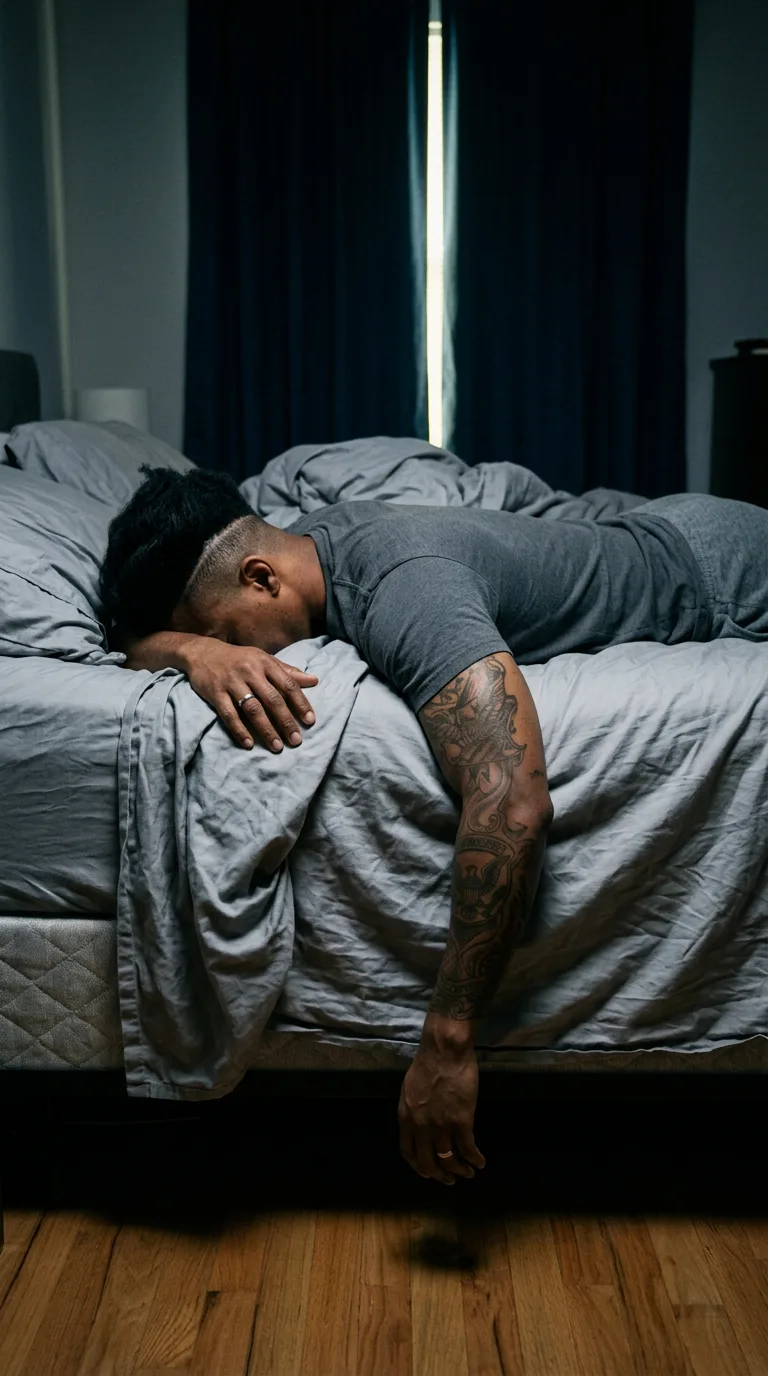
Rarest thing about him: An undercut — rare, 1 in 71
Season 0seed 1576992604 · engine v10
Character card
lineage EN1F2L
His body-swap story
@justin.moy, wearing Justin Moy, rolled the wheel on and woke up as Marcus Deveraux Whitlock, spent under a minute in him, then spun the wheel and woke up as Terrence Okonkwo-Bell
The route is the same route it's been for two minutes, and two minutes is long enough to know everything wrong with it. The mirror over the dash keeps handing you back a face that isn't the one you want — narrow, East Asian, twenty-eight, a face that belongs to somebody with a route and a schedule and a supervisor named Dana who calls twice a shift to ask about the schedule. You feel his hands on this wheel, competent, bored past the edge of boredom, and you feel your own want underneath them, which is not his and never was. You pull to the curb outside a shuttered bodega, put the flashers on, and take out your phone like a man checking a text. The site loads the way it always loads, patient, gray, a wheel and a button and the balance you never look at too closely. You spin it sitting in a stranger's seat, in a stranger's idling bus, and you feel the bus driver go out like a pilot light while something else rushes in on the other end of it, somewhere hours behind this morning, still dark enough to call itself night.
You arrive breathing evenly, which is the first wrong thing, because half a second ago — his half a second, not yours — the breathing was ragged, was work, was a dream sliding downhill into the flat. The arm that was hanging off the mattress draws itself up like it was always going to. Hands fold at the chest. Streetlight comes through a gap in the curtain in one thin blade across the ceiling and you lie there inside him being still in a way this body has apparently never once managed on its own.
The room smells like fabric softener and, underneath that, faintly, cigar smoke that's been aired out of everything except the curtains. That's the first door. It opens onto a porch, two nights ago by his clock, a Montecristo going soft and grey between his fingers, his father-in-law across the little table saying something about the Eagles that didn't need an answer, just company. You feel the shape of that evening the way you'd feel a chair you'd sat in a hundred times — not remembered so much as recognized.
Then the shirt. It's not on him yet, it's folded on the chair, but the memory of putting it on comes anyway, because the body already knows the motion so well it doesn't need the shirt in hand to run it: left arm first, always left, because the sleeve tattoo needs room and habit made a rule out of what started as an accident. The eagle and the seal down his forearm, the unit insignia inked deep enough that boot camp is thirteen years gone and the skin still remembers the noise of the gun. He got it at twenty-two with three other guys from the platoon, all of them certain they'd stay in touch. Two didn't make it home. He doesn't say their names out loud anymore, not even to his wife, but his jaw does something when the shirt cuffs the sleeve, a small clench, automatic, older than thought.
The ring is next — cool, plain, worn thin on the underside where it rubs the steering wheel of the truck he doesn't drive anymore because they're a one-car family now and the car is hers on weekdays. Ceremony memory: her in ivory in her mother's backyard, him sweating through a dress shirt in July, both of them laughing because the officiant forgot the rings and somebody's cousin had to run to the car. He remembers her voice more than her face in the memory, which tells you something about how a marriage settles into a person — not as a picture but as a sound you'd know anywhere.
And under all of it, further down, the one that comes without being asked for: a hospital hallway at four in the morning, his wife's hand crushing his fingers, and then a weight put into his arms that undid something in his chest he'd kept locked since basic. His daughter's whole fist around one of his fingers. He does not think the word love when this comes up. He just holds still inside it, the way you're holding still now, wearing him.
The mattress under you is the same mattress it's been all night, cheap memory foam gone soft in the middle, and his body on it is thirty-four years of use: a knee that clicks when it's cold, a lower back that complains after formation runs, forearms that are stronger than the rest of him ever asks for. It is a good body to be in. You feel that plainly, the way you didn't in the driver's seat two minutes and a life ago. This one has weight. This one has been chosen by someone, is missed already by someone down the hall or across a bed you can't see yet, in a room whose window is throwing the wrong hour of light for a man who should be sleeping through a whole night, not a dayshift's leftover morning — which only means the hours here run backward from what he's used to, and neither of you have to solve that now.
You bring the hands up in front of your face. Turn them over. The right one carries the tattoo up to the wrist, ink disappearing under the rolled sleeve of a shirt not yet worn. The left carries the ring.
You say, quietly, to no one in the room, "Not yet, man. Not yet," and you don't know if you mean him, or the wheel, or whoever's still asleep on the other side of that mattress — and you don't look away from your own hand to find out.