Justin Moy
Fictional. Generated by AI — not a real person, and no likeness of one is intended.
28, bus driver in New York · rolled by @justin.moy · card — no film
History
who has worn him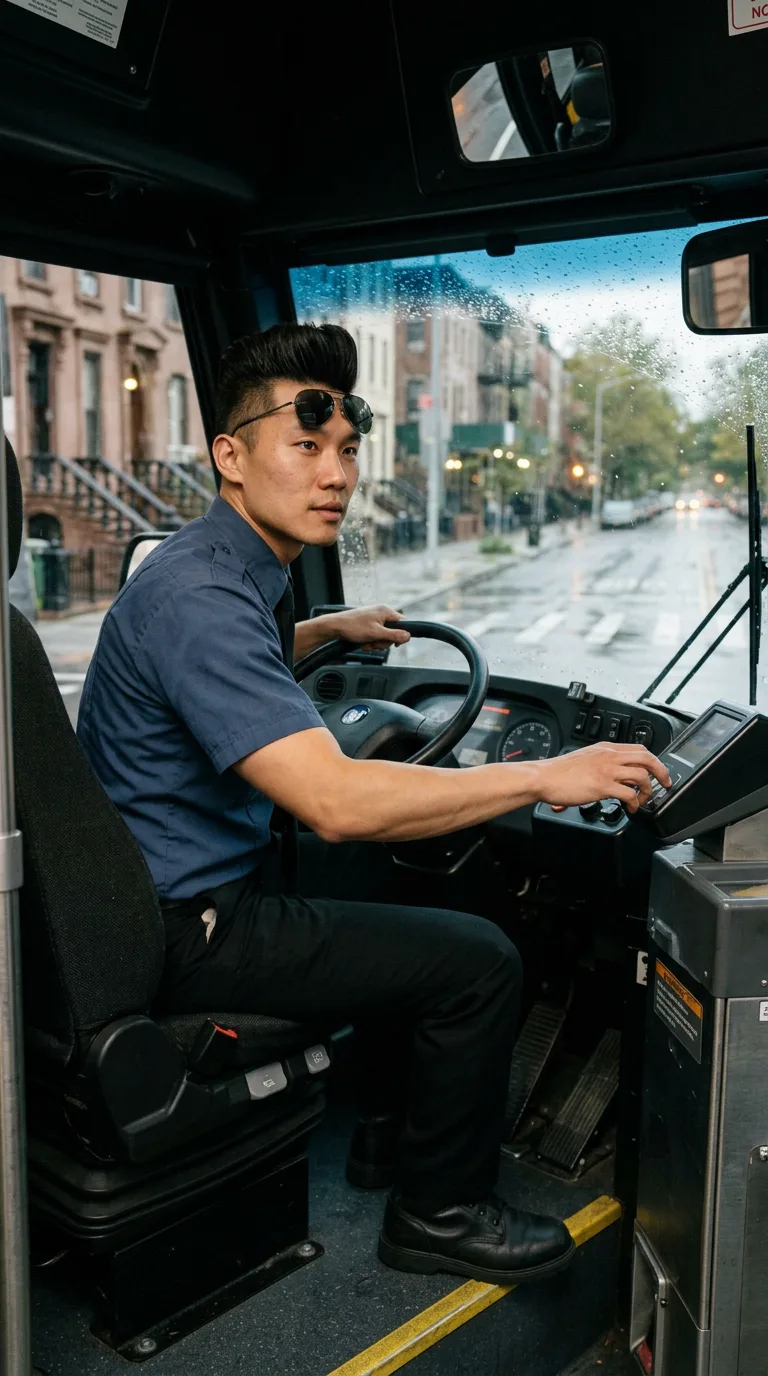
Rarest thing about him: A tic — a hard blink, a throat clear — epic, 1 in 152
Season 0seed 2117334633 · engine v10
Character card
lineage EN1F2L
His body-swap story
@justin.moy, wearing Brian Nolletti, rolled the wheel on and woke up as Justin Moy, spent 3 minutes in him, then spun the wheel and woke up as Marcus Deveraux Whitlock
You have been Brian Nolletti for one hundred and twenty seconds and already you know you made a mistake.
It's the hands. That's what does it. You're standing at a med cart on a bright ward at eleven in the morning, and these hands — pale, blunt-nailed, a nurse's hands, capable of starting an IV in a rolling vein on the first try, hands that have held dying strangers and meant it — pick up a little paper cup of pills and you feel, with total clarity, that you cannot do this for one more hour, let alone a life. Not the work. The knowing. Nolletti knows everything, feels the weight of every one of these people, and the wheel dropped you into that fully loaded, and it turns out competence you didn't earn is its own kind of unbearable. Two minutes of being needed by people whose charts you've never read. You set the cup down like it's hot. Somewhere behind Nolletti's blue eyes you are already gone, already reaching for the site with a mind that isn't quite entirely your own yet — one thumb, one thought: *not this one.* You don't even clock out. You just spin.
—
The wheel gives you weight first — less of it than Nolletti's, packed differently, low and coiled — and a wheel that isn't a metaphor: an actual one, rubber-wrapped, vibrating faintly under your palm through a half-turn you didn't start. Your hand is already moving to correct something. Fingers walk back a knob on a dash you've never touched and nudge it again, slower, right. The bus doesn't swerve. Nobody screams. Rain needles a windshield in front of you, wipers ticking, brownstones sliding by wet and orange under sodium light that shouldn't exist at this hour where you came from, and doesn't, quite — his hour and yours don't match, and something in you notes that the way you'd note weather.
There are sunglasses pushed up into hair that stands a foot off his forehead, stiff with product, and you feel the particular vanity of that hair before you feel anything else, which tells you something about him already.
—
The shirt is the first door. Short sleeves, top button open at the collar because the tie he still has to knot is looped loose around his neck — and it comes back sleeve by sleeve, this morning, his morning, six-fifteen and dark, an apartment with a mattress on a frame and not much else, the smell of the last cigarette of the night before still in the fabric of the couch. He'd stood in front of a mirror that was too small for him and built the pompadour with his fingers, patient, the one act of care in the whole routine, and thought about nothing, which was the point. He'd quit drinking two years ago without telling anyone it was a quitting, just stopped buying it, the way you stop calling someone. The pack of cigarettes in his shirt pocket presses now against your — his — chest, half gone already, and you feel the want for one arrive out of nowhere, ambient, low, always there under everything he does.
The wheel under your palms is the deepest door. Ten years of it, maybe more — the memory doesn't come dated, it comes as knowledge, the specific give of this particular bus's power steering, the blind spot by the mirror that swallows cyclists if you don't lean, the stop before this one and the one after and the ache low in the back that comes at hour six of a shift and is already, right now, four hours in. His body is twenty-eight and treats itself like it's got nothing better to spend itself on — a build kept up not out of vanity but because there is nothing else to do with the time between shifts, a gym with a monthly fee he resents and pays anyway.
A throat clear comes up out of him unbidden, a tic, and behind it, unwilled, a woman's laugh — an ex, no name attached at first, just the laugh, and then her name arriving the way names do, late, second — and a whole stretch of a year comes with her, an apartment they'd shared two trains from here, her leaving her toothbrush the first week like a flag planted, the fights that were never about what they were about, the last one that was. He does not carry a photo of her. He doesn't carry anything he'd bring up if you asked him straight. But his hand, when you flex it on the wheel, remembers the shape of her hand in it anyway, and that's worse than a photograph, somehow, because there's nowhere to put it down.
The route comes next, unbidden the way the tic is: this stop, that light, the woman two blocks back who always has exact change and never says thank you, the ten thousand small unregistered kindnesses and rudenesses of a job that nobody clocks as a life's work but that has quietly become the entire shape of his days. He likes the early ones best, before the city's awake enough to be annoying at him. He has never once, in all these mornings, thought of it as beneath him. He has thought of it as his.
—
You look down at the hand on the wheel — his hand, wide-knuckled, a callus riding the base of each finger from a grip held ten thousand times — and you turn it over slow, palm up, like you could read something there that would tell you how long you're planning on staying.
You don't know. That's the truth of it, sitting under your tongue where his tic wants to go instead — a hard blink first, then the words.
"Guess I'm driving," you say, out loud, to the wet street, to no one, and you don't know if you mean today or every day after it, and neither does he, because he isn't in there to ask anymore.