Marcus Delvard
Fictional. Generated by AI — not a real person, and no likeness of one is intended.
55, janitor in Boston · rolled by @colin.hasbrook · card — no film
History
who has worn him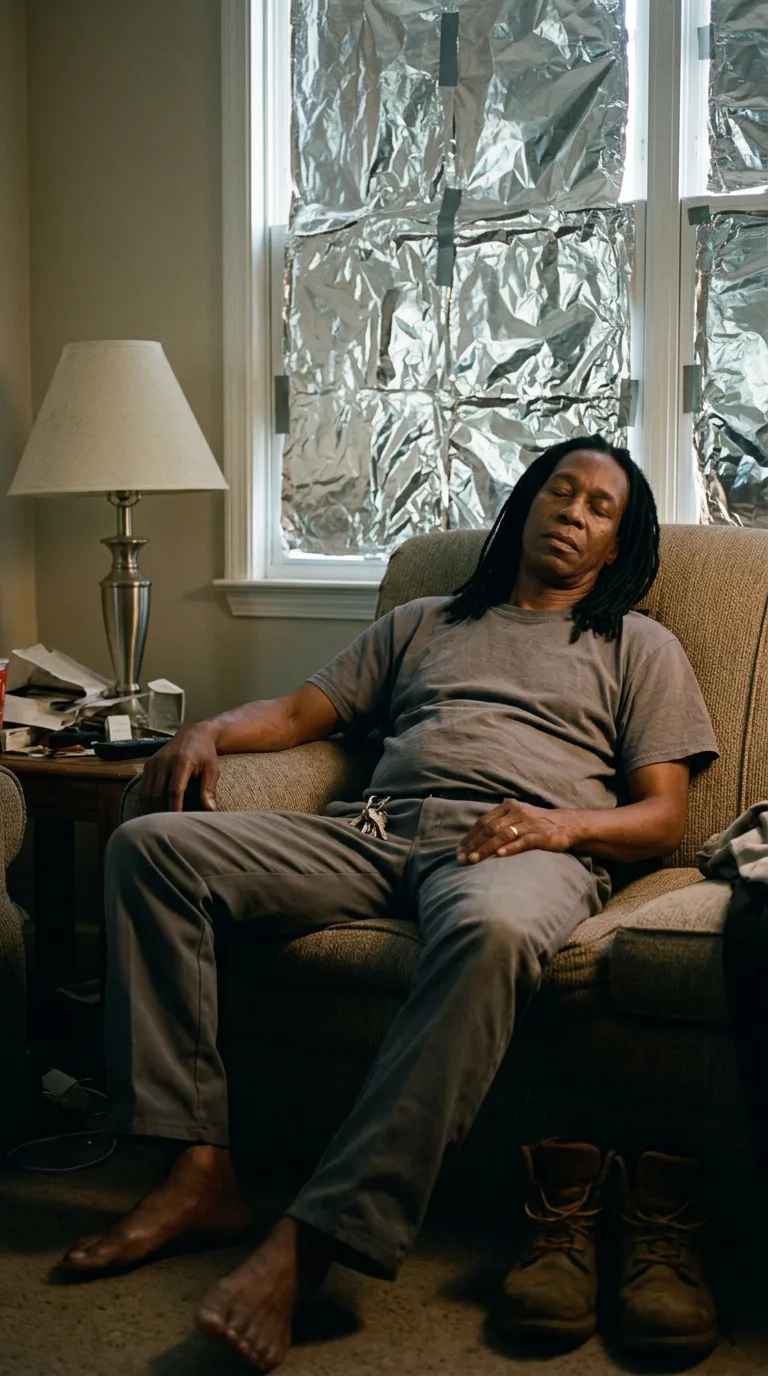
Rarest thing about him: Dyed black — epic, 1 in 57
Season 0seed 1508669448 · engine v10
Character card
lineage 2NZHHJ
His body-swap story
@colin.hasbrook, wearing Ronald Aldape, rolled the wheel on and woke up as Marcus Delvard, spent under a minute in him, then spun the wheel and woke up as Danilo Restrepo
The flower shop smells like refrigeration and cut stems, and Ronald Aldape's knees ache the same way they have all week, and that is the whole reason. Not pain exactly — familiarity. Six hundred and something days in this body and you know every one of its complaints by name: the left knee, the lower back when he bends to the cooler, the way his breath goes short climbing to the register. You paid the light bill in this body. You learned the regulars' names. You did not choose any of that, it simply accrued, the way it always does, and tonight, alone in the shop after close, sweeping petals that aren't yours off a floor that isn't yours, something in you goes quiet and flat and finished, and you know the feeling. It has a number. Four hundred and twenty-nine.
You don't decide so much as arrive at the laptop already knowing. The wheel spins on the screen, gray light on Ronald Aldape's gray-stubbled face reflected in it, and it lands.
Foil light. A hard white bar of it lying across a face that is not the face you had a second ago, and the body under you rolls toward it, some old animal instinct, and then rolls back into the glare on purpose and the eyes open into it and hold, unblinking, and they are brown and they are his.
You are sitting low in a chair that has taken his shape over years — you can feel that, the give of the cushion knowing him better than it will ever know you. There are keys against your hip, a ring of them, warm from a pocket. Boots on the floor, empty, standing where he stepped out of them. And a wedding band on your left hand, and that is the first door.
*Denise.* The name comes up out of the gold band itself, unbidden, a woman laughing at something in a kitchen that smells like Sunday, twenty-some years of Sundays folded into one smell. You didn't ask for her. She's just there, the way the shirt against your back is already telling you about six a.m., pulling it over his head in the dark so he wouldn't wake her, the two of you a courtesy to each other after this many years of shift work eating the middle of the night. He loves her in a way that isn't loud about it. Two kids, grown now, a boy in Providence who calls on Sundays and a girl who doesn't call enough and he doesn't hold it against her, not really, not out loud.
The keys tell you about the school — a ring of maybe thirty of them, each one a door he knows by feel in the dark, the gym, the boiler room, Ms. Alvarez's classroom where the radiator ticks all winter. Thirty-one years of that building. He started at twenty-four with a broken nose from a fight he doesn't like to talk about — you get that flash sideways, a bar in Dorchester, a night that went wrong fast, and then the memory shuts itself like a door he closed on purpose — and by the time they moved him to nights, his own choice, the quiet suited something in him that daylight never did. Empty hallways. His radio low. The particular satisfaction of a floor buffed to a shine nobody but him will ever appreciate at that hour, and that not mattering to him at all.
Your scalp is warm under your palm before you even notice your hand has gone there, an old unconscious habit, dragging flat over the locs at the crown the way he's done ten thousand times without deciding to. Somewhere in that gesture is a barber's chair from thirty years ago, a mother's hands before that, and a body underneath it all that is fifty-five and knows it — soft where it used to be hard, strong still in the forearms and the low back from twenty-thousand pushed mops, a wheeze that isn't sickness so much as a machine at the CPAP's mercy most nights, though not tonight, not this once, and that's why the sleep is this heavy, this strange, foil taped to keep the day out so his body can pretend it's the dark it's owed.
The trousers still on him, work-gray, a little tight now at a waist that wasn't always this waist — and there, fainter, a whole life of it: church on Sundays growing up, his mother's voice, a faith he doesn't perform much anymore but still carries low in his chest like a pilot light. A drink now and then with the crew from the building, never more than that, never the cigarettes the other men had, he never saw the use in it. All of it arriving through his own hands, his own clothes, nothing of it asked for and none of it yours until right now.
You open your eyes.
The lamp is on beside the chair, the foil throwing its hard flat light, and your left hand is up in front of your face before you mean to lift it, turning slow, the ring catching what light there is.
"Denise?" you say, to the empty room, in his voice, and it comes out rough with a sleep that was never really yours to wake from — and underneath the word is the other question, the one with no clock on it, the one that doesn't care whose mouth is asking: how long is this one going to hold you.