Danilo Restrepo
Fictional. Generated by AI — not a real person, and no likeness of one is intended.
40, tailor in Small-town Ohio · rolled by @colin.hasbrook · card — no film
History
who has worn him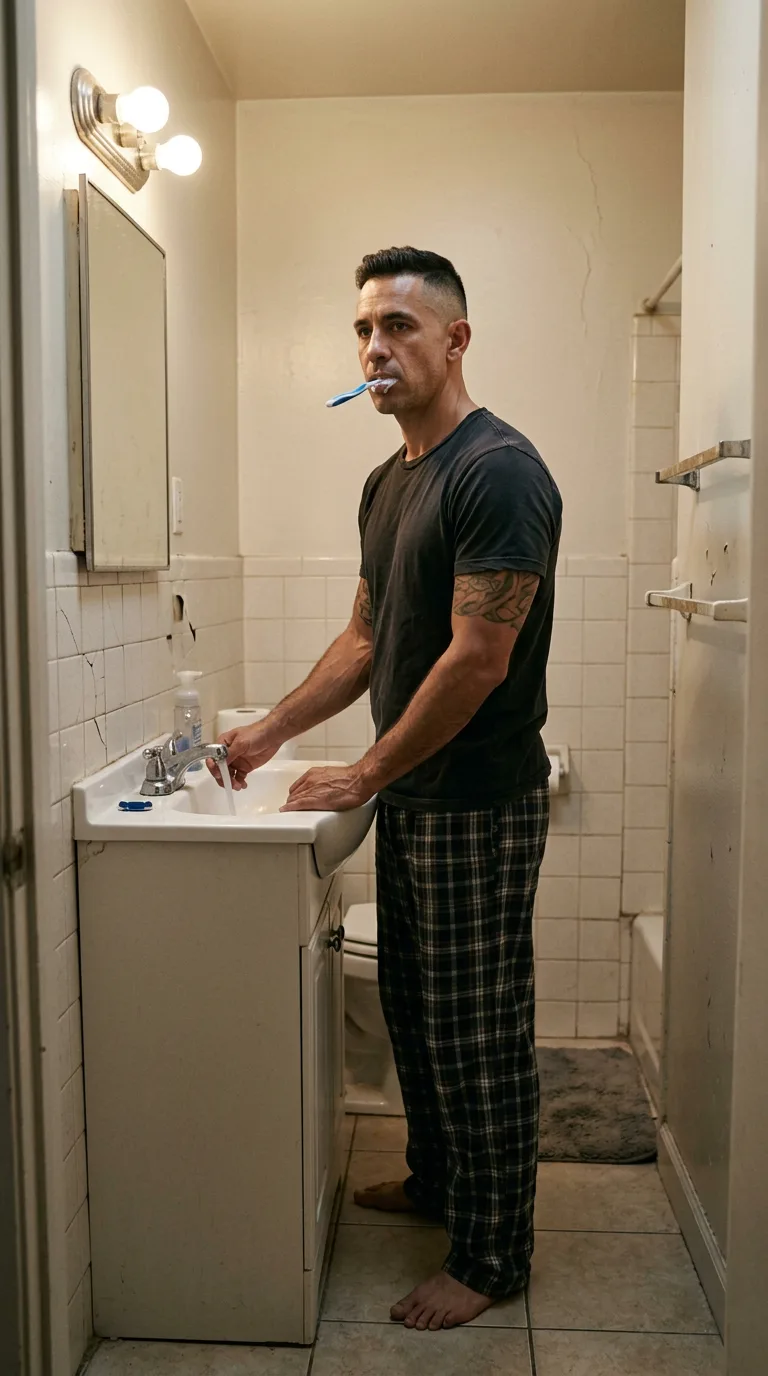
Rarest thing about him: Vapes daily — rare, 1 in 28
Season 0seed 571704056 · engine v10
Character card
lineage 2NZHHJ
His body-swap story
@colin.hasbrook, wearing Marcus Delvard, rolled the wheel on and woke up as Danilo Restrepo, spent under a minute in him, then spun the wheel and woke up as Marcus Duvall
The mop is still where Marcus left it, leaning against the bucket in the third-floor stairwell of a building that will never be finished being cleaned. You put him down there on purpose. Fifty-five years old, that nose that never healed right, the ache in his knees on the cold nights, the smell of bleach that never leaves his hands no matter how long the shift's been over. You spun into him three weeks ago — his time, not yours, time doesn't run the same for you — and it was fine. It was always fine. But tonight the mop bucket tipped and you had to reach into filthy water up to the wrist for a rag, and something in you said *no, not this one, not tonight,* and that was reason enough. There's no drama in it. You've stopped needing drama around spin four hundred. You just wanted to not be him anymore, for about the length of a held breath, and the wheel doesn't ask you to explain more than that.
You are standing at a bathroom sink. The tap is running. There is foam on a lip that is not your lip yet, a molar being worked on the left side, slow, and the water sound is very loud and very close. The toothbrush is blue and white and cheap and it is between your teeth without your having put it there. You rinse it. You rinse twice, out of a habit that isn't yours yet either, and you stand it up bristles-first in a glass that has held a toothbrush the exact same way for eleven years, though you don't know that number yet — you will.
The shirt comes first, because it's what's closest, an undershirt worn thin at the shoulders where a tape measure sits every day of his working life, and touching the collar of it gives you a morning: him standing in front of a mirror above a cutting table, buttoning a white shirt with the cuffs already rolled before the sleeves are even down, because his father taught him you roll them once and never twice, you don't want the crease showing when a client's eyes go to your forearms while you're pinning their inseam. The vest is not on him now — it's on a hanger somewhere behind this moment, navy, chalk-marked at the pocket, and just the thought of it gives you the weight of pins in the little pocket over the heart, the specific danger of leaning wrong and finding one with your ribs, laughing once, short, dry — *goddammit* — no one else in the shop to hear it.
The trousers are plaid flannel now, soft with age, and they bring back a woman's hand smoothing this exact waistband down over a stomach gone a little soft in the last two years, saying *you sleep in these every night, you know that,* and him saying *they're comfortable,* and her saying *that's what men say about everything they won't throw out.* Her name comes slow, in pieces, the way memory does when it isn't yours: Priya. Not the ex. The one now. The one who laughs at him for keeping his work shears sharper than anything in the kitchen. There were two daughters somewhere in another year of this life, small, sticky-handed, sitting on the shop floor with fabric scraps while he worked a hem, and a woman before Priya — younger, laughing harder, gone now to a city he never followed her to, and there is a whole unlived version of him that ended up somewhere else, with her, that he still touches sometimes the way you touch a scar that isn't there.
Your knees don't ache the way Marcus's did. This body is forty and strong through the shoulders from years of standing at a table, cutting, pressing, holding cloth taut against a dummy's chest for hours at a stretch. There's a permanent looseness in the right wrist, tendon worn soft from scissors, and a tightness behind the sternum that isn't pain yet, just pressure, blood pushing too hard against walls too old to argue — high numbers on a cuff he keeps meaning to mention to a doctor and doesn't. Your knuckles want to crack. You let them.
The tile under your — under *his* — feet is cold and cracked at the grout, this is not a rich man's bathroom, this is a man who is scraping, who does careful work for people who barely tip him, who vapes on the back step so the shop doesn't smell like smoke, who drinks more than Priya likes and never in front of the girls, who goes to Mass some Sundays out of something between guilt and habit and finds, once he's kneeling, that some of it's real.
You look down. The hands are not yours — dark-knuckled, a faint white scar-shine of old pinpricks across two fingertips, a life of small precise violence written into them. You turn one over slowly, like checking a stranger's ID.
You look up into the mirror, into eyes that are his and aren't, and you say, quiet, almost gentle, testing the new voice in an old bathroom at an hour that isn't yours yet either —
"Okay. Let's see what you've got."