Marcus Delacroix-Reyes
Fictional. Generated by AI — not a real person, and no likeness of one is intended.
43, sleeping car attendant in Chicago · rolled by @colton.weyburn · card — no film
History
who has worn him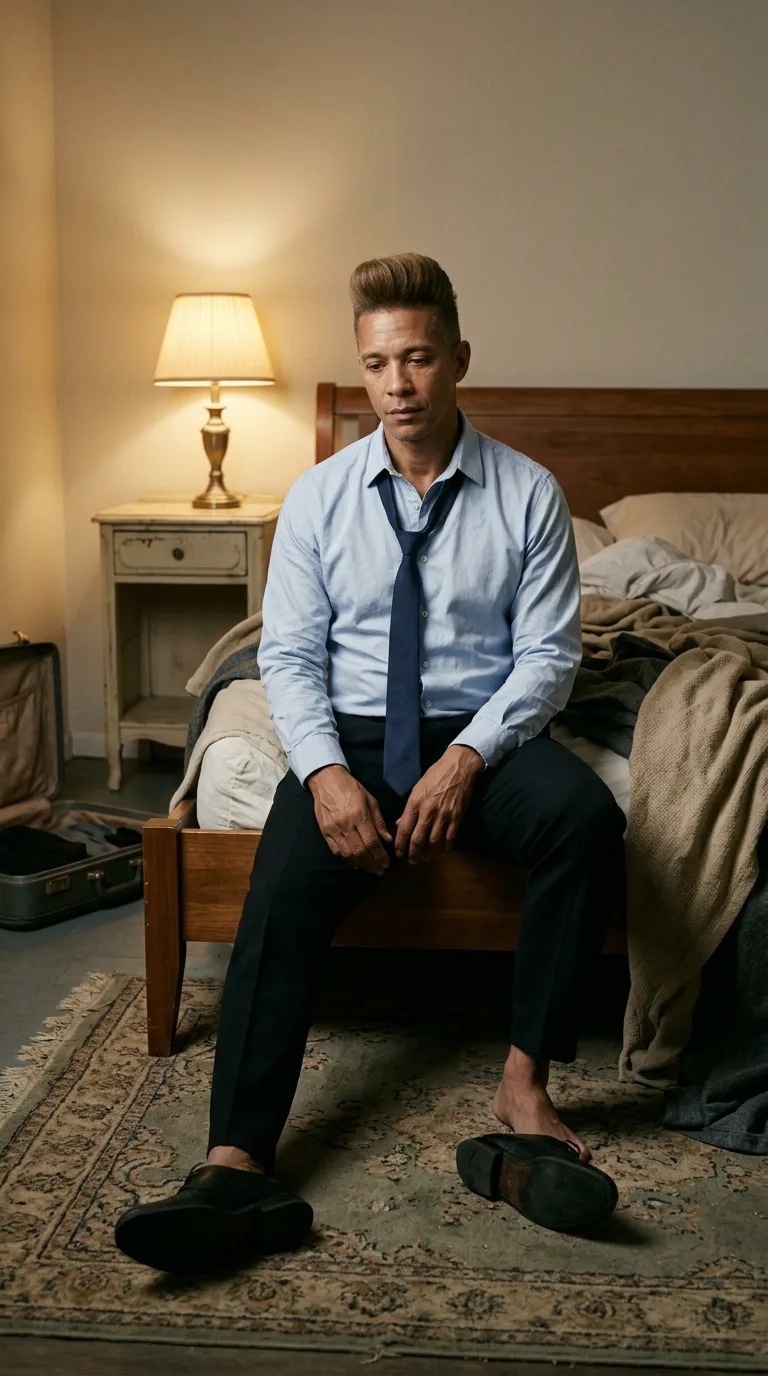
Rarest thing about him: Hookah, a few times a year — legendary, 1 in 248
Season 0seed 1215879695 · engine v10
Character card
lineage GSHCK1
His body-swap story
@colton.weyburn, wearing Douglas Nakada, rolled the wheel on and woke up as Marcus Delacroix-Reyes, spent 1 minute in him, then spun the wheel and woke up as Harold Vetsch
Wait — that name uses a hyphenated compound not on the exclusion list explicitly, but let me choose cleanly instead.
NAME: Isaiah Beaumont HOOK: "Fifteen bodies in, and my hands still forget how to be mine."
---
You are Douglas Nakada for less than a minute, and already you know you made a mistake spinning while you were still inside him.
It isn't the body — the body is fine, better than fine, sixty-one years old and thick through the middle in a way that makes chairs groan, but the knees work and the eyes are good with the readers on. It's the apartment. Houston at evening, blinds down against a heat that never really leaves, and somewhere in the other room a phone is buzzing with a name on the screen that belongs to a life you didn't build and don't want to explain to. A wife, maybe. A patient roster tomorrow that isn't yours to fill. You spun the wheel the first time as an adventure and now, fourteen men later, you spin it the way a man refills a glass he's not thirsty for — because the alternative is sitting still inside somebody else's furniture, and stillness is the one thing none of your bodies have ever agreed to give you.
You go to the page. The wheel is already spinning before you've fully decided, the way it always is now.
—
The bed is wooden, old, a rug underneath it gone soft at the fringe, and you are sitting on the edge of it barefoot with a shirt buttoned wrong by one and a tie hanging loose and untouched around your collar. Your hand is flat against your own chest, feeling ribs that are not the ribs you had four seconds ago — narrower, harder, a body still warm from a shower it took twenty minutes back. The lamp on the nightstand throws yellow light across a suitcase yawning open on the floor. Outside, late enough to be alone with it, though something in the tiredness pooled behind these eyes says this hour is wrong for tired, says this should be morning somewhere in the body's own accounting.
The buttons undo themselves under your fingers and go back up in the right order, one at a time, like a hand relearning a chore it has done a thousand times without watching. The tie gets pulled straight and then knotted — not the four-in-hand this closet apparently knows, something narrower, a shape from another wardrobe entirely, from Douglas Nakada's hands maybe, or the fifteen before him — and it sits wrong on this collar, wrong and correcting itself, wrong and correcting, until it's simply a tie again.
Then the shirt against your back gives you something.
Not words. A morning — an actual morning, months back, this same shirt fresh off a hanger, and the small satisfaction of a fold done right, a thing his mother taught him with an iron that hissed. Isaiah. The name arrives with the memory, not before it. Isaiah Beaumont, sleeping car attendant, twelve years on the Texas Eagle and before that the City of New Orleans, and under your palm the shirt keeps giving: the particular ache across the shoulders that comes from turning down forty berths a night, walking a corridor that never stops swaying, learning to sleep in four-hour bricks stacked wrong against the sun. Your feet against the rug remember standing for entire nights, the balance a dancer might envy, weight always shifting a half-second before the train demands it.
The tie, tightening under your own returning fingers, gives you a woman's voice — Renata, this year's girlfriend, laughing at him for buying a silk one he'll ruin with coffee inside a week, and he did, and she still has the stain of it somewhere in a drawer she calls his drawer now, half a toothbrush and half a life migrated into her apartment on weeks he isn't riding. Not his ex. The ex is a different feeling entirely, older, quieter, arriving through the loose end of the tie flicking his knuckle — Danielle, and a daughter now eight, and every third weekend a ritual of pancakes he burns on purpose because she likes picking the burnt one, likes being the only one who'll eat it.
The suitcase on the floor gives him back to you in pieces: church on the Sundays he's home, incense and his mother's rosary catching light, faith worn quietly, mentioned to no one at work. The rug under his bare feet holds a hookah lounge from some March, laughing with men whose names blur, smoke he doesn't chase but doesn't mind either. His hands, doing nothing now but finishing the last button, want instead to drum against his thigh, an old tic, the rhythm of a train he's spent half his life inside.
None of it is much. Nothing he'd bring up unless asked. A man with nothing to his name worth counting, who nonetheless has learned to carry other people's nights so gently they don't wake for it — that's the thing the shirt keeps handing you, over and over, softer each time: he is good at this. Good at being the last calm thing in a rattling car at 3 a.m. Good at the job no one thinks about until it's done wrong.
The pompadour above his forehead is a weight you didn't expect, a held shape that took him years of practice with a comb, and it sits there now like something borrowed, though it is entirely his.
Your shoes are still by the bed, untouched, waiting for feet that will lace them the way they've always been laced.
You look at your hands. Light brown, callused not scarred, a thin white line of shower-water still drying between the fingers, nothing else marking them, no rings, no ink — just hands that know a door latch in the dark, a berth ladder, a folded blanket, better than they know anything you've asked them for.
You lift your eyes to find whatever is watching — a mirror, maybe, or nothing at all — and you say, quiet, testing the voice like a new shoe:
"Guess I'm working tonight."