Marcus Alvarado
Fictional. Generated by AI — not a real person, and no likeness of one is intended.
42, warehouse picker in Houston · rolled by @connor.waskiewicz · card — no film
History
who has worn him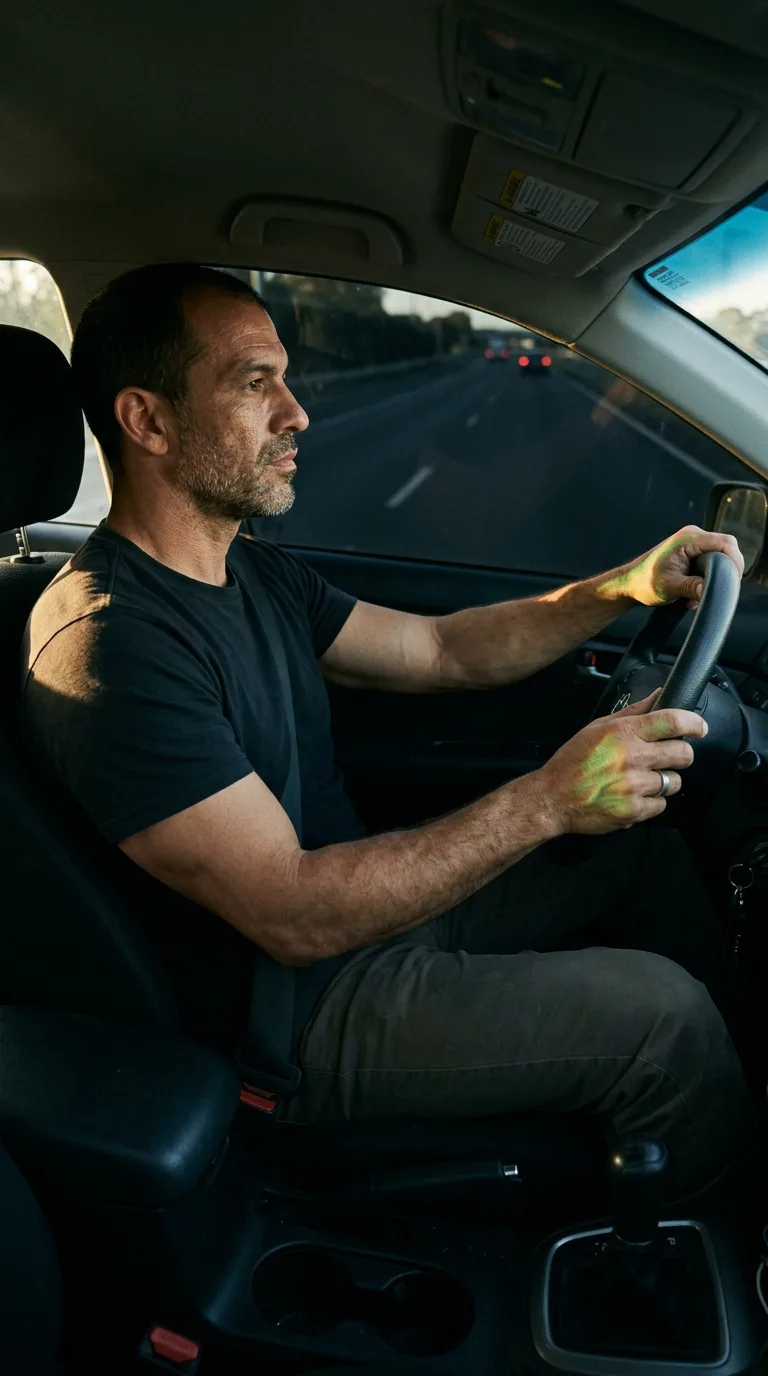
Rarest thing about him: 6'5" — rare, 1 in 229
Season 1seed 312718794 · engine v11
Character card
lineage 2NZHHJ
His body-swap story
@connor.waskiewicz, wearing Raymond Acosta, rolled the wheel on and woke up as Marcus Alvarado, spent under a minute in him, then spun the wheel and woke up as Terrell Washburn
—
The pole is forty feet up and Raymond Acosta's shoulder has started to sing that high thin note it sings now, the one it didn't sing at thirty, and you are sixty-one years old in a body that has given forty years to bucket trucks and cherry pickers and does not want to give any more tonight. Wednesday, end of shift, Boston going gray and close around you. You clipped in ten minutes ago and something in the left hand went to sleep like a switch thrown, and you sat there on the strap thinking: not tired. Not sore. Wrong. Held it out in front of your face like a stranger's. Watched the fingers not quite listen. Less than a minute in him this time and already the meter is running down, and you have had sixty-one years of your own before this one and you know what a body sounds like when it is starting to close a door on you. So: down the pole, into the truck, phone out, thumb on the bookmark you never delete. Not fear exactly. An accountant's instinct. Cut your losses while the hand can still hold the wheel.
You spin.
—
The seatbelt is tight across a chest wider than the one you left, and your hands — his hands, huge, a laborer's hands — are not where they were a half-second ago. They were at ten and two. Now they have dropped and spread, low and wide on the wheel like a man settling into a couch, and the blinker is ticking for an exit nobody who lives at the end of this road would ever take. Outside the windshield the light is all wrong for evening — Houston in full yellow afternoon, sun still high enough to lay a bar of it across the backs of these new knuckles, though something in the marrow of you still expects Boston's dusk. A dash vent breathes warm plastic-smelling air against your shin. The wedding band on the left hand catches the light and throws it.
Three miles from a house you have never seen.
—
The wheel is the first thing that speaks. Not words — grip. The heel of the right palm knows exactly where the worn spot is on the rim, the place where the vinyl's gone shiny and thin, and the knowledge arrives with it like a photograph developing: fourteen years of commutes on 610, fourteen years of one thumb worrying that same spot at red lights. Then the seatbelt against the collarbone, and a whole year comes with it — the year the check-engine light stayed on for four months because there wasn't four hundred dollars that wasn't already somewhere else.
The shirt is next, cotton gone soft at the collar, and it gives you this morning whole: him standing in a bedroom with the blinds still down, pulling the navy polo over his head one-handed while the other hand held a mug, because Denise was still asleep and the light switch was loud. Undershirt first, day-old, he'd told himself he'd do a wash and hadn't. The polo went on inside-out once, he laughed once at himself, alone, quietly, so as not to wake her, and turned it right. He is a man who is tender about noise in the morning. That comes through clean, unmistakably his and not yours — a small private fact nobody else in the world has, that his wife sleeps like something easily startled and he has spent years being careful about it.
The vest is folded on the back seat, orange gone gray-brown with warehouse dust, and touching it with the mind that is now half yours gives you the aisle: eleven, twelve hours a shift, a scanner gun heavy on the wrist strap, the forklift's beeping somewhere behind a rack that never once, in three years, stopped meaning get out of the way. His body knows things without asking — how to drop a case off a shoulder in one motion so the knees take it and not the back, how far a pallet jack's tongue reaches before you have to walk instead of ride it. Nothing hurts exactly. Everything is used. Forty-two years old and the strength in the arms is the good, earned kind, the kind that comes from carrying other people's things eight hours a day for money that never once felt like enough of it — no debts exactly, nothing owed anywhere, but nothing put by either. Under five thousand dollars in the whole world and he has never once let himself think about that number directly.
The gearshift under the right hand gives you Denise — not a memory so much as a temperature, warm and constant, fifteen years of her, no kids and some old grief folded into that fact that you only get the edge of, quickly, like a door not quite shut. And under that, older, further back, an ex-girlfriend's name arriving with the smell of the car's upholstery for reasons his own heart couldn't explain to you even if it were still his to explain — Christine, a name that still has weather in it, faint, a long time gone, a door he does not open on purpose and that the wheel's key has turned anyway.
The scalp under the ballcap — you feel him reach up, out of habit, out of nothing, run a palm over the thinning crown the way he must do forty times a day without deciding to, the gesture of a man checking a fact he's already made peace with. Catholic in the marrow of him too, a rosary somewhere in a glovebox you haven't opened yet, a stubbed pack of cigarettes in the cupholder that gives you, on contact, the whole ugly familiar comfort of a habit he quit drinking to make room for and never managed to quit twice.
None of it is much. That is its own kind of true thing. A marriage, a job, a body that works hard and asks little back, a wanting for nothing you can name — and you are standing in the middle of it, three miles short of a driveway, with a turn signal ticking for an exit that belongs to no one.
—
You cut the blinker. Bring both hands back up to ten and two, and look down at them on the wheel — his hands, scarred faint white across two knuckles from a warehouse mishap you didn't get the memory of, the wedding band catching the sun again.
"There you are," you say, out loud, to no one, to the windshield, to whatever was three miles from home.
Somewhere behind these eyes, sixty-one years of Raymond Acosta are already going thin, already becoming a story you'll tell yourself about a numb hand on a pole. You do not know how long Marcus Alvarado gets. You never do.