Marco Villalobos
Fictional. Generated by AI — not a real person, and no likeness of one is intended.
31, janitor in Houston · rolled by @colin.hasbrook · card — no film
History
who has worn him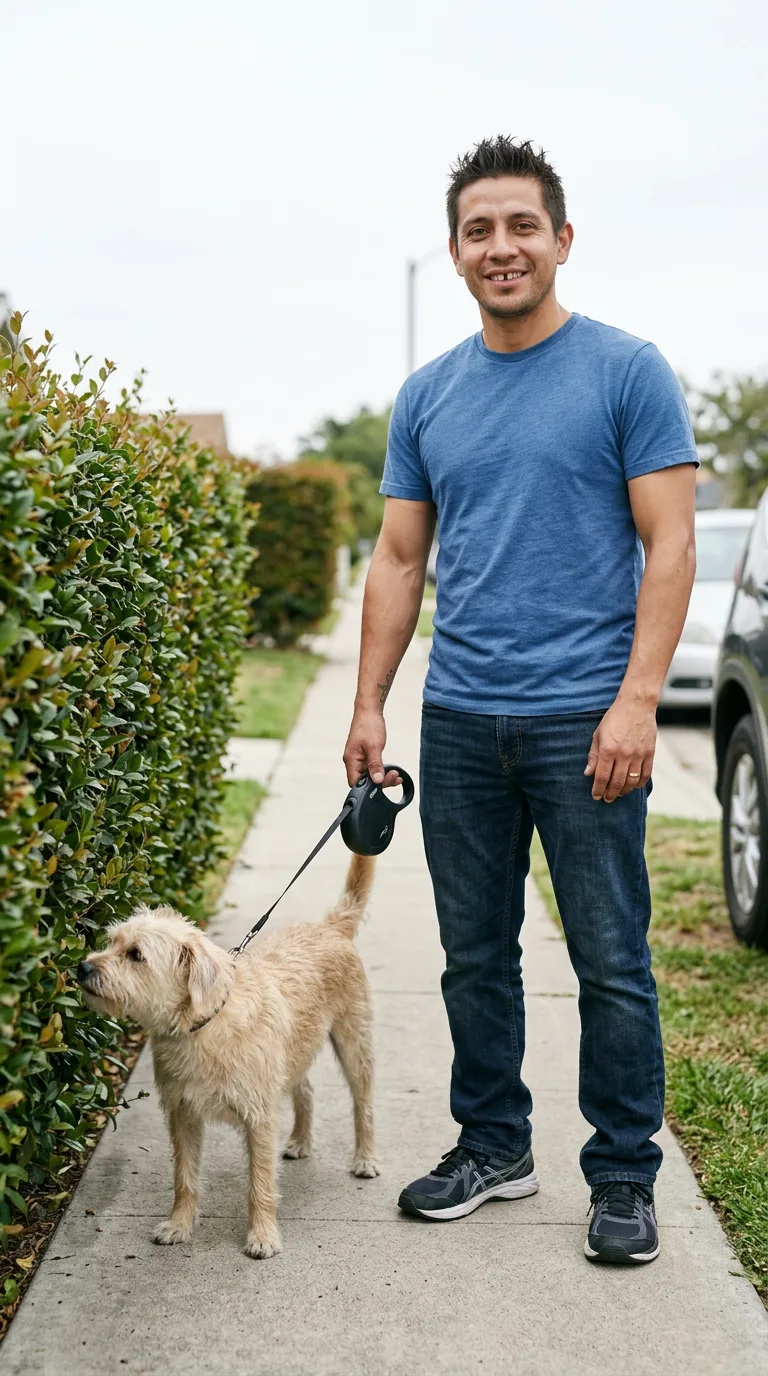
Rarest thing about him: A gap between the front teeth — rare, 1 in 24
Season 0seed 1842588965 · engine v10
Character card
lineage 2NZHHJ
His body-swap story
@colin.hasbrook, wearing Danny Reséndez, rolled the wheel on and woke up as Marco Villalobos, spent 30 minutes in him, then spun the wheel and woke up as Aaron Kessner
---
Fourteen minutes is nothing. Fourteen minutes is barely enough to learn a body's weight, and already you know this one is wrong for you: Danny Reséndez, twenty-one, longshoreman, dimples like a kid's, forearms still humming with the ghost of cargo work he did this morning before you took him. You are standing in his apartment in Anchorage in the flat gray light of midday, and it is boring in a way that has nothing to do with the light. Some bodies you want to keep a while. This one you slid into wrong-footed — too young, too eager, somebody else's dumb optimism sitting on your face like a mask that doesn't fit — and the phone in his pocket keeps buzzing with a name you don't care about. You didn't come back to the wheel for a reason you'd say out loud. You came back because the wanting came back, plain as that, the way it always does, faster this time. You open the laptop on his kitchen counter, the one with the tape over the camera, and you go to vessel.cards, and you spin.
The hedge is still trembling from the dog's nose when you arrive.
Your — his — hand has already stopped. The leash hangs slack in it, a little weight of black plastic and tension gone loose, and the dog looks up past the leaves with its ears back, like it heard something arrive that it cannot smell yet. You feel the sidewalk through a pair of work boots that are not the boots in the picture, sneakers actually, gray mesh, still warm from walking. You feel humidity sit on your skin like a second shirt. Houston air, thick as a held breath, and beneath it a body five inches shorter than the one you left, denser through the shoulders, weight sitting low and solid where Danny's had run long and loose. Your hand winds the leash twice without you telling it to — muscle first, mind second — and you start walking, and the dog has to trot to catch the new rhythm of you.
The wedding band is the first thing. You didn't even mean to notice it, but the fingers holding the leash handle keep finding it, an old motion, thumb dragging over metal, and it opens like a struck match: a church in the Heights, incense and candle wax, a woman in white lace her mother made over, laughing because the priest fumbled her name. *Elena.* The feeling underneath it isn't yours — it's steady, worn-smooth, the specific gravity of eleven years married, not romance anymore so much as architecture, something load-bearing. You didn't ask for this feeling and you get all of it anyway: three kids' worth of noise in a house that's never quiet, a minivan with a cracked visor, a fourth pregnancy scare last spring that turned out to be nothing and left them both quietly grateful and quietly ashamed of the relief.
The shirt against your back — not the gray janitor's shirt from the card, a soft blue tee, laundry-line smell, a little static still in it — gives you this morning. Or his morning; Houston's afternoon is Anchorage's midday, and you feel the seam of it, wrong in a way that doesn't smooth out: he should be at the school right now, running a mop bucket down a hallway that smells like pine cleaner and gym floor, but instead he's here, on a sidewalk, because today was his day off and he almost slept through it. You get his hands pulling this shirt over his head in a dim bedroom before six kids' worth of breakfast noise started, Elena still half-asleep, murmuring *walk him before it gets hot,* him laughing because in Houston it is never not hot. Sleeve, then sleeve, then the collar catching once on gelled spikes he fixed without a mirror by feel alone, the same three motions he's made ten thousand mornings running.
The dog's leash handle gives you almost nothing — a name, Bosco, rescued two years ago from a shelter that smelled like bleach, a compromise after the kids begged — but the ground under these sneakers gives you every version of this walk he's ever taken, an inventory of hedges and cracked slabs and the specific dog-sniffed geography of six blocks he could walk with his eyes closed. Your jaw remembers, without permission, a gap between two front teeth that his tongue finds at idle, an old habit older than the marriage, older than the job.
The job comes through nothing here — no mop, no keys on this walk — but it arrives anyway, riding shotgun on the quiet: empty corridors after the buses pull out, fluorescent hum, the particular loneliness of cleaning up after other people's children when your own are asleep at home, and beneath that a low current you recognize because you've felt its cousin in other men — treated, managed, not gone. A therapist twice a month. A prescription bottle in the medicine cabinet he doesn't hide but doesn't mention either. Something that gets quieter when Elena's hand finds his in the dark and louder on nights like the one that put him in that chair in the first place. You get the shape of it without the whole story, which is its own kind of mercy.
The dog tugs. The leash bites your palm. You look down.
Your hand — his hand — turns the ring once around the finger, an unconscious half-turn, thumb over gold, and you watch it do that like it belongs to somebody standing just behind you.
You lift your eyes off it, into the heat, into the hedge-lined street, and you say, out loud, to no one:
"Okay. Not yet."
The dog looks back at you, waiting to see which one of you is walking it home.