Danny Reséndez
Fictional. Generated by AI — not a real person, and no likeness of one is intended.
21, longshoreman in Anchorage · rolled by @colin.hasbrook · card — no film
History
who has worn him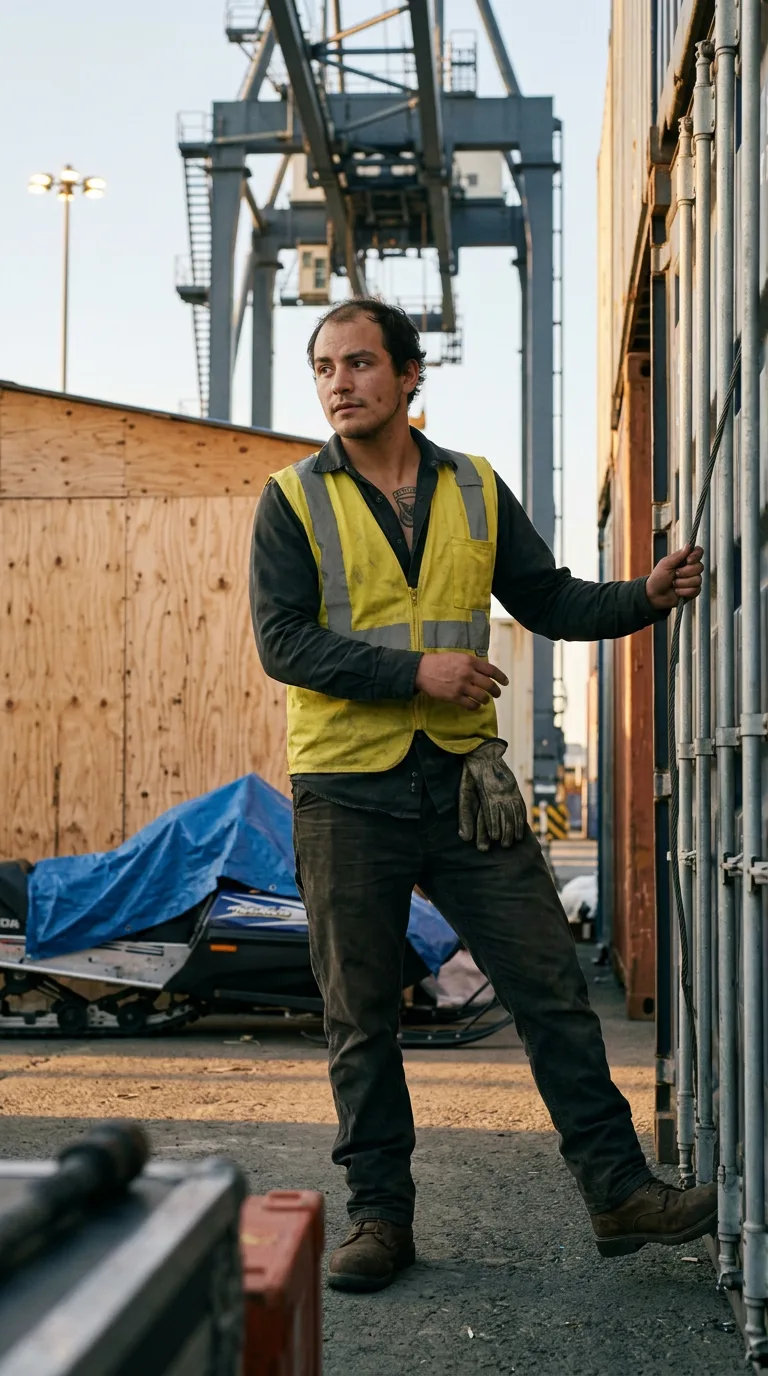
Rarest thing about him: A receding hairline — epic, 1 in 326
Season 0seed 1438128489 · engine v10
Character card
lineage 2NZHHJ
His body-swap story
@colin.hasbrook, wearing Samir Haddad, rolled the wheel on and woke up as Danny Reséndez, spent 14 minutes in him, then spun the wheel and woke up as Marco Villalobos
---
You are twelve minutes into being a nineteen-year-old rookie in Houston and it is already boring you to death.
The body is small and coiled tight, quick in a way you haven't felt in three hundred spins, cleft chin, shaved head still faintly stubbled, standing in the parking lot behind a strip mall with a radio clipped to your chest that hasn't said anything interesting since you arrived. Samir Haddad. You know his name because it came with him, the way names always do, sitting on top of the body like a label on a jar. You do not know him. You never do. Twelve minutes of his rookie nerves running through borrowed nerves, twelve minutes of his training officer talking about a call that turned out to be nothing, and underneath it, the itch. The old one. The one that has taken you through four hundred and sixty men and never once let you sit still in any of them.
You reach into the pocket of a uniform that isn't yours, past a phone that isn't yours, and you find the thing that is actually yours: the account, the wheel, the site that is always exactly as far away as your own hand. You do it standing there in the lot, sun flat and white on the asphalt, his partner saying something you don't answer. You do not decide to leave him so much as notice that you already have, the way you notice a door is open by the draft.
The wheel spins.
And two thousand miles northwest, in the middle of an Anchorage afternoon that is night for no one but the sun, chasing amber across a rail yard, a hand stops.
It is holding a shackle pin, and the motion halts a half-second into itself, the way a record skips — one motion done wrong, then again, slow, correct. Then the next ten, checked, each one, deliberate as a man doing a job for the first time instead of the ten-thousandth. Nobody around him notices. A gantry crane groans somewhere overhead. The light is doing something extraordinary to the containers, stacking gold on rust, and you are standing in boots you didn't lace, in a body a half-foot taller than the one you left, heavier through the shoulders, tired in the lower back in a way that isn't drama, just twenty-one years of a working spine.
You look down. Gloves, one hooked over your belt by the thumb, one on your hand, gray with grease and salt. A vest, yellow going dull with dirt, unzipped enough to show a line of dark ink at the collarbone — a shield, a number, wings, something regimental — and it gives you nothing yet, because you are not touching it, not really, it is just sitting against skin that used to be your skin.
Then your palm closes tighter around the steel cable you're holding to keep your footing on the uneven ground, and it comes.
*Danny.* That's what surfaces first, whole, like a name shouted from another room. Danny Reséndez, and with it the smell of diesel and cold salt water, and a version of this exact dock at four in the morning in January with frost on the containers and his breath going up in a column and the crane lights swinging red across the snow. He has done this job since he was eighteen, got in through his uncle, and it fit him the way almost nothing else had — his mind that would not sit in a classroom, that lost the thread of any sentence longer than six words, found something to hold onto out here: bodies of things, weights, angles, the cable in your hand right now, a decision he trusts more than he trusts most people. The gloves know how to do this without him. That's the phrase that comes with the memory, in his own voice, half proud of it.
The vest zipper is cold under your knuckles when your hand brushes it and you get another one — the locker room this morning, or what was this morning to him, fluorescent and echoing, him pulling this same vest over this same collar and catching the shirt underneath at an angle so the ink showed, an insignia that isn't his, exactly — his brother's unit, the one who didn't come back from it, and Danny wears it on his own skin because there wasn't another way he knew how to keep him. He didn't think about it while dressing. He thought about coffee. He thought, distantly, about a text he hadn't answered.
The phone. You feel its outline in the vest pocket without meaning to, and that's where the ex comes from — Marcus, three months gone, the kind of gone where the coffee mug is still in the cabinet and the texts still come sometimes at midnight not saying much, and Danny still looks at his name on the screen a half-second longer than he means to before he decides, every time, not to answer. There is a specific ache in that, small and stupid and completely alive, that has nothing to do with you and arrives anyway, sitting in the chest like something swallowed wrong.
Your boots are planted on gravel that has been rained on and frozen and rained on again, and standing on it you get flashes of nights out here with the guys, somebody's radio playing something terrible, a big night at a bar downtown once or twice a month where Danny laughs loud enough that the dimples that never go away go deeper, and everyone thinks he's fine, easy, uncomplicated, and mostly he is, except for the diagnosis he got at nineteen that explained ten years of report cards in one afternoon and the vape he pulls out sometimes just to have something for his hands to do that isn't a pen, isn't cable, isn't grief.
He clicks pens. You know that the way you know your own name, except it isn't your own name, it's a fact sitting loose in muscle memory, thumb already twitching for a pen that isn't there.
Twenty-five to seventy-five thousand dollars sits somewhere in an account he checks more than he'd admit, savings from years of double shifts in a town where the season is short and brutal and pays for it. He believes in something, not church, not really, more a sense that the northern lights mean something when they come and that his brother is somewhere that isn't nowhere. He has never said this to anyone.
The cable is rough under your palm, cold-bitten steel, and one more comes, small and complete: him at fourteen learning to snowmobile behind the house, the blue tarp that now sits folded over the machine parked just past the containers, his father's hands on his shoulders correcting his lean into a turn. The tarp is right there. You could walk to it. You don't.
You look at your hand instead — his hand, wide, a scar along one knuckle you didn't put there, grease worked so deep into the lines it will never fully wash, a glove hanging off the wrist by its thumb like it's been doing that for years — and you turn it over slowly, the way a man checks a hand he's not sure is broken.
The gantry crane's shadow crosses your boots. Somewhere behind you a supervisor calls something about the next container and you don't answer yet.
You lift your eyes off your palm and look straight into the light coming low off the water, and you say, quiet, mostly to yourself:
"Okay. Okay, let's go."