Marco Tapia
Fictional. Generated by AI — not a real person, and no likeness of one is intended.
30, refrigeration technician in Anchorage · rolled by @colin.hasbrook · card — no film
History
who has worn him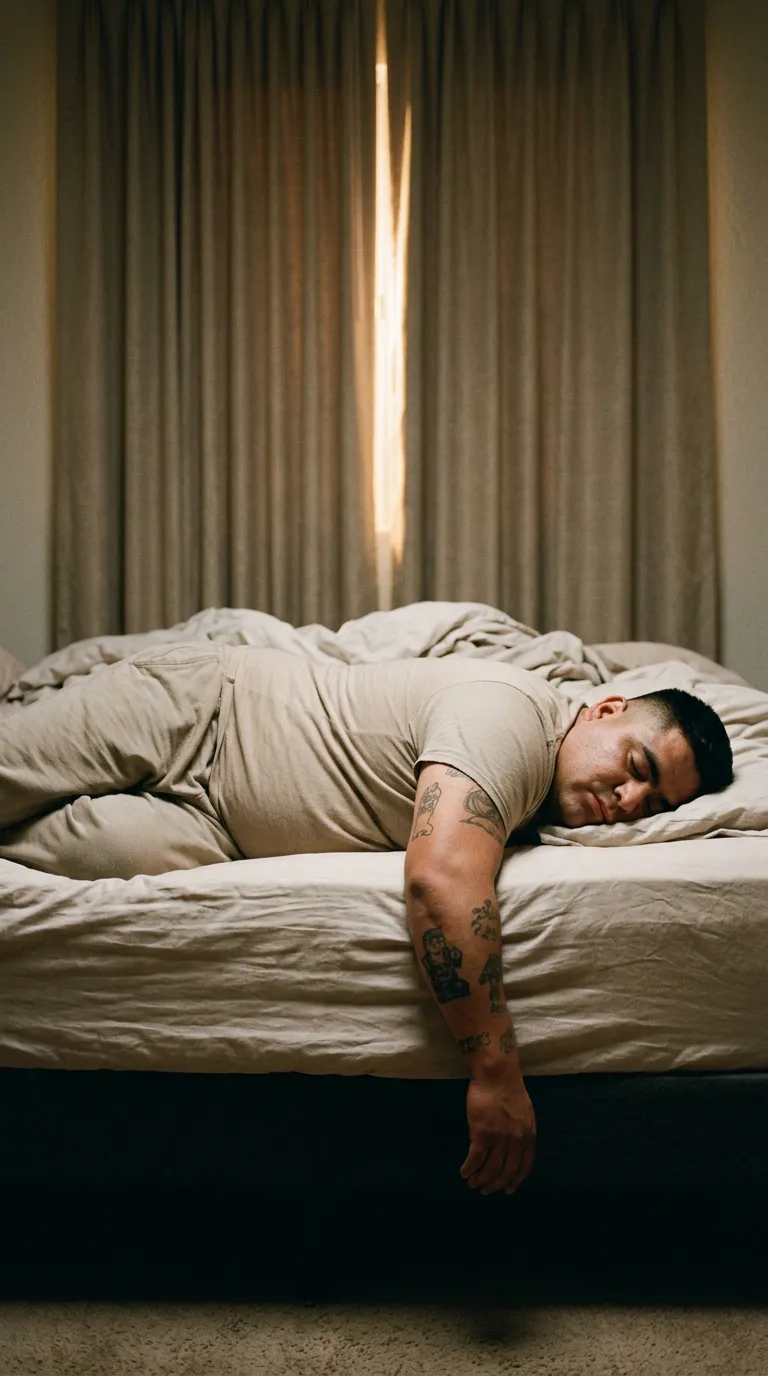
Rarest thing about him: A unibrow — rare, 1 in 48
Season 0seed 1697720360 · engine v10
Character card
lineage 2NZHHJ
His body-swap story
@colin.hasbrook, wearing Nick Sorrentino, rolled the wheel on and woke up as Marco Tapia, spent under a minute in him, then spun the wheel and woke up as Reginald Boykins
You are Nick Sorrentino for less than a minute before you stop wanting to be. That's the thing nobody tells you about a dad bod that isn't yours: you feel every year of it. The knee that clicks going down the gym stairs. The way his phone is full of texts from a woman named Steph asking if he's coming to dinner with her parents, and you have no idea who Steph is or why the thought of her parents makes this body's chest go tight. You're standing in the break room of the gym he works at, a protein shake going warm in his hand, and you think: this isn't boredom, exactly. It's that you can feel the whole rest of Nick's Monday lined up in front of you — the dinner, the small talk, the years — and none of it is yours, and none of it ever will be, and today that fact is louder than usual. So you set the shake down on the counter where he'll wonder later how it got there, and you take out your phone, and you go to vessel.cards, and you spin.
The cold hits first — not painful, just present, a wall of it against a back you don't have yet — and then the fog, thick and white, rolling out of a walk-in cooler with its door propped open, and you are crouched in front of a compressor unit with a wrench in your hand and your breath fogging in a way that has nothing to do with the walk-in at all. Your knees ache in a low, satisfied way, like they've been asked to do this a thousand times and don't mind once more. There's a radio somewhere playing norteño low under the compressor's hum. Your hand — thick-fingered, tattooed along the forearm, a couple of fresh grease smudges across the knuckles — turns the wrench another quarter turn out of pure habit before you even know why.
The unibrow is the first thing you register about your own face, oddly, before you've even seen a mirror — you just feel it, the weight of it, one continuous line of muscle over both eyes when you frown at the pressure gauge. Marco. The name arrives with the tool belt, the way his name always used to arrive with his father calling him in for dinner, tools still in his hands, don't come to the table dirty, mijo.
The wrench keeps talking. It gives you three years of Tuesdays exactly like this one — Marco loading the truck at five, driving under streetlights that don't quit until almost ten this far north, the particular satisfaction of fixing something instead of talking about it. It gives you the day he got hired, nervous in a polo shirt too tight in the shoulders, and the older tech who taught him to bleed a line telling him refrigeration's not a young man's game, it's a patient man's game, and Marco believing him.
The tattoo does something different. It's on his other forearm, half-hidden under a rolled sleeve, and touching it — just brushing his own sleeve back to check a gauge — brings back a night nine years gone, a shop three blocks from where he used to live before Anchorage, a design he picked off a wall in about four minutes because his friend was already in the chair and he didn't want to look scared. He has hated it steadily ever since, the way you hate a decision more than a picture, and every time his girlfriend runs a finger over it now she says nothing, which he has decided is its own kind of mercy.
The shirt against your back — a company polo, navy, faded at the collar — remembers this morning for you: him pulling it over his head in a dark bedroom, careful not to wake anyone, though there's no one in the bed to wake this shift, his girlfriend's at her own place tonight and his daughter is with her mother, the ex who still texts him about pickup times in a tone gone finally, mercifully flat after two rough years. He'd stood at the closet a long moment holding the shirt, thought about her — the ex — the way you think about weather, and then put it on and gone.
His lungs are the last thing to arrive, and they arrive as a small warning rather than a memory: a tightness at the bottom of each breath in the cold fog rolling off the open cooler, an inhaler somewhere in his jacket pocket that his hand already knows the shape of without looking. Asthma, mild, managed, mostly forgotten until a cold room reminds him. You breathe carefully. He always did.
You set the wrench down on the compressor housing. You turn your hand over in front of your face — broad, tan, a burst of ink at the wrist he wishes wasn't there, a groove where a wedding ring never was — and somewhere behind your ribs a small persistent whistle answers the cold.
You look up into the fog, into the light coming sideways through the propped door, and you say, to no one, in a voice that isn't yours yet and already is:
"Okay. Okay, let's go."