Marco Belletire
Fictional. Generated by AI — not a real person, and no likeness of one is intended.
45, cop in Mexico City · rolled by @colby.nash · card — no film
History
who has worn him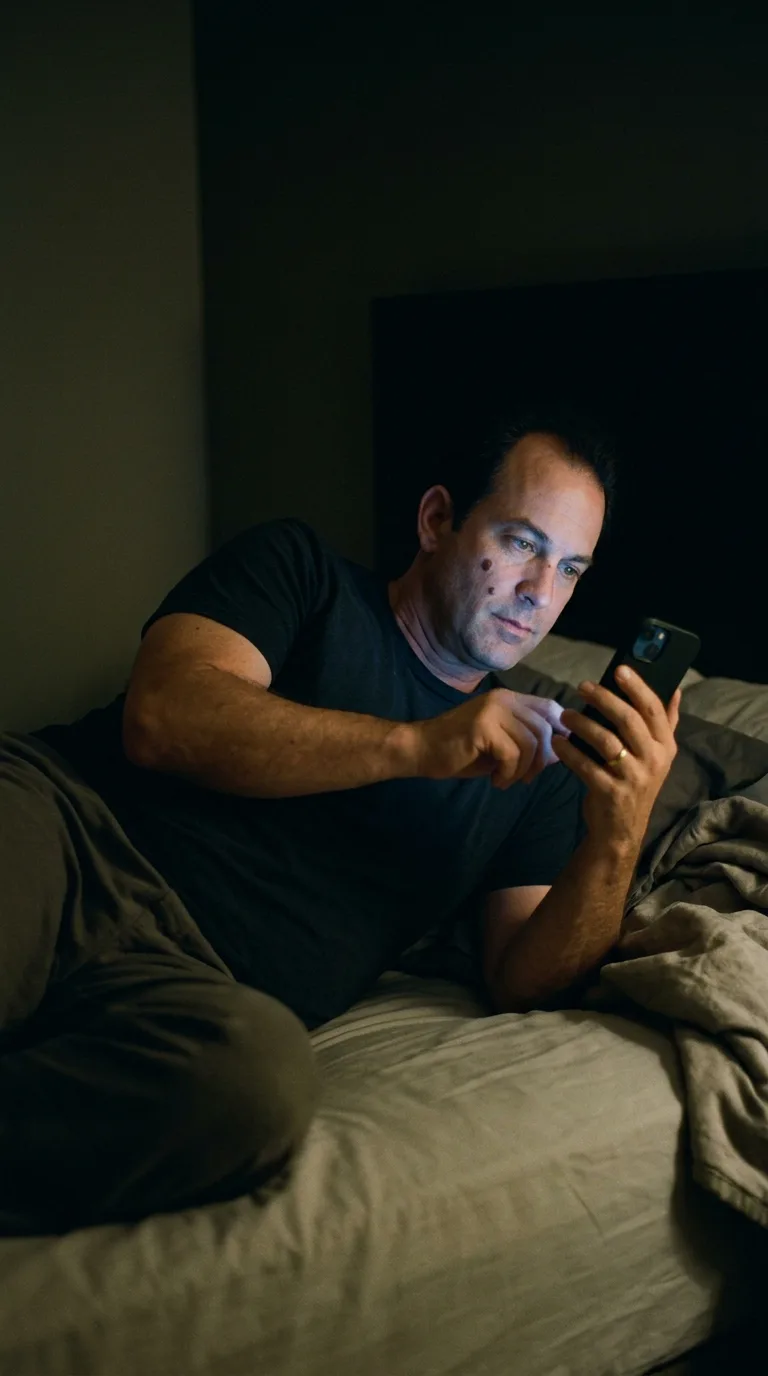
Rarest thing about him: Mexico City — epic, 1 in 421
Season 0seed 1779349928 · engine v10
Character card
lineage E1W54H
His body-swap story
@colby.nash, wearing Neil Okafor-Whitmore, rolled the wheel on and woke up as Marco Belletire, spent 4 minutes in him, then spun the wheel and woke up as Harjot Nirwan
HIS LAST NAME IS Belletire — he is Gary Belletire's brother, and they share it.
HOOK: Four minutes in a man's life, and you already miss him.
---
Neil Okafor-Whitmore stands in his own kitchen at three in the morning, forty-seven years old, blue eyes, light brown hair going thin at the crown though not like Marco's will turn out to be, and his hands don't hurt tonight, which is unusual, because Neil's hands almost always hurt a little, ten years of hauling backboards and dead weight up apartment stairs in Houston humidity. You like Neil fine. You liked being a paramedic for exactly as long as it took to realize that the job follows you home in the shape of every call you didn't save, and Neil has had thirty years of those calls stacking up behind his sternum like sediment, and four minutes ago at a stoplight, none of it, none of that weight, was yours to carry either — you just felt it arrive complete, the way it always arrives, a life poured into you all at once. You are standing here at his counter because his phone is charging on it and the little rectangle of light from the screen is throbbing with a text from his ex-wife about their son's tuition, and something in you — not Neil, the *you* underneath Neil — doesn't want to answer it. Doesn't want to be the one who has to. Twenty spins in, and you have learned this about yourself: the wanting doesn't wait for a reason. It just gets tired of the furniture. You open the laptop. The wheel is already loaded, spinning lazily behind the login, waiting on you the way it always is, patient as a slot machine that never has to pay out because it always pays out. You put in your card. You spin.
And the light in the room is blue and close and six inches from a face that has just stopped scrolling.
Your thumb — his thumb — starts again. Faster now, steadier, flicking through photos of a soccer tournament, a waterlogged street, a meme in Spanish he'd have laughed at ten seconds ago, and none of it lands, because the man reading it isn't the man who opened it. The mattress under you is a stranger's give and pitch. The ceiling above, when your eyes lift off the screen for just a moment, is unfamiliar dark, beams instead of Sheetrock, a colonial ceiling in a colonial room, and beside you, breathing slow and even in her sleep, is a woman you have never met and are, apparently, married to.
The phone is warm in your hand, thumbed soft at the edges, a case with a crack starting at one corner, and it is the crack that does it — his thumb has worried at that crack a hundred times without thinking, and worrying at it now, the memory comes up through the pad of your finger like heat through a stove: him buying the case in a mercado stall two years ago, haggling badly, laughing at himself for haggling badly, his wife rolling her eyes affectionately from three feet away with a bag of mangoes in her arms.
That's Renata. You know her name now the way you know your own pulse — not told, just suddenly, fully there. Fourteen years married. She still calls him *flaco* even though he isn't, hasn't been since his twenties, and he lets her, because underneath the badge and the belt and the two decades of shift work, some part of him is still nineteen and skinny and unbelievable to himself, standing in her father's doorway asking permission for something he'd already decided.
The shirt is the next door in. Navy, long-sleeved, buttoned to the second-to-last button the way he always leaves it because the collar chafes his throat if he does the top one, and touching the fabric — his own fabric, his own shoulders inside it, because he never got out of uniform tonight, came home late off a double and just lay down in it meaning to shower and didn't — brings back the morning he put it on. Not this morning; some morning, all mornings, folded into one: the closet with Renata's dresses on one side and his four identical shirts on the other, jacadas dropping purple through the window grate outside, his daughter's voice somewhere in the courtyard already awake and already loud, his son still sullen and sixteen and refusing breakfast. The belt going on heavy at the hip, the weight of it a fact of his body now the way another man's weight might be a limp, twenty-two years of that belt settling exactly where it always settles. His hands know the drape of that belt without looking. They know the radio clip, the snap of the holster, they know it in the dark.
The mole is not something you feel. It is something you know is there, high on the cheek, because Renata kisses it sometimes, specifically, on purpose, has since the second month they dated, and that is a piece of him that comes back not through touch but through the absence of it — her mouth not on your cheek tonight, her sleeping and turned half away, and some low animal part of him disappointed by that even now, even mid-collapse into whoever you are.
The wedding band is cool and the rest of the hand warm, and there is a girlfriend in there too, from before, Camila, nineteen years gone and married to somebody else in Puebla, and he thinks of her sometimes on nights like this — not with longing exactly, more like checking a scar to see if it still hurts, and it doesn't, not really, but the checking is its own quiet habit, and you feel the small, guilty comfort of it settle and pass.
His body: forty-five, average through the middle in the way of a man who used to run and doesn't anymore, a low ache low in the back from the vest, from the seat of a patrol car, from standing too many hours leaning against too many fenders at dusk watching a lot empty out. Nothing broken. Nothing remarkable. Strong through the forearms in a way that surprises you, gripping the phone. Hairline pushed back into that M, and his own hand, not yours, has touched it in mirrors a thousand times with the specific rue of a man watching himself go, and made peace with it, mostly.
There is a lighter in the nightstand drawer, though he quit years ago — Gary's lighter, actually, his brother's, the one that used to be their father's, silver, dented on one corner, and Marco keeps it there not to smoke but to flip, thumb and forefinger, when his hands don't know what else to do with themselves, an old tell from the academy years that outlived the habit it was born from. You didn't reach for it. You don't need to. You already know Gary — you were him, six spins and five days ago, one minute wearing that gray-haired, cleft-chinned body in a gym in New Orleans, blowing a whistle you had no context for, gone again before you understood the play. You remember Gary's hands from the inside. You remember, distantly, that Gary calls Marco every Sunday and Marco doesn't always pick up, and that under the not-picking-up there is no coldness, just two men circling the same grief from different distances — a father, gone nine years now, whose lighter this is.
The thumb stops on the screen. The scroll ends.
You look down at the hand holding the phone — his hand, the ring catching the little light — and you turn it over slowly, the way a man checks for something he's misplaced, and you don't find him in it, because he isn't there to be found.
"Hey," you say, quiet, so as not to wake her, to no one, to the lens of the front-facing camera still lit and waiting, "soy nuevo aquí."