Manuel Ochoa
Fictional. Generated by AI — not a real person, and no likeness of one is intended.
37, teacher in Pittsburgh · rolled by @colin.hasbrook · card — no film
History
who has worn him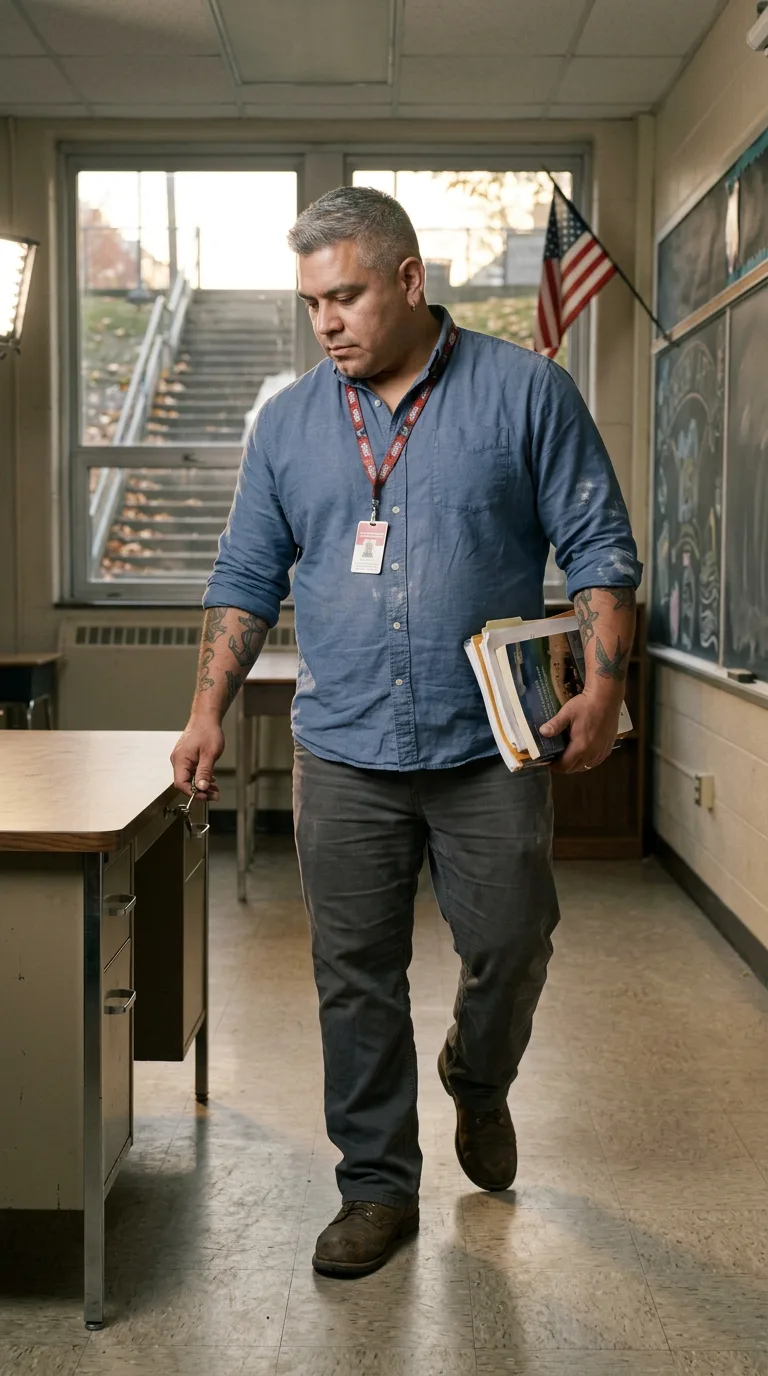
Rarest thing about him: One earlobe — epic, 1 in 28
Season 0seed 393328495 · engine v10
Character card
lineage 2NZHHJ
His body-swap story
@colin.hasbrook, wearing Dennis Yamashita, rolled the wheel on and woke up as Manuel Ochoa, spent under a minute in him, then spun the wheel and woke up as Rayaan Sethi
Dennis Yamashita's hands are wrong. They have been wrong for less than a minute — small, quick, careful hands, a conservator's hands, good with a scalpel under magnification and useless for anything that requires reach. You stand in his apartment in Philadelphia holding a brush you were cleaning when the last spin dropped you into him, and you look at the bristles instead of finishing the stroke, because that is the thing about Dennis: he notices everything about the object and nothing about the hour. It is late. It is Friday. Nobody is waiting on him tonight, which was the appeal of him once, and is the whole problem now. Thirty-six years old and every evening the same shape. You have been him for eleven days and the boredom arrived on day four and has not left since. You set the brush down wet, which he would never do, and that small cruelty to a man who isn't you anymore is the last thing you feel as him. You open the laptop. The wheel is already bookmarked. You spin knowing only that you want weight, want noise, want a life with people already standing in it who will not leave when you get tired — and the wheel doesn't care what you want, it only spins.
The chalk tray. That's what your hand is on when it happens — no, not chalk, a stack of folders, and reading glasses pinched between two fingers of the other hand, halfway to a desk drawer that is already half-open. The motion is a thousand identical motions: glasses in, drawer shut, folders under the arm, go. Except the hand that closes the drawer closes it on nothing, fumbles, has to do it again, slower, and this time gets it right. Ten more motions come out of you checked — checked the way a new driver checks a mirror he's checked nine thousand times before — on a job that has not needed checking since maybe 2019. The room smells like chalk dust and radiator heat and wet outside air through a cracked window. Late light comes low and orange through glass across a stairway packed with other people's wet leaves. A flag hangs still in the corner. You are standing heavier than you have stood in five bodies. Something on your chest, on a lanyard, taps once against a shirt button.
The shirt is the first thing that talks. Chambray, soft from washing, a little tight now across a gut that wasn't there in whatever year he bought it — and it gives you a bathroom mirror, early, this exact shirt going on one sleeve at a time, the cuff snagging on the silver hoop in his ear the way it always does, a small practiced twist of the wrist to free it. His wife's voice from the hallway, not urgent, just naming the hour. Three names hollered down a stairwell after that, in the tone of a man who has hollered them ten thousand mornings and will ten thousand more, except one of the names doesn't answer right away and there's a half-second of a father's attention going somewhere it always goes, checking, before it lets go again. That's Manuel. That's the whole texture of him arriving through cloth: not a fact you're told but a rhythm you're given, sleeve, twist, holler, check, and only then his own name comes with it, the way a man's name arrives last of all because he never needs to say it to himself.
The lanyard gives you the badge photo underneath it, a version of this same face three years and no gray yet at the temples, and under that a first week in this building, terrified in front of twenty-six freshmen who could tell, and a colleague — Marisol, room 114, gone now, moved to Ohio — who told him just start, they forgive you for starting badly, they don't forgive you for not starting. He never forgot that. He says some version of it to himself every September, silently, at this exact desk.
The folders under your arm are report cards, and touching them opens a whole different register — not a memory but a feeling with no picture attached, a low tired satisfaction, the particular exhaustion of caring whether forty different teenagers pass or don't, multiplied by however many years, cut clean through by a flash of a woman who isn't his wife: a face from twenty years back, a diner booth, a laugh he can still hear better than he can hear his own kids' laughs some mornings, and the specific guilt of that fact, filed and never opened, opened now, closed again fast, the way he's always done it. Then the wedding band on the hand holding the folders puts the guilt back where it belongs and gives you her instead — his wife, tonight, right now three hours behind him in the evening's arithmetic, probably already got dinner going, probably already wondering where he is, and the wanting to be home that comes with that is so plain and so unglamorous it almost knocks the boredom clean out of you before you remember the boredom was never his.
The boots on the floor answer for the body itself: the ache low in the back that comes from standing all day in front of a room, the sweetish thickness in the blood that means test the sugar before dinner or pay for it later, a body that carries fat and muscle both, built for this — for standing, for reaching classroom shelves other men would need a stool for, for absorbing a full day of teenagers without breaking. Tired in the ordinary way. Whole in every other way.
You look down. The hand on the drawer has ink up both forearms, faded blue-green birds and anchors laid down by a man in his twenties who wanted something permanent and got exactly that, and a wedding band that has worn its own groove into the finger under it, and you turn the hand over once like you're checking it's really attached, because after four hundred ninety-one of these the wonder should be gone and it never quite is.
"Okay," you say, out loud, to an empty classroom, in a voice with more gravel in it than the last one had, and you look up into the low window light like it might answer you back. It doesn't. Somewhere down that outside stairwell, under the wet leaves, is a walk home you didn't earn and are about to take anyway.