Dennis Yamashita
Fictional. Generated by AI — not a real person, and no likeness of one is intended.
36, museum conservator in Philadelphia · rolled by @colin.hasbrook · card — no film
History
who has worn him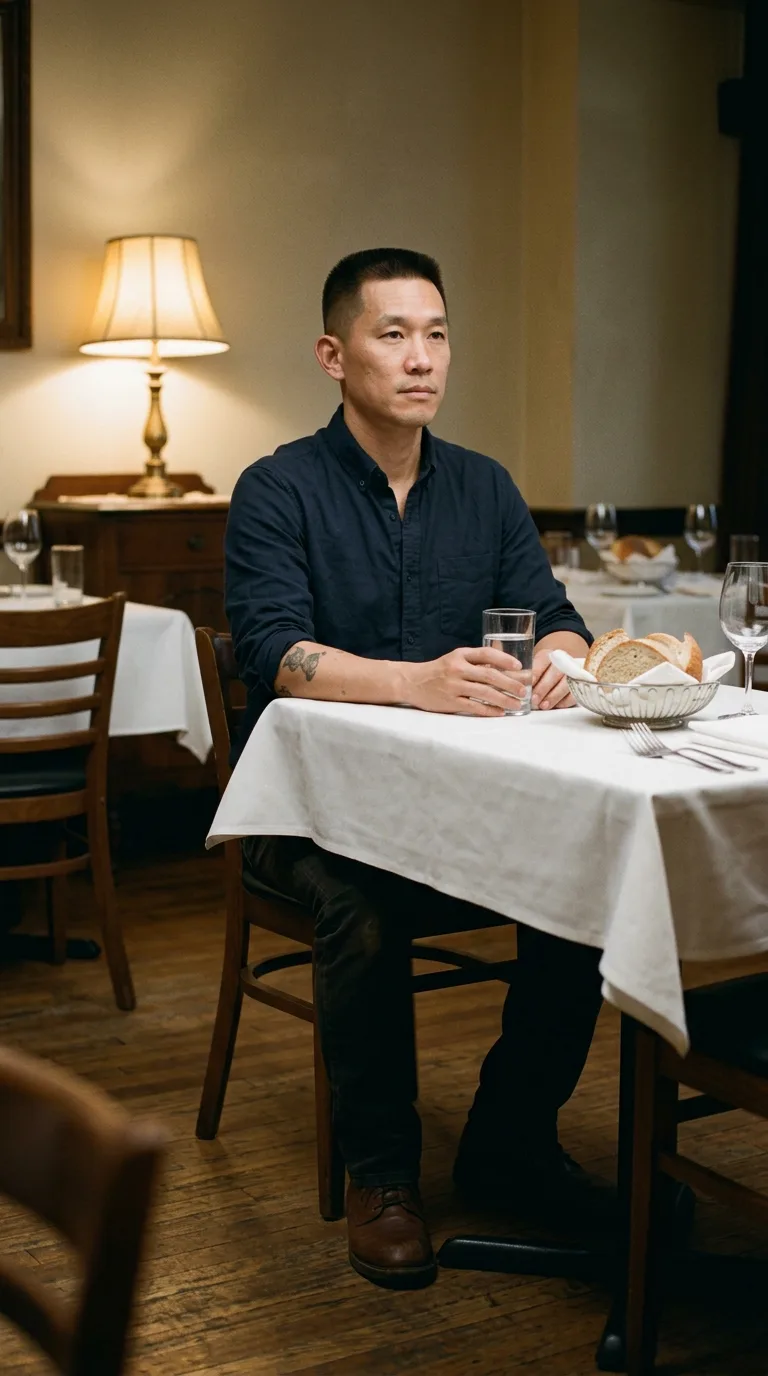
Rarest thing about him: Half sleeve — epic, 1 in 57
Season 0seed 941552997 · engine v10
Character card
lineage 2NZHHJ
His body-swap story
@colin.hasbrook, wearing Héctor Salomón, rolled the wheel on and woke up as Dennis Yamashita, spent under a minute in him, then spun the wheel and woke up as Manuel Ochoa
The shop smells like bay rum and old floor wax, and you have been standing in it for less than a minute, which is not enough time to stop noticing the smell. Héctor's hands — your hands, for now — are broad and dry and a little swollen at the knuckles, and they know how to hold a razor without you asking them to. The chair behind you is empty. The last customer left forty minutes ago. You told him to come back Monday, and he laughed, and you don't remember laughing back.
You are looking at the mirror instead of anything in it. Fifty-eight years sit in this face easy, like they were always going to end up there — silver hair, the nose that healed a half-inch off center sometime in the eighties, brown eyes that have watched a lot of Fridays end exactly like this one. Rural Texas outside the window, the light doing that long orange thing it does before it quits for the day. You like this body. You liked it yesterday too. That's the problem, actually — you have been liking it for weeks now, easy and steady, and something in you has started treating "liking it" like a warning bell instead of a comfort.
It isn't boredom, not exactly. It's that you caught yourself, this morning, thinking about keeping him. Thinking in a way that had a future tense in it. Four hundred and ninety spins and you have never once let a body get that far into you, and the fear of it — of finally wanting to stop — moves your hand to your phone before you've decided anything at all.
You spin because stopping is worse than spinning. You have always known that about yourself, even when you were only Héctor, even when Héctor felt, for one whole minute, like a place you could finally stand still.
*
The water glass is cold and sweating under your fingers, and it is not your fingers, it is his — you feel that instantly, the way the hand is narrower, the knuckles smaller, a faint ridge of old callus along the side of the first finger that a razor never put there. You are mid-sentence. You can feel the shape of the words still moving through a throat that isn't the one you left, feel breath already committed to the back half of something, and you finish it because the body finishes it, on its own, before you've caught up to what it's saying.
"—and I really am sorry, I don't usually get like this."
It comes out clean. It comes out loud enough that a woman two tables over glances up from her plate. The glass turns a quarter-inch under your grip, water lipping the rim, and then stops.
Across the table, the woman waits to see if there's more. There isn't. You don't know her name yet. You don't know your own.
*
The shirt is what gives him to you first — dark, cotton, soft from a hundred washes, and touching it is like putting a hand into a tide pool: something darts back before you can see it whole. Then it holds still and you get the morning. Steam on the bathroom mirror. Standing in it in his boxers, holding this shirt up by the shoulders, deciding — actually deciding, for a full ten seconds, a grown man alone in an apartment — whether tonight mattered enough for the good shirt or whether that was setting himself up. He put on the good shirt. He always puts on the good shirt. He tells himself it's just fabric and then irons it anyway, standing at the board in bare feet with the local news murmuring behind him, sleeve by sleeve, collar last, the way his mother taught him before she stopped being someone he called.
His name arrives with the belt — Dennis, threading it through the loops with the practiced economy of a man who has dressed himself the same way for twenty years — and then the rest comes in pieces too big to hold at once.
Thirty-six years old. A conservation studio two miles from here, north light falling flat and even across a bench all day, no shadows to fight with, the smell of him always faintly of solvent no matter how much soap he uses. Right now your — his — forearm carries a small tattoo under the sleeve, something he got at twenty-three on a trip to Atlantic City that he has spent thirteen years wishing he hadn't, a badly drawn thing that the good tattoo artists he's since become friends with wince at politely and never offer to fix, because fixing it would mean talking about it. He doesn't talk about it. He wears long sleeves in summer sometimes just so nobody asks.
You feel the job in his hands before you feel anything else about him — hands that know how to hold a brush an inch off a four-hundred-year-old varnish without letting the tip drift, hands trained to be patient with things that cannot forgive a mistake. He loves that patience. He has never once loved a person the way he loves the moment a cleaned inch of pigment comes up bright under swab and solvent, nobody watching, north light doing all the work, nothing expected of him but steadiness. He is good at steadiness. He is bad, it turns out — he is finding out right now, at this table, in real time — at whatever this is.
The chair under you is hard-backed, borrowed-restaurant hard, and his spine already aches faintly from sitting straight too long, performing okay-ness. He is thirty-six and average-built and carries himself smaller than that, five-five, used to being the shortest person at a table and having made an old peace with it. He sleeps badly — some nights not at all without the machine humming beside the bed — and there is a tiredness sitting behind his eyes tonight that has nothing to do with the date and everything to do with three nights running he didn't wear the mask because a woman he'd met twice was maybe going to stay over and he didn't want her to see it. She isn't staying over. He knew that twenty minutes in.
There is no one behind him. No ex who left a mark, no kid's photo in his wallet, no faith he leans on when a night goes like this one is going. There is a toothpick he isn't chewing right now because his hands are full, and a habit, most evenings, of one drink too many alone in the kitchen with the radio on, not to feel anything, just to let the day stop asking things of him.
He wanted this to go well. Under the apology, under the unnaturally loud finish of that sentence, is a whole ordinary hope — that someone across a white tablecloth might, for once, want to stay past the bread basket. It is such a small hope that it goes through you like something borrowed and returned in the same second, and you feel, with his feeling and not yours, exactly how much it costs him that it's already over.
*
You look down and there are his hands on the glass, narrower than you're used to, the tattoo dark against paler skin at the wrist, and you turn one over slowly, palm up, like it might have an answer written in it.
Across the table, the woman is still watching you, waiting, her fork not moving.
"Sorry," you say, in his voice, to her, to the room, to nobody. "I don't know where that came from."