Lucas Ferriday
Fictional. Generated by AI — not a real person, and no likeness of one is intended.
21, accountant in New York · rolled by @colin.hasbrook · card — no film
History
who has worn him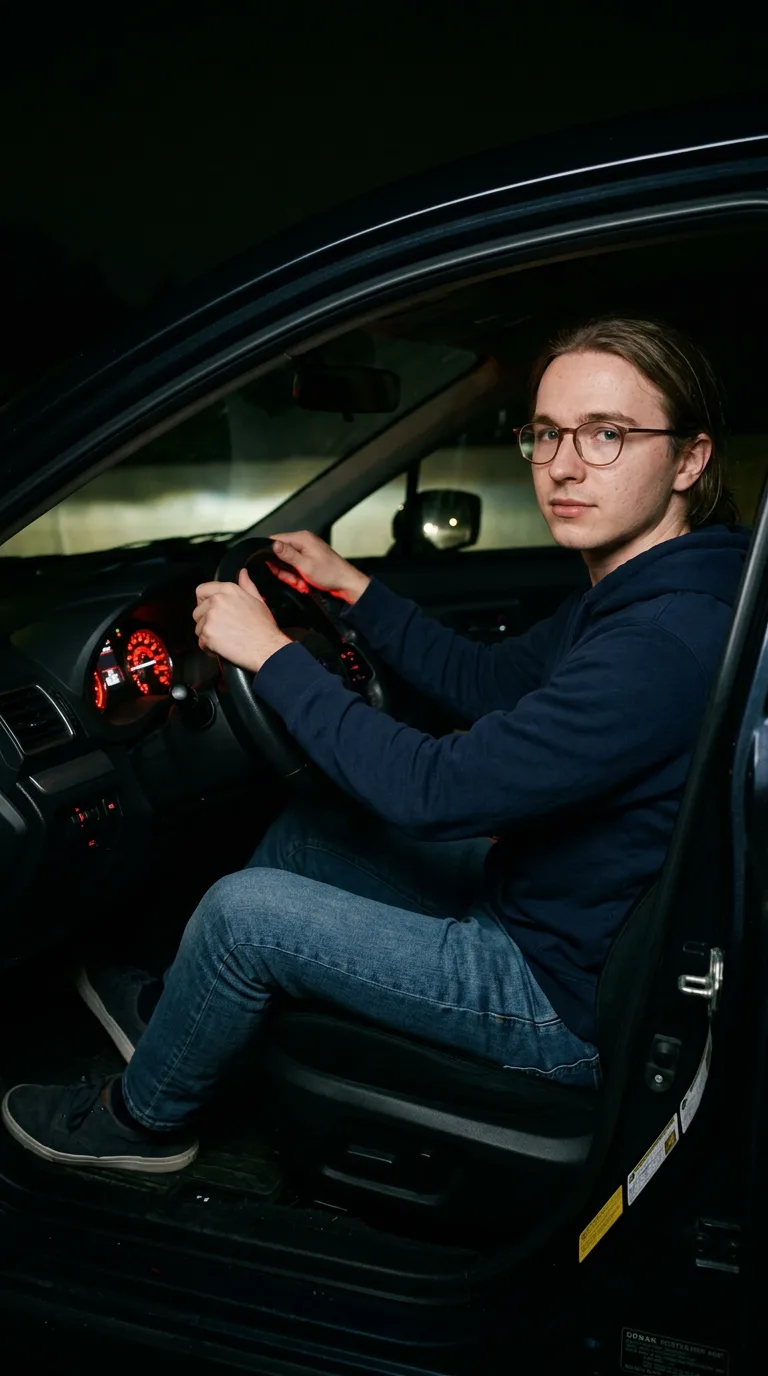
Rarest thing about him: Accountant — rare, 1 in 186
Season 0seed 553053701 · engine v10
Character card
lineage 2NZHHJ
His body-swap story
@colin.hasbrook, wearing Tyler Bousquet, rolled the wheel on and woke up as Lucas Ferriday, spent 1 minute in him, then spun the wheel and woke up as Miguel Otero
You are eighteen and athletic and two minutes into being Tyler Bousquet, standing in a hallway that smells like a dorm's industrial carpet cleaner, and the phone is still in your hand from the text you just read. It is not even a text about you. It is a photo somebody's girlfriend sent of a party you weren't invited to, a stranger's living room, and none of it matters — what matters is the itch, already there, already familiar after a hundred and seventeen times: this body is fine, this body is nothing, you have not even learned its class schedule and you don't want to. Two minutes was always going to be enough. You open the site on the borrowed phone with the borrowed thumbs. The wheel is already spinning before you've decided anything, the way it always is by the time you admit you decided.
It stops.
You are sitting down. That's the first thing — the wrongness of a chair under weight that a second ago was standing in a hallway. Then: a wheel under your hands, ten and two, the vinyl worn smooth in two ovals where palms have been for years. Dashboard light the color of a stovetop coil, low and red, painting the backs of your knuckles. Glasses on your face, weight you didn't ask for pressing two small dents into the sides of your nose. The car is drifting — you feel it before you understand it, a foot of asphalt sliding under the tires toward the yellow line — and your hands, his hands, correct it themselves, one smooth pull, like the body already knew what to do before you arrived to ask it. Both hands come off the wheel. Resettle lower, wider, the way a driver sits when he's not thinking about driving anymore. The turn signal clicks on, patient, ticking toward an exit that means nothing to you yet.
The glasses come first, of course — they're the thing already on him, the thing your face is wearing before you know whose face it is. A pressure at the ears, a smudge of window light bending through the lenses, and with it: an optometrist's office in a strip mall off Flatbush, fluorescent, a woman saying *these are cheaper, the frame's cheaper*, and him saying fine, fine, whatever's fine, because there was somewhere else he needed to be that afternoon and he can't remember now where. That's him. That's the whole shape of him already, in one dumb little flash: somewhere else he needed to be.
The wheel gives more, the longer your palms sit on it. A commute. Hundreds of them, actually, stacked like transparencies — the same on-ramp, the same gap in the median where a sign used to stand, the same three miles counted down not in mile markers but in songs, this one and then the next one and then he's home. Under it, low, a hum that's always there when he drives: his back. Not sharp, not new, just a permanent tenant between two vertebrae that flares when he's sat too long at a desk and hasn't gotten up, which is most days, which is today. You feel it now as your own ache, dull, exactly where a twenty-one-year-old's spine has no business complaining yet.
The shirt against your back opens the morning. Cardigan first, gray, soft with washing, the kind of thing that was a gift — *her* gift, and here she comes, whoever she is, dating-girlfriend not wife, a name that arrives with warmth and a specific kind of carefulness, like something he's still learning not to compare to somebody else. The comparison arrives too, unbidden, a woman from before who is not in the car and never will be again, who he does not talk about, who left a shape behind that the cardigan's softness apparently still brushes against on its way onto his shoulders every morning. You feel him missing her the way you'd feel someone else's sunburn — real, but not yours, fading as fast as it came.
The desk comes through the seat itself, oddly, the particular slouch his spine has learned for eight hours under two monitors and a light that never changes color. Numbers all day. Small numbers, other people's numbers, careful work that nobody thanks you for and everybody notices if it's wrong. He is good at it. He hates that he is good at it. He has never told anyone that, not the girlfriend, not the roommate.
The roommate. That one lands differently, lands like your own memory instead of his, because it is: seven minutes ago, on your side of things, you were standing in that man's kitchen in Ohio, in his actual hands, for a single minute that's already dissolving at the edges the way they all do. You know this man from there — from the inside of the other half of that apartment, the noise complaints, the borrowed jumper cables, a birthday where somebody bought the cheap champagne and everyone drank it anyway. Except no — wrong coast, wrong life, the wheel doesn't work that way, and even as you reach for it you feel the two men refuse to be roommates after all, feel the false memory curdle and fall away, leaving only the true thing under it: you have stood inside somebody who knew a version of loyalty, and now you're inside a stranger who never met him. It doesn't matter. You keep both anyway, the way you keep all of them now, stacked like the transparencies of his commute, each one thinner than the last.
His hands are on the wheel. Small hands, five-five worth of a man, average through the shoulders, a light frame carrying that ache low in the back like it's always been there and always will. Nothing about him snags the eye — not a wide jaw, not a scar, not a ring — and there's something almost peaceful in that, in wearing a face nobody's ever pointed at on the subway. Underwater, whatever that means for a man like this, some debt he signed his name to that hasn't caught up with him yet. He doesn't know that word. You do, distantly, the way you know all of their numbers now, a ledger nobody keeps but you.
The exit sign passes overhead, lit and unfamiliar, his instead of yours, three miles from a home that isn't yours either.
You look down. His hands on the wheel — thin fingers, a old ballpoint-pen callus on the middle one, the pale band of untouched skin where a watch usually sits but doesn't tonight. You turn one hand over slowly, like checking it for something that isn't there, headlights sliding across the knuckles.
"Okay," you say, out loud, to the empty car, in a voice that isn't the one you had two minutes and a hundred and seventeen bodies ago. "Okay. Let's see."