Kyle Ostrowski
Fictional. Generated by AI — not a real person, and no likeness of one is intended.
30, sales rep in Phoenix · rolled by @marco.villagrana · card — no film
History
who has worn him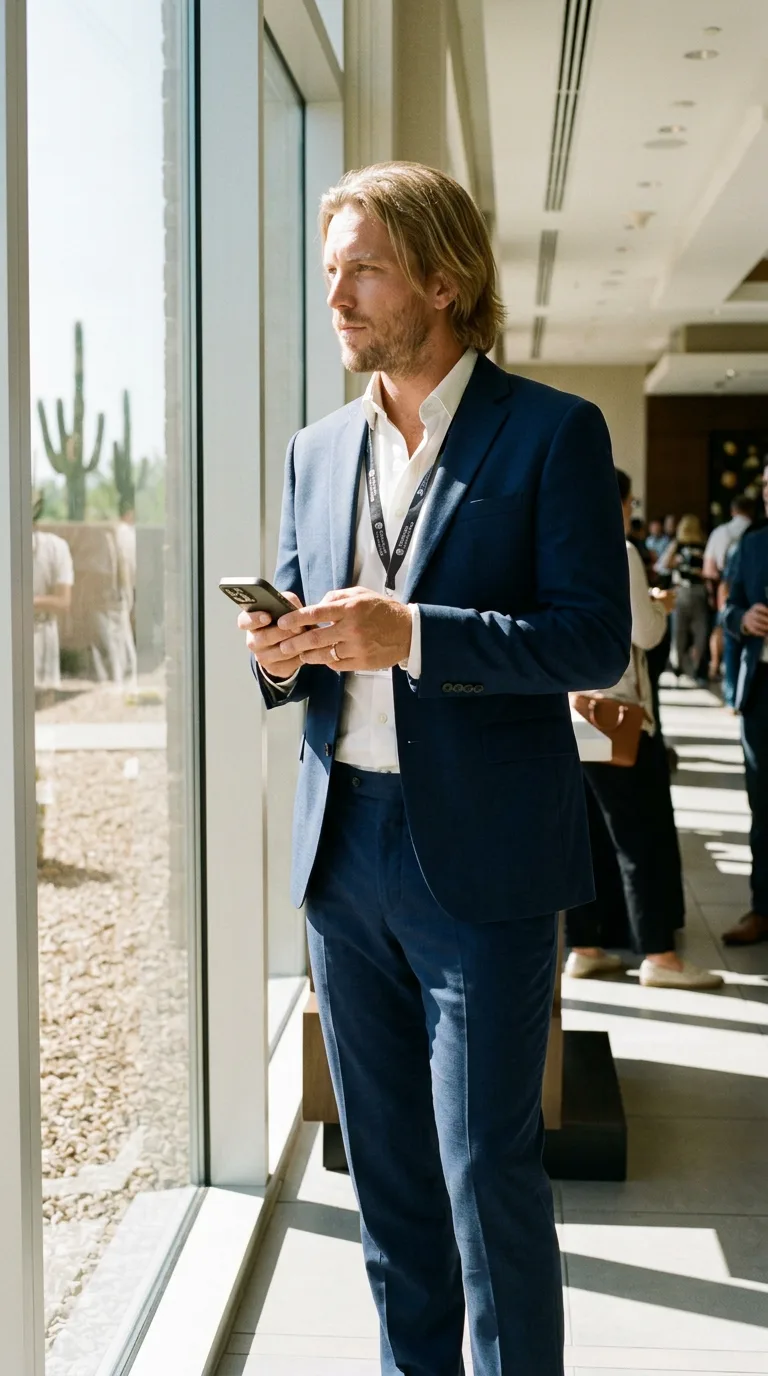
Rarest thing about him: Mainline Protestant — common, 1 in 15
Season 1seed 1487125295 · engine v11
Character card
lineage LJL8SV
His body-swap story
@marco.villagrana, wearing Douglas Hennessy, rolled the wheel on and woke up as Kyle Ostrowski, spent 4 minutes in him, then spun the wheel and woke up as Aaron Whitcomb
---
The shears are heavier than they were an hour ago, or you are. That's Douglas Hennessy's forearm burn, not yours, though for one day and eighteen hours you've been calling it yours. You're kneeling in a client's boxwood in Westchester, the light going long and orange through the hedge, and there's a sound in your head that isn't tinnitus, it's just wanting, the old wanting, back already, come back too soon. You told yourself last time you'd sit in a body a while, really live inside one, and you have — a day, a night, a morning of coffee that tasted like someone else's habit — and it isn't enough, it's never enough, the second body always turns into a waiting room for the third. You strip a glove off between one cut and the next. Somewhere behind Douglas's sternum there's the small ordinary ache of muscles used honestly for forty years, and you don't want it. You want new ache. You take out the phone with his name on the lock screen and you open the site with the wheel on it, standing in a stranger's flower bed, and you spin it the way you always do — fast, no ceremony, greedy — and the last thing Douglas Hennessy's eyes ever see is a hedge going soft at the edges like water.
Then you're upright, not kneeling. Warm all the way through, a different warm, dry heat instead of humid, and there's a lanyard swinging light against your chest and a suit jacket snug at the shoulders and glass in front of you throwing back afternoon sun so hard you nearly lose the thread of what your hand is doing. It's halfway through tapping something into a phone. The motion glitches — one thumb-stroke wrong, deleting a letter that wasn't there — and then, slow, correct, deliberate, you finish the text like a man double-checking his own signature. Ten more taps come out the same way, checked, each one, on hands that have not needed checking in years.
The phone is the first thing that gives you anything. Warm glass, a case with a hairline crack along one corner from a drop he doesn't remember which counter — and there it is, whole, a Tuesday eight months back, coffee mug sliding, catching it wrong, the tiny flare of *not the phone, not on a workday* — and under that, steadier, the daily thing: seven-forty a.m., propped against a coffee maker in a kitchen in Phoenix, his wife's voice from upstairs asking has he seen her keys, a small boy's cereal bowl already emptied into the sink because the kid eats standing at the counter like his father does. Kyle Ostrowski. The name comes with the phone, the way a smell comes with a room.
The lanyard against his collarbone gives you the hotel — the actual building around you, glass and travertine and a strip of gravel yard outside with three saguaros standing black against a sky bleached nearly white — a distributors' conference, day two, a name badge that says his company and his first name in a font too small for anyone to read across a room. You feel, distantly, underneath, how tired his eyes are of this particular fluorescent-and-desert-glare combination, how many of these lobbies he has stood in between meetings holding a phone like a life raft.
The suit jacket is the deepest one. Navy wool, a size that was right two years ago and is a little roomier now, because he lost weight after his father-in-law's funeral and never quite put it back on. Putting it on this morning: hotel room, curtains not fully closed, a strip of parking lot light already announcing the heat to come. Shirt first, no tie — he stopped wearing ties to these things three conferences ago, some small rebellion nobody noticed — cuffs rolled once and unrolled because rolled looked too casual for the first pitch of the day. The jacket last, shoulders settling into it the way a familiar coat always settles, without thought, a decision made by the body and not the man. He'd checked himself once in the mirror, decided he looked like exactly what he was, and gone down without minding that.
The wedding band is cool at first against your palm when you notice it, then not — his hand has kept it warm for six years. It comes with a whole wedding you didn't ask for: a backyard in Tempe, string lights, his wife laughing too hard at his best man's toast, the ring feeling enormous and foreign on his finger for the first month and then just being there, weight so constant it stopped being weight. There's an ex in there too, folded flat and small the way old things get folded — a woman from college, a fight that ended it, a version of himself he doesn't examine much anymore, not guilt exactly, just a room in the house he doesn't go into. And there's a boy, five, who calls him from the iPad screen sometimes mid-trip and holds up a dinosaur too close to the camera, and the feeling that comes with that memory is so plain and unguarded — *that's my son, that's my son* — that it nearly knocks the wanting out of you for a second.
His feet are bare on the cool stone floor — shoes off between meetings, a habit, a small relief in a day of stiff leather — and that groundedness is its own kind of memory, no story attached, just thirty years of a body that likes the floor. Average build, easy in a jacket, hands that know without being told how to hold a phone, a badge, a pen, a client's attention. Nothing wrong with him. Nothing remarkable either. A man built for exactly this hallway, this light, this hour.
You look down at your hand — his hand — the ring catching the window glare, and you turn it over slow, studying the back of it like it might have arrived with instructions.
"Right," you say, out loud, to no one, to the glass, to the gravel yard and its black cutout cacti, "let's go be him for a while."
Whatever a while turns out to mean, you don't know yet either.