Douglas Hennessy
Fictional. Generated by AI — not a real person, and no likeness of one is intended.
43, landscaper in New York · rolled by @marco.villagrana · card — no film
History
who has worn him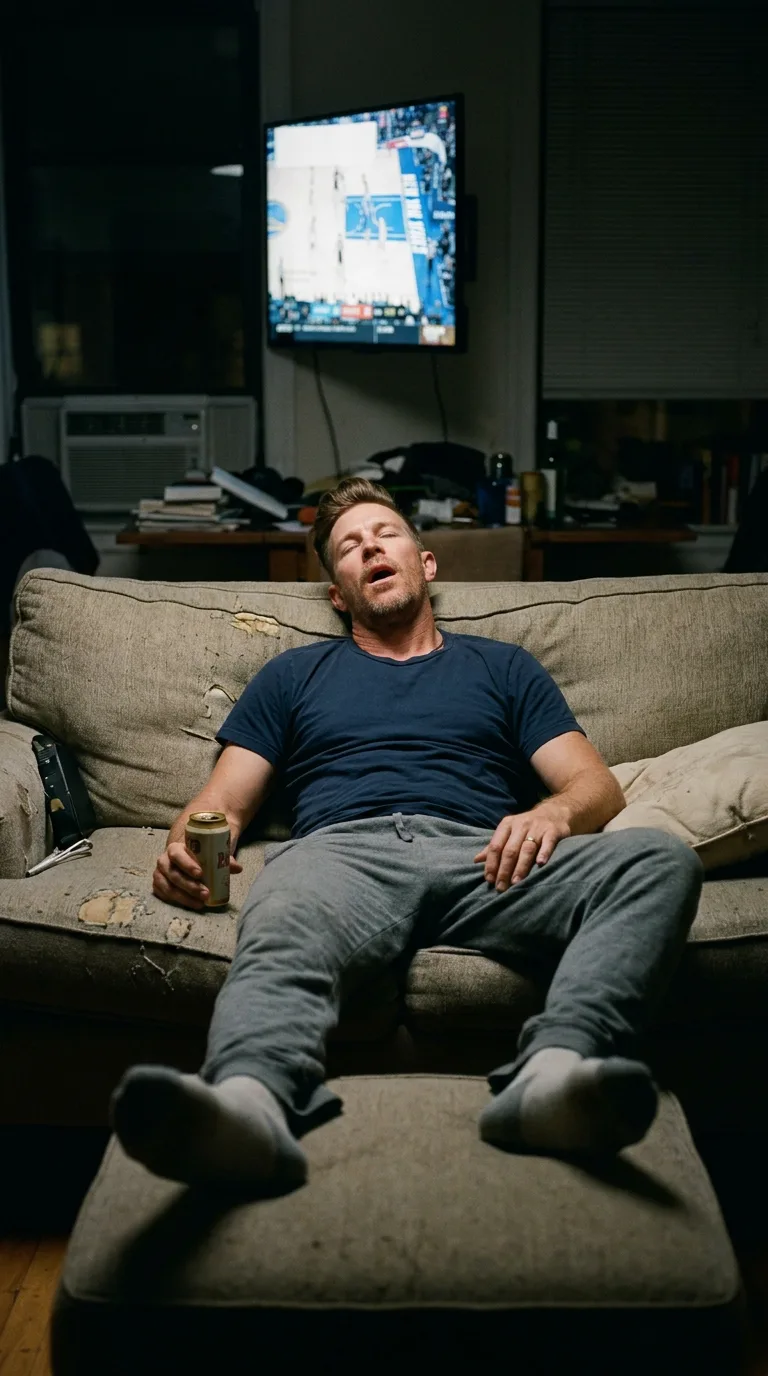
Rarest thing about him: Falling asleep in front of the game — common, 1 in 59
Season 1seed 2013236182 · engine v11
Character card
lineage LJL8SV
His body-swap story
@marco.villagrana, wearing Colton Reyes, rolled the wheel on and woke up as Douglas Hennessy
Colton Reyes's leg ends below the knee, and the socket has been biting all evening — a dull, specific pain that lives at the seam of plastic and skin, and it does not go away no matter how the merchant marine sits on the edge of his bed. Four minutes ago you spun the wheel and got him: 29, tall, average build, brown eyes, a life on cargo ships out of Miami that felt, for about ninety seconds, like a good trade. Then the phantom ache started up in a leg that has not existed in years, and you remembered — too late, the way you always remember too late — that you don't actually want a body's problems, you want the *feeling* of a new one, and that feeling is already gone, spent, filed. The apartment is hot. The window unit rattles. There is a bottle of aspirin on the nightstand that will do nothing for a nerve that isn't there. You pull up the site again on his phone with his own thumbprint, feeling faintly criminal about it in a way that does not stop you, and you spin.
The couch takes your weight before you know it's a couch. Sodium light through venetian blinds lays orange bars across a stranger's shins. There's a can in your hand, warm, nearly empty, tilting. Your mouth is open. On the television a basketball arcs into a net for the second time — the replay — and something in this body's habits, some worn groove of attention, makes the thumb find the remote and take the volume down two clicks before the eyes have even finished opening. You watch the ball. Not the score. The room smells like fabric softener and something faintly green, cut grass ground into a cuff that never fully washes out.
The shirt isn't on you — it's draped somewhere, day's end, but the T-shirt against your back holds the memory of it anyway, close enough: sun, eight-thirty this morning, standing in the truck's open door pulling the canvas work shirt on sleeve by sleeve while the trailer of mowers ticked as it cooled from the drive over. Douglas Hennessy's hands know this motion without asking permission — button, button, cuff rolled twice, the collar that always sits a little high because his neck is thicker than the size below. The hat comes next in the memory, the strap of the ear protection settling against his collarbones like something he's worn so many years it's stopped being a choice. He mowed six lawns today. Marcy Deluca's hedge fought him the way it always does. He thought about his daughter's recital, which is Tuesday, and whether he'd get out of a job in Canarsie in time.
The wedding band on the left hand comes with its own small current: Erin, seven years, the two of them in a kitchen too narrow to both stand in at once, an argument about money that resolved itself the way it always did, with him doing the dishes without being asked and her laughing despite herself from the doorway. And underneath that, quieter, guiltier, a name that isn't hers — Priya, who he saw the last time in April, who told him this can't keep being what it is, and who he agreed with out loud and has not stopped thinking about since. He does not tell Erin. He does not tell anyone. It sits in him the way the ache sat in the other man's leg — not gone, just not looked at.
The body itself: forty-three and it shows in the good way, the stubborn muscle of a man who lifts things for a living, shoulders that have absorbed ten thousand mower pulls, a lower back that complains on Sundays and forgives him by Wednesday. No injury worth naming, no old fracture, nothing broken that healed wrong. Just wear, evenly distributed, like a tool kept oiled. His right hand, loose around the can, wants a pen; there isn't one, so the thumb finds the can's rim instead and taps it, once, twice, the exact rhythm of a man totaling a lawn-care invoice in his head at a red light.
You feel all of it arrive in no order at all — daughter, wife, ex, grass, aspirin he doesn't need because this body doesn't ache anywhere specific, just generally, honestly, like a good day's labor — and none of it is yours, and all of it is, now, the only address you have.
You lift the can-hand and look at it. Rough knuckles, a green-black crescent of old dirt under one nail that three showers hasn't touched, the band catching the TV's blue light.
"Huh," you say, to the empty apartment, to no one, watching your own fingers like you're checking they still close.