Kevin Cho
Fictional. Generated by AI — not a real person, and no likeness of one is intended.
40, security guard in Pittsburgh · rolled by @bryce.kellerman · card — no film
History
who has worn him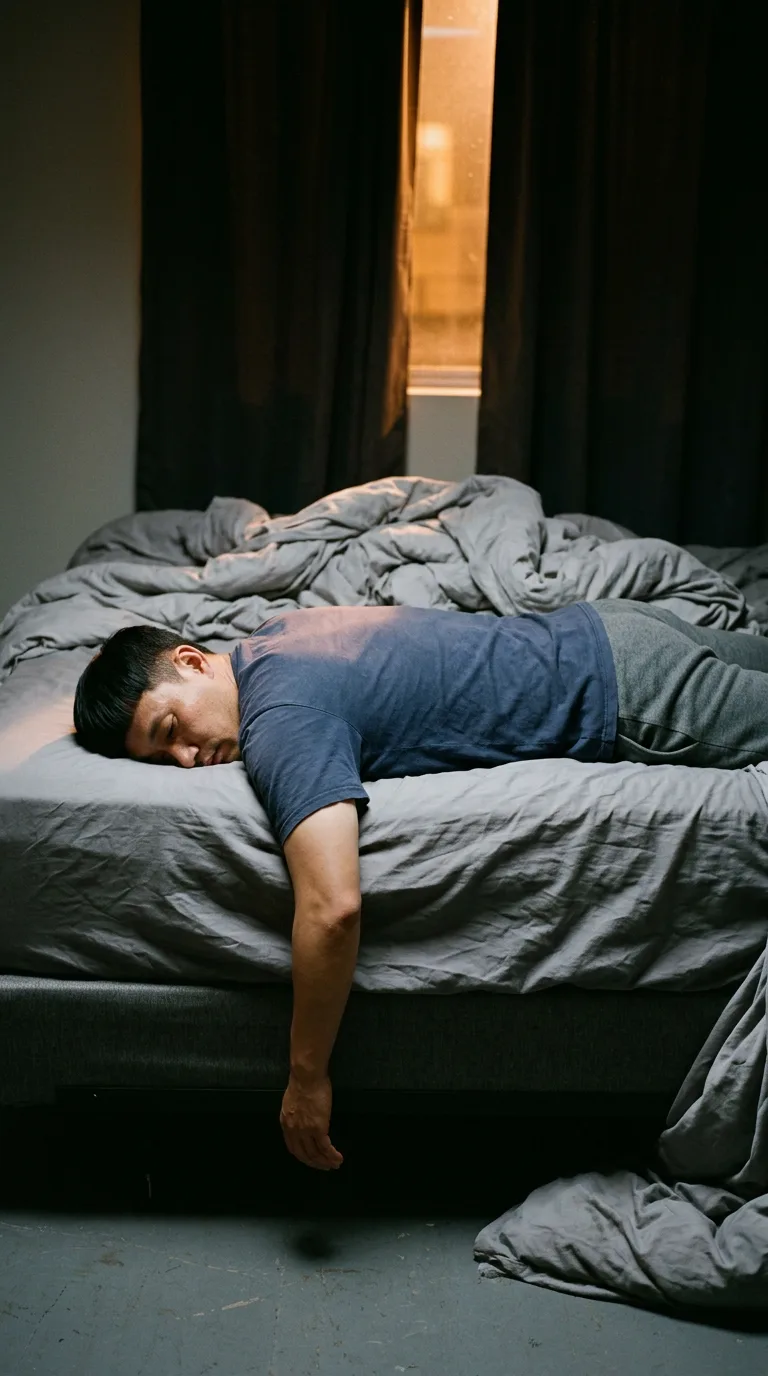
Rarest thing about him: Vapes socially — epic, 1 in 50
Season 0seed 1261468993 · engine v10
Character card
lineage 9IC4OB
His body-swap story
@bryce.kellerman, wearing Gerald Poindexter, rolled the wheel on and woke up as Kevin Cho, spent 3 minutes in him, then spun the wheel and woke up as Brett Halloran
Gerald's hands — no, your hands, for three more minutes — are wrapped around a water pitcher, and the pitcher is sweating onto your fingers the way old glass does at eleven in the morning in a Back Bay diner with the heat already up too high. You are refilling a booth of nobody important. Gerald Poindexter, sixty-three years bald and broke and mixed and tired in the knees, is a good enough coat, but he has been complaining, in the small wordless way a body complains, since the moment you put him on. His lower back. His feet on the mats. The particular ache of being someone who has stood at this angle to a coffee station for forty years. You liked him fine for three minutes. Three minutes was long enough. What decides it — what actually decides it, standing there with the pitcher sweating — is not the knees. It's that you remember, suddenly and completely, the last time you had a body that didn't hurt anywhere, and it wasn't this one, and it wasn't the one before it. It was six days and nine hours ago, in San Francisco, in a nurse named Ryan who kept a ring he never talked about and turned it over in his fingers at red lights, on buses, in the break room, an old habit with no story attached that you never got to the bottom of in two days of wearing him. You think about the ring. You think, I want to know whose it was. You set the pitcher down. You go to the site on your phone under the table, thumb shaking a little with a want that has nothing to do with Gerald's arthritis, and you spin.
The gap gives you no drop, no falling — only a stitch, a breath, and then breath itself, going from ragged to even in your chest, on its own, before you've caught up to having a chest. You are face down. There is a mattress under you and a shirt-sleeve of streetlight cutting the dark and one arm hanging off the edge of the bed into cooler air. You feel that arm draw itself up on its own, feel your shoulders roll, feel your hands come together and fold at your sternum in a shape this body has apparently never once made in sleep, like it's trying on a stranger's posture from the inside — because it is. Somewhere outside this room it is the middle of a Monday morning; in here the curtains are still lightless enough to argue night. You breathe. You are thicker through the shoulders than Gerald was and lighter on the hips, and your face against the pillow is someone else's face, a fringe of black hair cut in a straight line you can somehow already feel without seeing it.
The room gives you nothing yet. It's the sheets that start it — cheap cotton, familiar-cheap, and under your folded hands a memory surfaces of buying three sets of these at once because you hate laundry day, hate it specifically, a small domestic grudge that isn't yours and is now. Then the pillow: down against your cheek, and with it a whole stretch of nights, dozens of them, going down face-first into it at ten in the morning still smelling of the lobby downstairs — carpet cleaner, cold coffee, the particular hush of a building with nobody in it but you and the cameras. Kevin Cho works nights. Has worked nights for six years at a downtown high-rise where the tenants don't know his name and he prefers it that way. You feel it in the give of his knees when you finally, still lying there, flex a foot under the sheet — nothing wrong with them, not yet, not like Gerald's, just forty years of ordinary wear and one long shift still sitting in the muscle like a held note.
The gray shirt on the floor by the bed — you can smell it from here, and smelling it opens a hand reaching for it eight, nine hours ago in a locker room that smelled the same, the particular ritual of it: left sleeve first, always left, a habit from some job before this one that outlasted the job. Buttoning up the front while looking at nothing, at the middle distance, at a shift already half-lived in his head before he's clocked in. The belt with the flashlight loop and the radio clip, cinched to a notch worn shiny by years of the same notch. Boots that his feet know the exact give of, the exact place they pinch after hour six. None of it dramatic. None of it his — the belt is a rental from the company, the badge patch on the shoulder says a name that isn't a person, SECURITY in a shield, and under it is a man who has never needed the job to be more than a job.
Deeper, unbidden: a woman's voice on a phone two years ago, not unkind, saying she didn't think this was going anywhere, and Kevin's feeling arriving whole and strange in your chest — not devastation, something quieter, closer to confirmation, like she'd said out loud what he'd already decided and hadn't told her yet. No one since. He isn't broken up about it in the mornings, if you can call eleven in the morning a morning for him. He vapes on the back steps between residents' complaints, watches the wet leaves collect on the public stairs behind the building where the yards run downhill into each other, likes the quiet of that more than he'd admit to a coworker. There's no one waiting on him. There's no ring on this hand — that was the other man, the one you're already six days gone from, the one whose ring you spun away from a diner booth to go looking for and have, in the arriving, already half-forgotten, the way all of them start to blur once there's a new set of hands to live in.
You open your eyes. Streetlight is cut into ribbons by the curtain gap, gold at eleven in the morning, wrong in a way that only makes sense from inside a man who sleeps on the wrong clock than the one his walls are hung on. You lift the folded hands off your chest and hold them up over your face, turn them, palms then backs — broader than Gerald's, calluses along the trigger-side of the right hand from a flashlight held the same way a thousand nights running, nothing on any finger. You sit up into the gray light, into Kevin Cho's tired ordinary body, and you say, to the empty room, in his voice, coming out rough with a night that wasn't a night:
"Whose bed did I go to sleep in?"