Kenji Okabe
Fictional. Generated by AI — not a real person, and no likeness of one is intended.
25, wind turbine technician in Seattle · rolled by @arjun.devadas · card — no film
History
who has worn him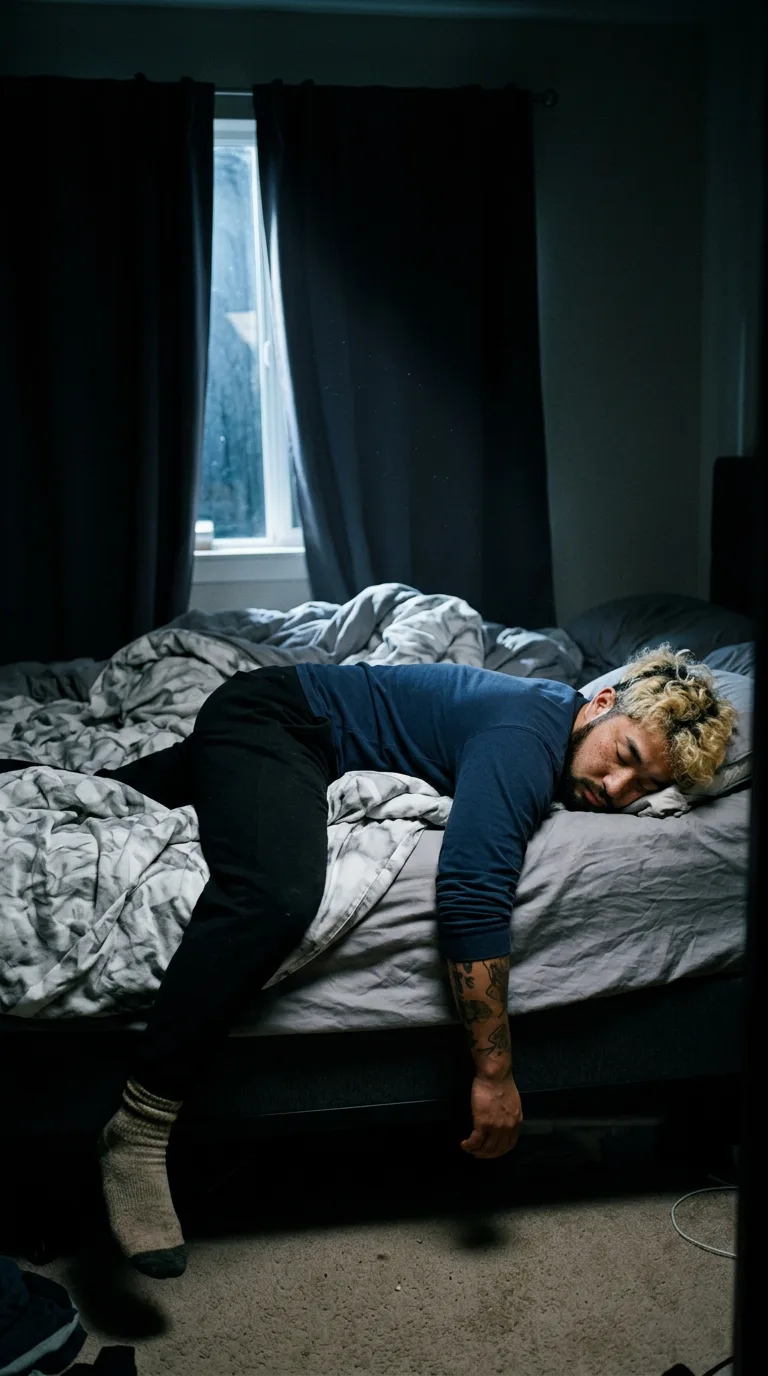
Rarest thing about him: Wind turbine technician — uncommon, 1 in 2,444
Season 1seed 1520586620 · engine v11
Character card
lineage OZ80W3
His body-swap story
@arjun.devadas, wearing Hector Maldonado, rolled the wheel on and woke up as Kenji Okabe, spent 4 minutes in him, then spun the wheel and woke up as Donald Mazzarella
---
Hector's knees are the first thing you notice every time you come back to him — not pain exactly, more a creak like a door that's been swelled shut by rain and finally gives. You're standing in his kitchen in the dark, the clock on the microwave the only light, and the mop is still in the bucket by the door where he — where you — left it four hours ago after closing out the floors at the plant. The fridge hums. Somewhere two streets over a dog barks once and quits. You are forty-seven years old in this body and you have been forty-seven for less than a minute of wearing it, and already you know you are not going to stay.
It isn't boredom, not quite. It's that Hector's hands ache in a way that doesn't go anywhere, that the mop bucket will be there tomorrow and the one after, that his life has the exact shape of itself and no door out of it that isn't the one you walked in through. You spun the wheel for forty-nine men before him and you will spin it for a fiftieth now because the wanting came back the way it always does, quiet, with no warning, like a hunger that isn't about food. You go to the laptop on the counter — his, bought on credit, still warm from being left on — and you pull up the page with the wheel on it, and you pay, and you spin.
---
The breath changes before you do. It goes from ragged, open-mouthed, sleep-heavy — to even. One breath. The arm that had been hanging off the mattress, fingers almost brushing the carpet, draws itself up like it was never allowed to hang in the first place. The body rolls onto its back. Hands fold at the chest, over the shirt, like a man laid out for a wake, and that is wrong, that is not how he sleeps, but there's no one left in him to mind. Streetlight comes through the gap in the curtain in one flat blade across the ceiling. Outside, impossibly, it's not quite dark-dark — Seattle in the hour before true morning, a bus somewhere grinding its gears on a hill, and this body has been asleep since four, because this body climbs into turbines over the Columbia Gorge and doesn't get down until the light's almost gone, and he came home spent and slept the day around backward, which is why a man can be face-down in his sheets at a time most people are having lunch.
---
The sheets are the first thing. Cotton gone soft with washing, a smell of fabric softener and, underneath it, him — clean sweat, a little grease that doesn't fully wash out of a workman's skin anymore. That's where Kenji starts arriving, not all at once but in pieces, the way heat comes back into a hand that's been cold too long.
The shirt against your back — his back — is navy, long-sleeved, the one he pulled on backward once and laughed about alone in his apartment, no one to see it, which somehow made it funnier. You feel the morning he put it on, sleeve by sleeve, the first one easy, the second one catching at the elbow the way it always does because the cuff's a little tight, a tell that this shirt has been through enough washes to shrink a half size and he never buys a new one because why would he, it still works. Standing in front of the bathroom mirror in Ballard, hair still showing yesterday's bleach job growing out dark at the root, thinking he should touch it up and not doing it, because Saturday was for sleeping and Sunday is for sleeping too, on this schedule, on this life.
The freckles come back to you like a joke someone told him as a kid — spattered across his nose and cheekbones, and in third grade a girl called him "constellation face" and meant it unkindly and he decided, alone, in the quiet way kids decide things, that he liked it better than she did. His mother's people were fishermen two generations back near Busan, saltwater people, and she used to say the sun just liked him more than it liked other kids, and he believed her the way you believe your mother about anything that makes you feel less strange.
The calluses on his palms are turbine calluses — not the kind from a desk, not the kind from nothing. You feel, without being asked, the particular grip of a torque wrench at altitude, the roof hatch open above him to gray sky and wind doing what wind does eighty meters up, which is never nothing. You feel the harness strap's exact tightness across his chest, how he checks it twice without thinking about checking it, how the inside of the nacelle smells like hot grease and ozone and cold air coming down the tower shaft. He is twenty-five and his knees don't creak yet. His shoulders do, a little, from the climb, a good ache, an earned one, nothing like Hector's.
There was a woman, once, for eight months — Priya, from the gym near his place — and it ended without cruelty, just a slow drift apart that he still thinks about sometimes with more fondness than grief, the last good thing that felt like it was going somewhere before it didn't. There is a thing nobody knows: that he cried once at the top of a turbine, alone, with the hatch open and the whole gray Sound spread out below him, for no single reason he could name, and told no one, and has never told anyone, and the sky up there kept his secret the way skies do.
He went to Mass with his mother at Christmas and Easter and otherwise kept his faith the way you keep a key to a house you don't visit — somewhere in a drawer, still yours. He drinks maybe four times a year, a beer at a coworker's barbecue, never more than that, and has never once wanted a cigarette even when the other techs smoked on break at the base of the tower, passing a lighter hand to hand in the cold.
The sheets smell like him and like a rainy city and like the particular exhaustion of a body that works outside in weather for a living. He is single. He has freckles. He is twenty-five and his hands already know, without you, how to turn a wrench and tighten a strap and climb a ladder in the dark.
---
Your hands come up off your chest on their own, the folding gone, and you turn them over in the thin streetlight — his hands, broad and sun-weathered across the knuckles despite the city's gray, calluses riding the base of each finger, no rings, no marks, nothing but freckles that run all the way down to the wrist like they couldn't stop at the face.
You bring them close enough to feel your own breath on them.
"Okay," you say to the dark room, to no one, to the window and the curtain and the two streets of sleeping Seattle beyond it. "Okay. Let's see what you've got."