Hector Maldonado
Fictional. Generated by AI — not a real person, and no likeness of one is intended.
47, janitor in Small-town Ohio · rolled by @arjun.devadas · card — no film
History
who has worn him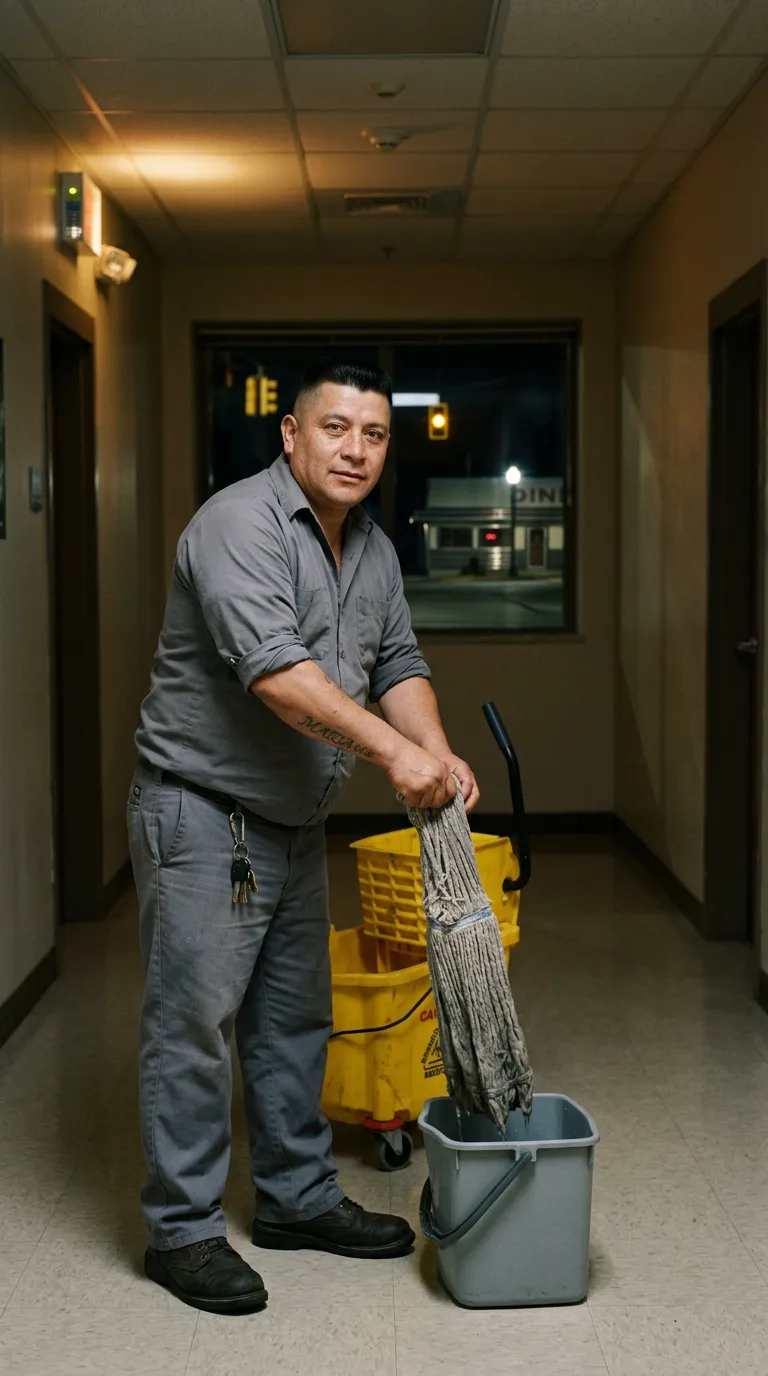
Rarest thing about him: Orthodox Christian — uncommon, 1 in 96
Season 1seed 1352108385 · engine v11
Character card
lineage OZ80W3
His body-swap story
@arjun.devadas, wearing Arturo Beltrán, rolled the wheel on and woke up as Hector Maldonado, spent under a minute in him, then spun the wheel and woke up as Kenji Okabe
---
The nose is the first thing wrong about Arturo Beltrán, and you have had forty-eight men's worth of time to notice it — broken once, badly, and never properly reset, so that his breathing has a small catch in it when the house is this quiet. It is quiet now. Rural Texas, the dead hour, his wife asleep two rooms down in a bed he stopped sharing with her months before you arrived and never started again, because some arrangements are easier to inherit than love. You are sitting in his study with his laptop open and the blue light doing nothing good for that blue-gray hair, that once-broken nose, and you are thinking, not for the first time tonight, that three billion dollars of portfolio feels exactly like zero dollars at eleven at night when there's nobody to spend it in front of. He has been you — you have been him — for nine months. It was fun for the first one. You caught yourself today reorganizing his sock drawer by color like that was a life's work. The leg under the desk is bouncing. That isn't his habit. It's the next guy's, already arriving early, the way it sometimes does right before you spin, like the wheel is leaning on the door before you've opened it. You open the laptop. You don't decide, exactly. You just find you are already on the page.
The wheel spins and lands and you are standing in a school hallway holding a mop that is heavier than any hand you've had in months, and the first thing is the smell — bleach and old varnish and the particular cold of a building with nobody in it — and the second thing is that your wrist, mid-wring, has done the motion wrong, twisted it the way you'd twist a steering wheel and not a mop handle, and water sheets down your forearm instead of squeezing into the bucket. You stop. You do it again, slow, correct, the cotton strands spiraling tight under your palm the way they're supposed to, water running off clean. You do it once more to be sure. Nothing about the hallway reacts. A clock somewhere behind a door ticks on toward 2 a.m. and a little neon light across the street — DIN , the E burnt out years ago, you'll learn — blinks red through the window like it's keeping its own kind of time.
The shirt is the first door. Gray, soft at the collar from ten thousand washes, and the memory that comes through it isn't a whole morning, not yet, just a hand — his hand — buttoning it one-handed in a dark bedroom so the lamp wouldn't wake anyone, except there's nobody left to wake, and the next button sticks a little because it always has, since before, since Marcela, and that name arrives like weather: not explained, just true, the way the tattoo on the arm the sleeve is hiding is true — script, a name, a date, the kind of thing you get once in your life if you get it at all. She went seven years ago. Heart, not drama, just quietly, the way clocks stop. He does not think her name most days anymore. Today — tonight — the shirt makes him think it anyway, because the shirt was hers to iron once upon a time and some muscle in the shoulders still expects it to be a little stiffer than it is.
The mop handle is the second door, and it opens on years, not a morning — the long midnight shape of this same hallway under these same lights, swept and re-swept, floor waxed in long parallel strokes that don't show until the morning sun comes sideways through the gym windows and lights up every scuff he missed, except he never misses, not anymore, not after twenty-some years of this building and the three before it before they tore it down. He works nights because nights are when the building is his and nobody needs anything from him, and that turns out to be the whole shape of the job's comfort: not the pay, which is nothing, but the hours when no one is deciding anything for him and no one is asking where Marcela is and he doesn't have to explain, again, that she is nowhere, that she is seven years nowhere.
The keys at his hip are the third door, and they jingle open three kids — more than three, a loud house once, now quieter, grown, one of them calling Sunday nights without fail, one of them not calling enough and feeling guilty about it from four states away, one of them still near, still local, still stopping by with groceries he doesn't need because he has, nobody in this town knows, more money than the whole block combined, an old policy and a lawsuit settlement and a stubborn refusal to move or to dress like it or to tell anyone, because what would that buy him that this hallway doesn't already give him at two in the morning — quiet, use, a floor that gets clean because his hands know how, freckles across his nose that his kids used to count out loud when they were little enough to be carried.
His wedding band is the fourth door and it does not open on grief tonight, for once — it opens on an ordinary Tuesday decades back, her laughing at something he doesn't remember the joke of, only the laugh, only that the ring went on in a church with incense thick enough to make his eyes sting, Orthodox, his mother crossing herself in the second pew, and that memory sits in the body like warmth even now, even emptied of her, the way a room keeps heat after the stove's turned off.
The nicotine pouch tucked behind his lip is small and sharp and his, entirely his, no memory in it at all except the dumb animal comfort of it, and underneath everything — the shirt, the mop, the keys, the ring — the leg starts up on its own, bouncing against nothing, a tic that was already his before you ever arrived and will be the last thing in this body to ever stop, long after you've gone somewhere else, long after this hallway forgets both of you were ever standing in it.
You look down at the hand on the mop handle — thick fingers, a laborer's scar across one knuckle that isn't yours and never will be explained to you by anyone but the skin itself — and you turn it over once like you're checking it's real, which it is, more real than Arturo's ever felt by the end.
You look up, into the dark window where the dead diner sign blinks red across the empty street, and you say, quiet, not quite believing which language came out first:
"Okay. Okay — not yet."