Kenji Arakawa
Fictional. Generated by AI — not a real person, and no likeness of one is intended.
34, lifeguard in A cruise ship · rolled by @colin.hasbrook · card — no film
History
who has worn him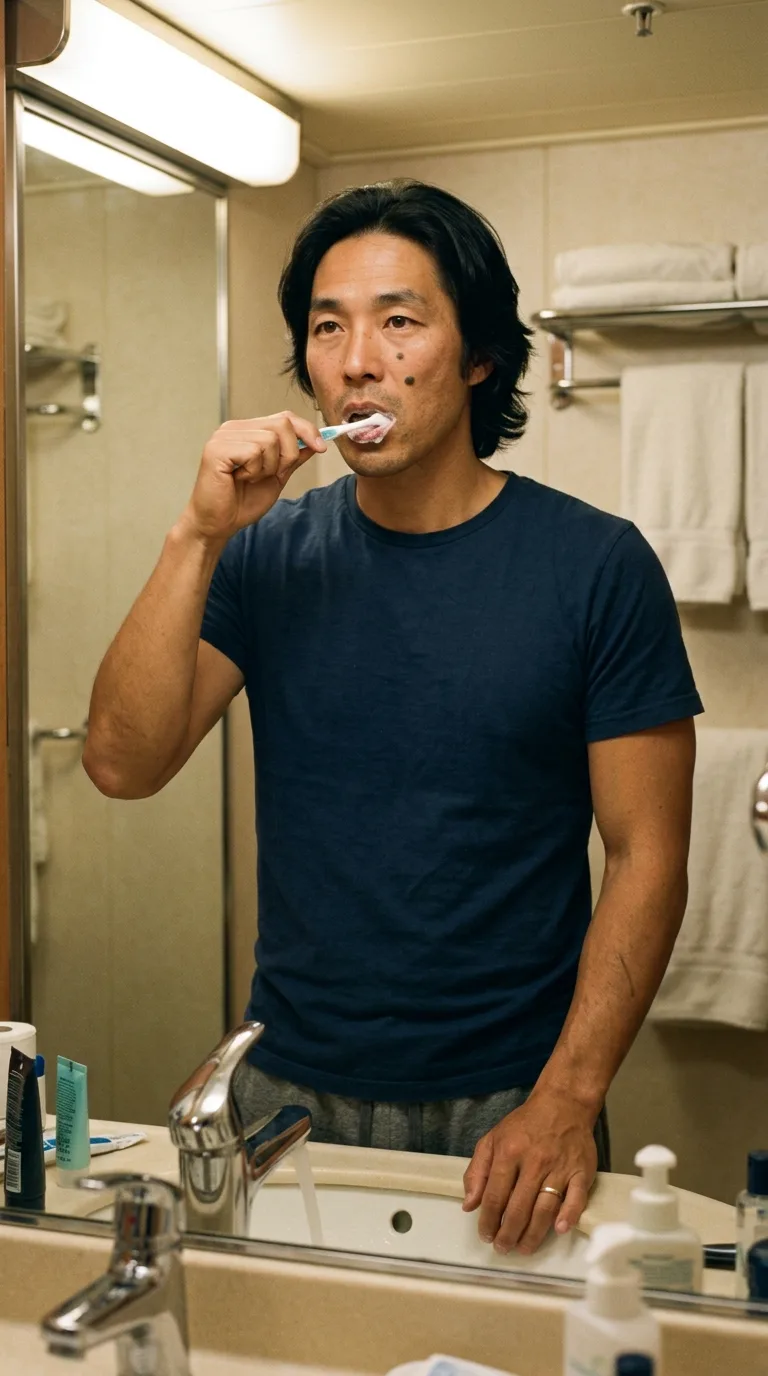
Rarest thing about him: A cruise ship — epic, 1 in 653
Season 0seed 391555245 · engine v10
Character card
lineage 2NZHHJ
His body-swap story
@colin.hasbrook, wearing Hector Villagrán, rolled the wheel on and woke up as Kenji Arakawa, spent under a minute in him, then spun the wheel and woke up as Bill Farrow
Hector's knees ache on the tile in a way that has nothing to do with anyone else's business, and that's the trouble with him — he is exactly as much as he looks like. Sixty-two years spent inside one unremarkable weather system of a body, retired from the county, divorced longer than he was married, a couch that knows his shape better than his son does. You have been him less than a minute and already the bathroom light over his sink feels like an accusation. You didn't spin four hundred and nineteen times to end up back in a body that creaks when it sits down. You did it because somewhere in the four hundredth or so man you wore, you noticed you'd stopped feeling anything arrive — just the flat click of a new name, a new commute, a new pair of shoes to stand in until you got bored of standing. Hector was supposed to be a rest. He is a rest. That's exactly the problem. You want the drop in your stomach again, the one from early on, before you knew you could have anyone. You go back to the site out of something you would not call greed if asked, though it is greed, wearing the coat of curiosity. The wheel doesn't care what you call it. You spin.
The tap is running. That's the first thing — not sight, not thought, just water against porcelain and a toothbrush already back in a mouth that was, a half-second ago, someone else's mouth entirely. Foam at the corner of his lip. Fluorescent light flat and shadowless, the kind that comes standard in a room built to be cleaned fast. You are standing at a sink bolted to a wall that hums very slightly, a hum with no source you can name yet, and your reflection has black hair to the collar and a mole riding high on one cheek like a period at the end of a sentence someone else wrote.
The brushing stops mid-stroke. Then starts again, other side, slower, working the back molars with a thoroughness that isn't yours — it's already in the hand, some old drilled patience, dentist's advice from a decade back that turned into a habit that outlived the reason for it. You rinse. Twice. Because that's what he does, though you didn't decide it. The brush goes bristles-up into its little grey puddle of a cup that has, you now feel rather than know, sat on this shelf through four different ships and one that sank a corner of a Cozumel pier for cleaning and was never the same after.
The T-shirt against your back gives it up first, the way cloth does — soft, thinned at the shoulders from washing in a machine that runs eleven loads a day belowdecks. You feel your own arm lift the sleeve this morning, in a cabin two decks down from this one, the twin bunk, the roommate's radio already going through the wall in Tagalog. Kenji Arakawa dressing at 5:40, sun not up yet, contract eight months deep, four more to go before he flies home to Emi. The shirt slides down over a chest that has been rowing a rescue board through chop for twelve years and answers to it: shoulders that know exactly how to reach and pull without being told, forearms corded from paddle and whistle-lanyard and hauling deadweight bodies up onto foam. This body is thirty-four and it knows things. It knows the particular give of a wave a half-second before it breaks over a swimmer's head. It knows how long a held breath can go before panic turns real. None of that knowledge is yours; you're a guest standing inside a trained animal.
The wedding band is a thin gold weight on the left hand you didn't lift on purpose — it lifted itself, habit, checking it's still there, the way it checks every morning and every night, a tic that started the week after the ceremony in Yokohama four years back, Emi in her mother's dress let out at the waist, both of them laughing too hard at the officiant's English. She's in Osaka now, keeping the apartment warm for a man who is home four months a year and calls it enough because the contract pays for the apartment and her sister's tuition and it will not, cannot, be forever. He believes that the way he believes anything — quietly, the way he believes in the small brass Buddha on the shelf above his bunk, the way he believes the tide always gives back what it takes if you're patient and don't fight it straight on.
The whistle isn't around your neck now, it's in a locker two decks up, but your fingers remember its weight anyway, remember the shape of the stand at Sunset Beach before this contract, the sun on red trunks, a kid pulled from a rip current at age nine screaming and alive, the mother's face doing something no training prepares you for. That was the year he decided lifeguarding wasn't a summer job anymore. He liked, more than he ever said to anyone, being the reason a bad day stayed a normal one.
The mirror gives you his face last, which seems right, since he never much looked at it beyond function — is there something in my teeth, is the mole bleeding again from a razor nick, no, good. He is not vain. He prays a little, drinks a little, smokes nothing, ever, watched his father cough himself into a hospital bed over it and decided at fourteen he'd rather not find out. He carries nothing he'd bring up if you asked him straight out what's wrong. Nothing is wrong. That's the whole shape of him: a man who solved his life down to a manageable ache — distance from his wife, four months at a time — and calls the arrangement fine, and mostly means it, and brushes his back molars slower on the left because a dentist in Yokohama once told him to.
You look down. The hand is smaller than Hector's, browner, steadier, a plain ring catching the fluorescent light without trying to. You turn it over once, like checking it's real, like checking it's yours, though you already know it isn't and that's the part that never stops being good.
"Okay," you say to the mirror, in his voice, testing the weight of it in a throat that isn't sore, hasn't smoked, hasn't shouted itself raw over thirty-four years the way Hector's had. "Okay."
You don't know yet how long you'll let the tide have him.