Kenji Amasawa
Fictional. Generated by AI — not a real person, and no likeness of one is intended.
41, retail sales associate in Buenos Aires · rolled by @colin.hasbrook · card — no film
History
who has worn him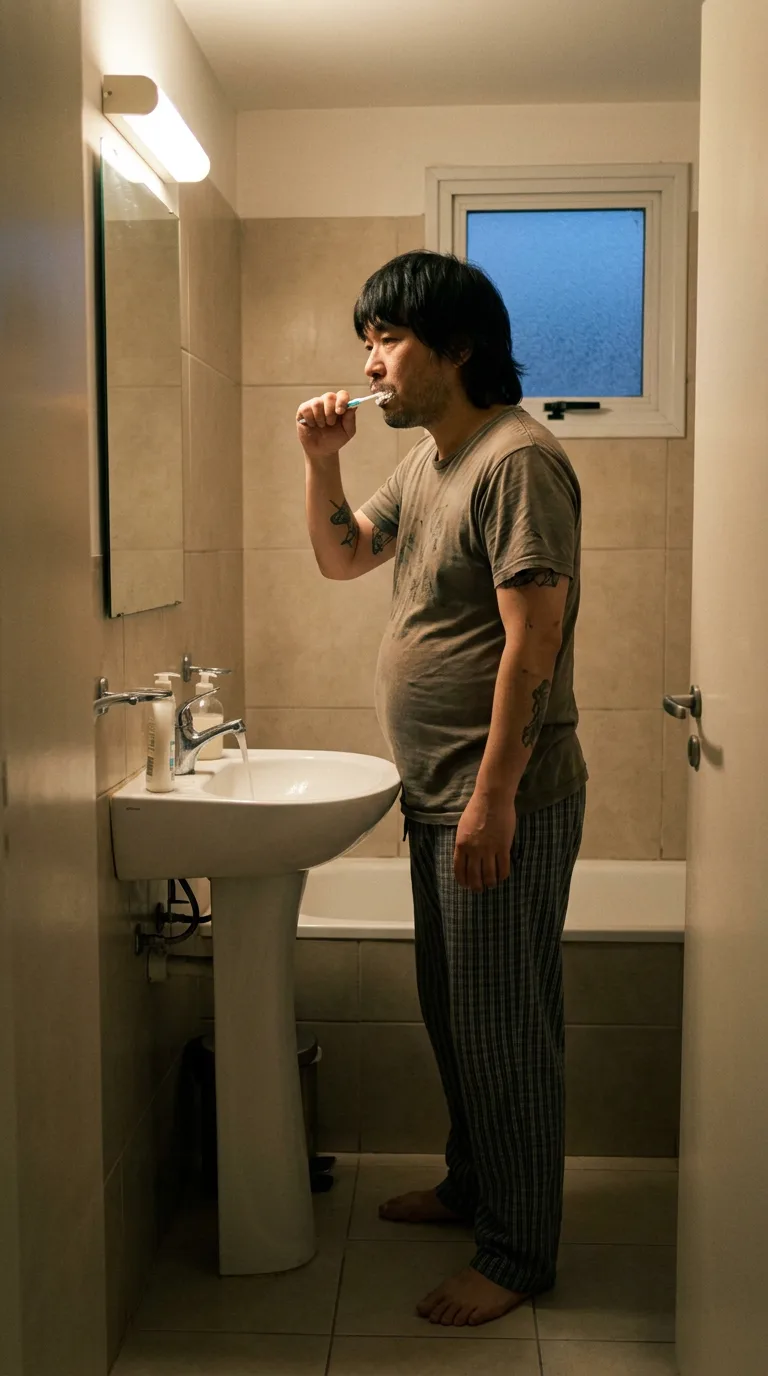
Rarest thing about him: Buenos Aires — mythic, 1 in 8,306
Season 1seed 65823242 · engine v11
Character card
lineage 2NZHHJ
His body-swap story
@colin.hasbrook, wearing Douglas Fenner, rolled the wheel on and woke up as Kenji Amasawa, spent under a minute in him, then spun the wheel and woke up as Yusuf Nassar
---
Douglas Fenner's gap-toothed mouth tastes like the coffee he made himself twenty minutes ago, and his knees ache the particular ache of six hundred stairs already climbed today, and none of it is interesting anymore. You are standing in his kitchenette in the flat afternoon light of a Wednesday, looking at a phone propped against a cereal box, and the wheel is already loading on it. You know this feeling now — the seven-hundredth version of it — the itch that comes not from misery but from adequacy, from a body that does its job and asks nothing else of you. Fenner is fine. Fenner is furniture. His girlfriend two lives ago wanted a garden; this one wants nothing you've noticed, which is its own kind of nothing to want. You do not hate him. You have simply run out of reasons to keep being him, the way you run out of reasons every time, and the site does not ask you to have a good one. You spin because spinning is the only thing that still feels like arriving somewhere. Your thumb — his thumb, blunt, the nail bitten square — taps the wheel before the coffee's even cold.
The bathroom is small and someone else's and it is evening in it, though your body a second ago swore it was afternoon. Foam sits on a lip that is not the lip you had. A toothbrush handle is between two fingers that are shorter, softer at the knuckle. The tap runs. You feel a gut that pushes gently at a shirt hem, a weight riding lower and rounder than Fenner's dad bod ever sat, a whole different arithmetic of balance in the ankles. The stroke you were mid-way through — someone else's mid-way through — finishes itself on the near side, then, a beat slower, starts again on the far molars, because some current under your new hands wants the job done properly even now. You rinse. Rinse again. Stand the brush up out of habit, bristles to the ceiling, away from water that has clearly sat grey in that cup for years.
The toothbrush is the first key. It turns and gives you nothing grand — just a thousand mornings exactly like this one, this same tiled bathroom with its frosted window gone navy-blue at night, the light fixture buzzing very slightly the way it's buzzed since the landlord half-fixed it two winters ago. You get his name off a prescription bottle by the taps before you get it any other way: Kenji, and then Amasawa, sounding out in a voice that isn't yours, in a language that arrives whole and unearned, the way all of it arrives — sideways, through his hands and not through yours.
The t-shirt against your back gives you more. It's soft in the way only three years of washing makes cotton soft, and wearing it calls up the morning he put it on — not this morning, a different one, folding it out of a basket while Valentina argued with him cheerfully from the next room about whether they were seeing her sister Saturday, and him saying sí, sí, vale, not really listening, more interested in the fact that the shirt still smelled like the detergent she liked and not the one he liked, and how that had stopped bothering him sometime in the second year without him noticing the exact day it stopped. The shirt knows his shoulders, a little narrow, a little round, and it knows the give of a stomach he has stopped fighting and mostly forgiven.
The plaid pajama trousers, loose at the waist, drawstring gone soft and grey from handling — these bring the job. Not tonight's version of the job, but a whole conveyor belt of them: an electronics aisle under too-white light, boxes he squares by muscle memory, corners snapped flush, the small private satisfaction of a shelf that finally reads as a straight line instead of a mess. He is proud of this in a way he would never say to anyone, proud the way monks are proud of a garden raked correctly. He likes customers less than boxes. He likes his manager fine. He has, in eleven years there, been late four times, and remembers each one specifically, with guilt, though nobody else does.
The bare feet on the cold tile bring the rest of the body up through the soles: 5'6", which has never once felt short to him, though a downtown crowd sometimes disagrees; a low ache behind one knee from standing eight-hour shifts on concrete flooring; forearms with more strength in them than the doughy shape lets on, from years of box-carrying, of stacking, of loosening tape guns with a practiced snap of the wrist. His hands right now, empty, already want something to do — they always want something to do, tapping the counter edge, working an invisible seam, worrying at nothing, a restlessness that has outlived every job and every girlfriend and every reason he might have once had for it. There is a small altar in the other room, a Buddha figure his mother sent from Kobe that he dusts more out of love for her than conviction of his own, and touching the memory of it brings a feeling like a held breath let out slow — not devotion exactly, more a place to put his hands still for once, incense between two fingers instead of tapping. He gave up drinking somewhere in his thirties without ceremony, just stopped noticing he missed it. Never smoked. Never wanted the thing everyone else seemed to need to hold.
Valentina is asleep, or near it, in the next room, on a Wednesday night that means nothing special except that it is one more of many nights that have quietly, without either of them declaring it, become a life. He loves her in the unglamorous way of shared laundry and shared silence, and some remembered warmth of that comes up through the tile too, faint, arriving like heat off a radiator two rooms away.
You look down. Foam still on the lip. A stranger's stomach under a soft old shirt, breathing. You lift your eyes to the mirror instead of your hands first — his face, tired, ordinary, two days of stubble across a jaw that has never once needed anyone's attention — and then, slower, you look at the hand still holding the toothbrush, turn it over, palm up, like you're checking it for something that isn't there.
"Bueno," you say, quiet, to no one, in his voice, and it comes out sounding almost like relief.