Kenji Amano
Fictional. Generated by AI — not a real person, and no likeness of one is intended.
18, accountant in Western Kansas · rolled by @colin.hasbrook · card — no film
History
who has worn him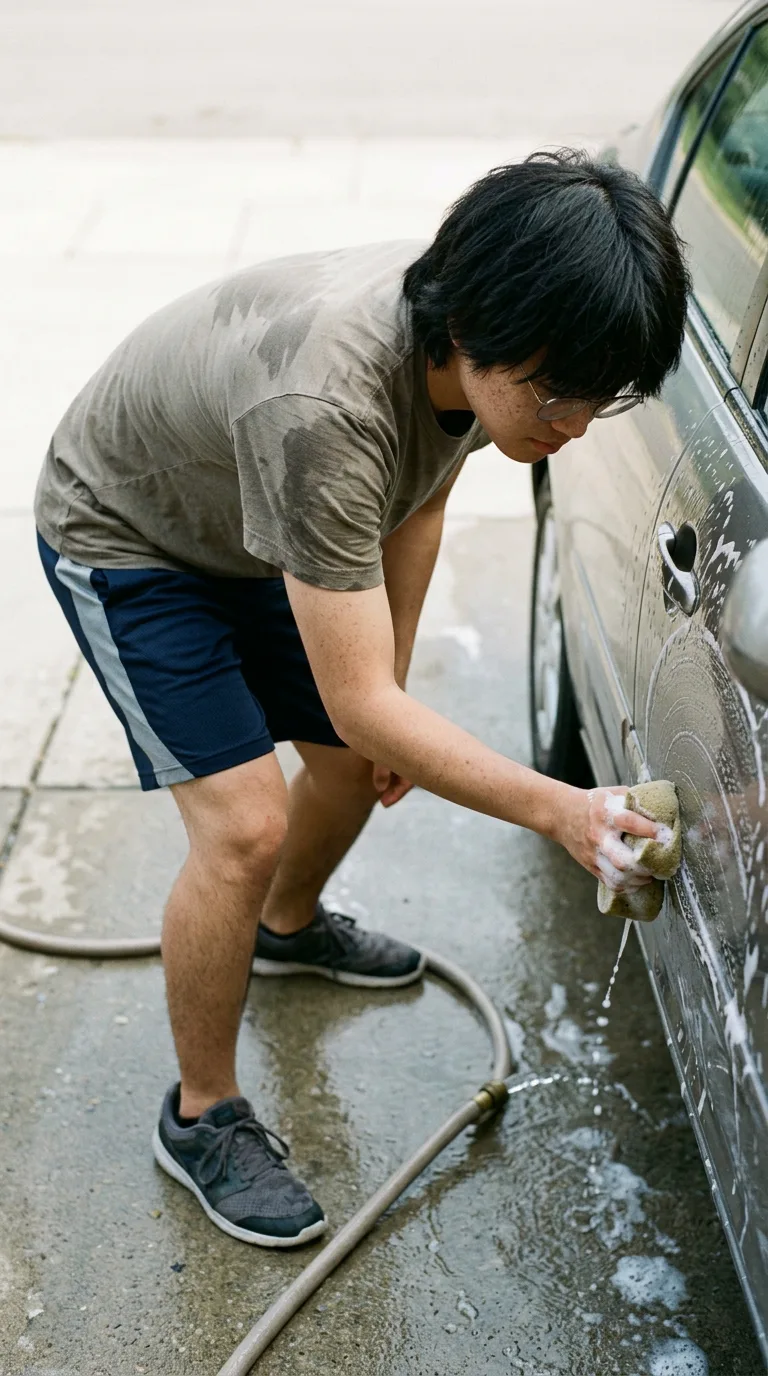
Rarest thing about him: Two — legendary, 1 in 140
Season 0seed 751507725 · engine v10
Character card
lineage 2NZHHJ
His body-swap story
@colin.hasbrook, wearing Deion Marsalis, rolled the wheel on and woke up as Kenji Amano, spent 1 minute in him, then spun the wheel and woke up as Grady Whitcombe
The stagehand's back is what tells you first. Deion Marsalis has been on his feet since six, hauling flats for a load-in that never stops being heavy no matter how many times you've done it in however many bodies, and right now, mid-Monday, he's standing in the wings with a coil of cable over one shoulder that is cutting a groove into muscle that isn't going to heal any faster for being big. You've had him less than a minute of his own time and you already know the whole shape of tonight: doors at eight, strike after, home at two, and the ache under his shoulder blade that never actually leaves, just gets rescheduled. There's nothing wrong with him. That's almost the problem. Twenty-five to a hundred thousand dollars underwater doesn't announce itself in a body, it just sits behind the eyes like a held breath, and this one has been holding it a long time, in a city that charges you for the air. You set the cable down. You already know you're not spending the afternoon in this. It isn't a decision so much as a itch you've had seventy times before, the specific itch of a body that fits fine and still isn't the one you want to be wearing when the boredom lands.
You open the site on a phone that isn't yours, in a stairwell that smells like rosin and old paint, and the wheel spins the way it always spins, cheerful and small, a toy pretending it isn't a door.
The hose is running before you are anyone. Then it's not running before you, it's running under your hand — no, under his hand, and his hand is yours now, mid-stroke, sponge dragging suds down a door panel in a wide low arc, and the arc stops. Just stops, mid-swirl, the foam sliding on without you for a second before you catch the rhythm from the inside. Thumb tucked under the sponge. Wrist doing small tight circles instead of the loose ones. A thunderhead is stacked up black over cut wheat stubble somewhere behind you, and the light has gone the yellow that means the storm is not bluffing, and none of that was Deion's sky, ever, and now it's the only sky there is.
The shirt is what opens first, because the shirt is what's on you — no, the shirt's not on you, this is a t-shirt gone gray-dark with water down the chest, and it gives you the morning anyway, the one before this one, because that's how it works, sideways: a gray cardigan going on over a blue gingham button-down, sleeve after sleeve, an apartment with one window and a space heater that never quite reaches the desk, glasses fogging faintly off the coffee and getting wiped on the hem before they go on. Kenji doesn't dress for anyone. Kenji dresses like a man rehearsing being older than he is, because at the office the youngest guy in the row of cubicles has to compensate somehow for a face that still gets carded buying scratch tickets he shouldn't be buying at all, not on what he's into it for, not with two monitors' worth of other people's numbers balancing clean every day while his own do not balance at all, have not balanced in longer than eighteen years of him have really existed to measure it against.
The sponge gives you more, and rougher: not this driveway, but every driveway, a boy of nine already good at this, his mother's voice from the porch — small circles, don't scrub, let the soap do it — and grief folds into that so fast and light you almost miss it, because she's the reason the car still gets washed every week whether it needs it or not, some Kansas Buddhist arithmetic about tending what's in front of you when what's behind you can't be tended anymore.
The hose under your bare foot, cold and fat and alive with pressure, gives you a woman's laugh from a spring evening two years gone, her hand closing over his on this same grip, before she was an ex, before there were two kids who live forty minutes away now with a name that isn't his on the mailbox, before he learned you can love people correctly and still lose the bet on them. He does not think about her every day. He is thinking about her right now, with your hand, on this porch, because the sponge is wet the way her hair used to get wet laughing under this same hose, and grief and want come up together and neither one asks permission.
The glasses on his face — fogged half a degree by the heat rolling off him — give you the office: fluorescent tubes buzzing a half-tone flat, a chair that's wrong for his back at 5'9" of average build going soft at the middle from sitting, the specific tired of a young man doing old man's math, whiskey at night that nobody at that office knows about because he is careful, meticulously, professionally careful, the way he is careful with everyone's books but never quite his own.
His shoulders are not big. There is no ache stitched into them the way there was in the last one. They are just tired in the ordinary way, sun-warm on top, a little pink already going freckled instead of brown, forearms flecked pale gold with the same freckling that sits thick across his nose and cheeks — the thing anyone would tell you about him first, if they were asked, and nobody who mattered ever really was asked, not enough, not in time.
Thunder rolls once, far off, unhurried. You straighten up out of his bent-over stance, sponge still dripping, and look down at his hand — the freckled back of it, the soap threading down between the fingers, a nine-year-old's rhythm still living in the wrist.
"Storm's early," you say, to no one, in his voice, and you don't know yet if that's the last thing he ever says or the first thing you do, and neither does the sky.