Deion Marsalis
Fictional. Generated by AI — not a real person, and no likeness of one is intended.
32, stagehand in Los Angeles · rolled by @colin.hasbrook · card — no film
History
who has worn him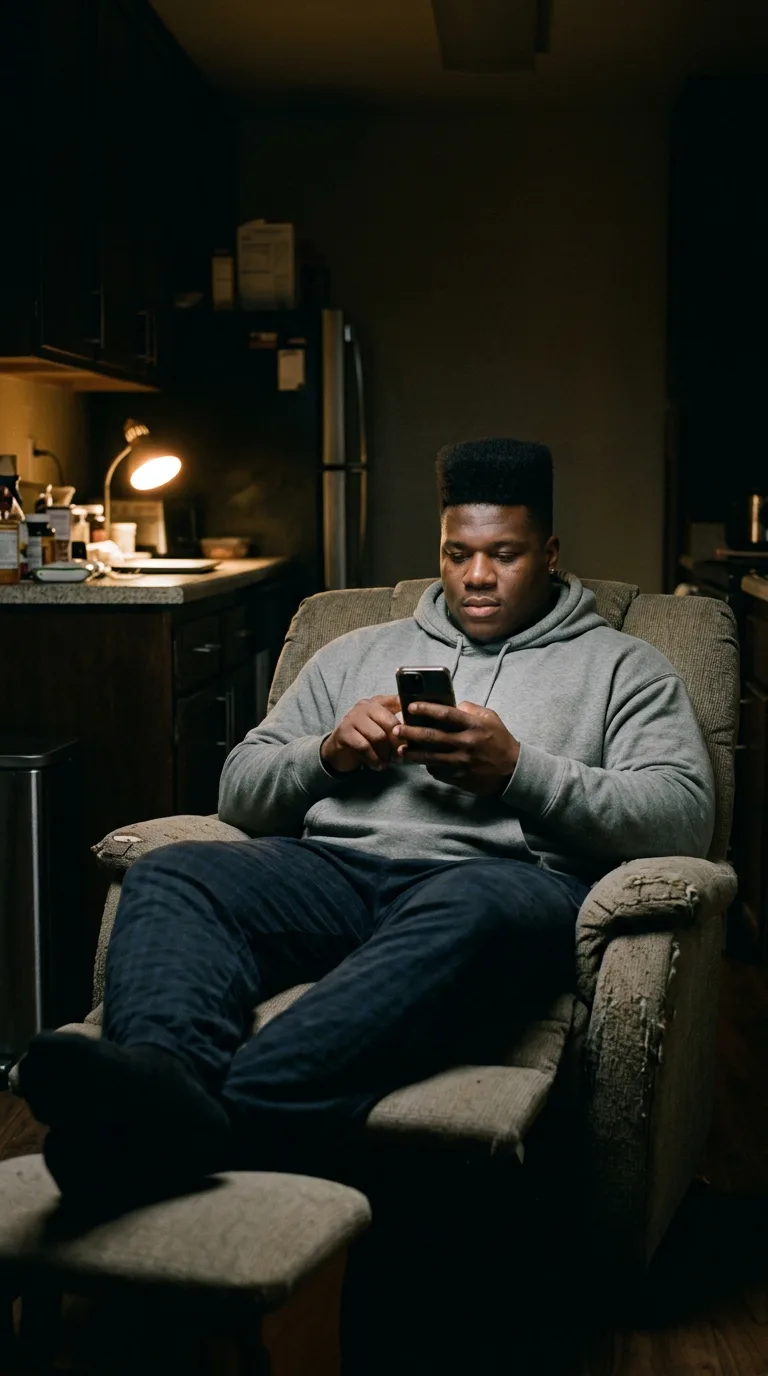
Rarest thing about him: 6'4" — rare, 1 in 76
Season 0seed 1926827117 · engine v10
Character card
lineage 2NZHHJ
His body-swap story
@colin.hasbrook, wearing Marcus Denny, rolled the wheel on and woke up as Deion Marsalis, spent under a minute in him, then spun the wheel and woke up as Kenji Amano
Marcus Denny's hands smell like antiseptic and dog fur, and they are not quite the hands you had a minute ago, but you have had them long enough now to know their complaints — the left thumb that locks in cold weather, the gap between the front teeth you keep running your tongue over out of habit that isn't yours. It is a Monday afternoon in a town small enough that the clinic parking lot is gravel, and you are standing in Marcus's office after the last appointment, holding a dog's chart you don't care about, and you feel the specific nothing that comes when a body stops being new. Fifty-two years old, good hands, a decent life — and you have been him less than a minute and already the itch is back, the one that has nothing to do with Marcus and everything to do with the wheel, with the feeling of the half-second before it stops. You set the chart down. You take out your phone, and you do not examine the wanting too closely, because it has never once needed a reason better than *again*.
The site loads the way it always does, patient, gray, waiting. You spin.
The kitchen is dark and someone else's thumb is dragging across glass, dragging past a watch that costs more than a month of rent, and the drag stops on a price with three commas in it and the thumb — his thumb, yours now — lifts off the screen and hangs in the air over it. You turn the phone face-down on the counter without meaning to, the way a man puts down something that has embarrassed him in a room with no one in it. The hand that set it there does not go back for it.
You are big. That arrives before anything else does — a largeness held all the way down through the shoulders and the gut, a body built for lifting things and made to carry that lifting afterward in the lower back, which is already announcing itself, dull and familiar, though you have not been it long enough for it to feel familiar to you yet. You are sitting. There is fabric under you gone soft in the arms, and a footstool, and a lamp burning somewhere to the left with a warmth that says late afternoon, though something in the tiredness sitting behind your eyes says this man's day started at night and is not supposed to be awake right now.
The hoodie against your back gives you the first of it: gray cotton, worn thin at the elbows, and a Tuesday — no, not this Tuesday, a hundred of them — pulling it over your head backstage under blue light, the smell of rope and hot gel and dust cooking on a lamp, someone yelling *rail, go* and your body already moving before your mind finishes hearing it. Deion Marsalis. The name comes with the shirt, the way a smell brings back a kitchen. Fourteen years hanging lines. Hands that know a knot before the head does — you feel that, a whole vocabulary living in the fingers independent of you, cleat hitch, bowline, the specific give of a rope under load, feel it the way you'd feel a language you never studied but somehow speak.
The jeans give you more: putting them on this morning, if morning is the word for two a.m., sitting on the edge of a bed with a woman's back turned warm against the sheets, her name arriving soft and whole — Renata — and the quiet math he does every night pulling these same pants up, rent due Thursday, a card already breathing fire behind him, eighty-some thousand dollars of held breath that never lets up, not once, not during load-in, not during a matinee, not now. Two kids somewhere in a school photo taped to a fridge he is not currently looking at, a boy's crooked grin, a girl who lost a tooth last week — those come in pieces, proud and sore at once, the particular ache of a father who is always either at work or asleep from work.
The toothpick is between his back teeth before you notice you're chewing it, an old motion, unconscious, and it brings its own small history — a habit from quitting something worse, a compromise his body made with itself years ago and never revisited. The cigar smell is in the chair's arm, ghosted into the fabric from nights on this same stool. The chronic ache down his spine sharpens when you shift, an old fly-rail injury nobody fixed right, and you feel how he's learned to sit so it complains less, a whole architecture of small mercies built around one bad decade of lifting.
The watches. That's what he was doing, and now that you're inside it you feel the shame under it clean and plain — not wanting the watch, wanting to be a man for whom the watch was possible, wanting one Thursday where the arithmetic came out even. You feel it land in the gut like weather.
You look down. The hand at the end of your arm is broader than the one you had a minute ago in Ohio, darker, a thin white callus ridge across three fingers where rope has run through them for over a decade, and you turn it over slowly in the lamp light like you're checking it's really attached.
"Damn," you say, to the empty kitchen, in his voice, not yours, "that's a good grip."
You don't know yet how long the wanting stays quiet this time.