Julián Reyes
Fictional. Generated by AI — not a real person, and no likeness of one is intended.
28, janitor in Seattle · rolled by @marco.villagrana · card — no film
History
who has worn him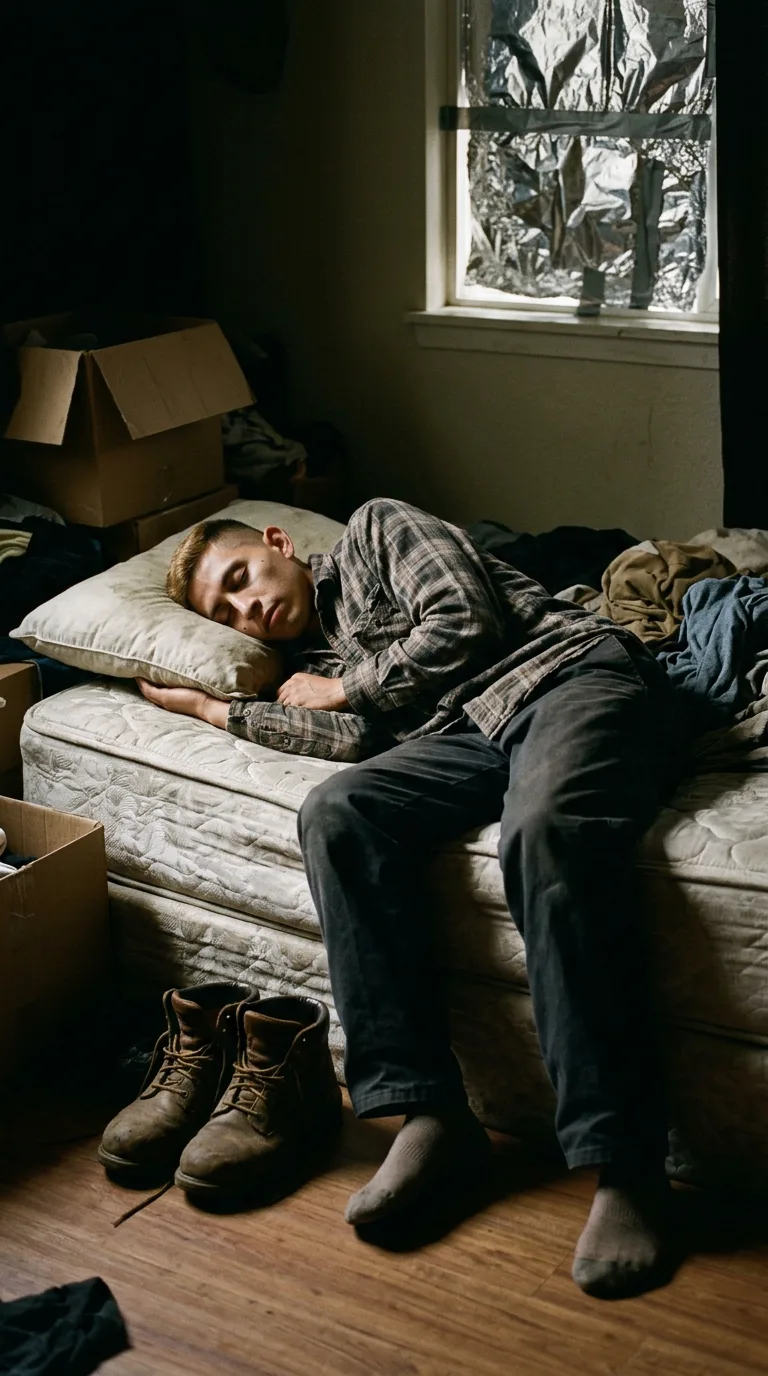
Rarest thing about him: Asthma — rare, 1 in 26
Season 0seed 1838052699 · engine v10
Character card
lineage LJL8SV
His body-swap story
@marco.villagrana, wearing Mike Donahue, rolled the wheel on and woke up as Julián Reyes, spent 3 hours in him, then spun the wheel and woke up as Samir Haddad
Boston, and it's Sunday, and the coffee in Mike Donahue's hand has gone cold in his grip without him noticing, because his grip is not doing much noticing lately. Three minutes in him. That's all it took. You already know the smell of the garage he half-remembers, the ex-wife who calls twice a year, the knee that clicks going up stairs — all of it arrived in the first thirty seconds, the way it always does, cheap and fast and used up almost as soon as it comes. He is skinny and blue-eyed and forty-three and his back already aches in a way that has nothing to do with you. There is nothing wrong with him. That's the problem. Nothing wrong is not the same as anything at all. You set the mug down on his counter with his hand and you feel how little that costs you, and some part of you that is older than any of the forty-five is already reaching for the laptop, already typing vessel.cards into the bar out of an itch you have stopped pretending is anything but hunger.
The wheel loads. You do not think about it as a decision. You think about it as a thing that is already happening, the way hunger always is by the time you notice it.
You spin.
There is no sensation of falling, no tunnel, nothing so considerate as a warning. One instant you are a hand on a cooling mug in a kitchen with weak Boston light coming sideways through the blinds, and the next you are lying on your side on a bare mattress with a pillow gone flat under your cheek, and a bar of white light is lying across your face like something laid there on purpose. You turn from it. Then, because the body wants it, because some tide in him is already pulling toward waking, you turn back into it and open his eyes into the glare and you do not blink.
The room comes in in pieces. Foil taped over the window, corner peeled back by wind or carelessness, the light knifing through the gap. A mattress on the floor with no frame. Boxes taped and half-taped, someone mid-move or never finished moving in. Your — his — chest is tight in that specific way, air going through a smaller door than it should, and even before you know the word asthma you know the shape of the problem, because his lungs are telling you plainly, the way lungs do.
You are on your side in a flannel shirt buttoned wrong at the collar, in work trousers stiff with something dried into the knee, socks on, boots standing at attention on the floor below you like they're waiting to be stepped back into. The second your palm presses flat against the mattress to push yourself up, it comes — not a thought, a feeling, arriving through your hand from the fabric worn thin under it: three years of this exact mattress, no frame because a frame was a thing you kept meaning to buy and never did, the last apartment and the one before it always somehow ending up with the mattress just on the floor, like a placeholder for a life that hadn't started yet.
The flannel gives you more. Your fingers find the wrong button at the collar and the memory of buttoning it wrong on purpose, hours ago now, too tired after the shift to care, standing in the school's break room under a buzzing light with your keys already clipped to your belt loop, ready to go, boots already laced because you never unlace them fully, just loosen and shove your feet in, loosen and shove your feet out. The keys. You don't have to touch them to remember them, but when your hand brushes the belt loop where they'd hang if you were dressed, the whole ring comes back at once — the janitor's ring, heavier than it looks, forty-some keys for forty-some doors, the gym, the cafeteria walk-in, the boiler room nobody else has a key to, room 114 where a kid left a jacket on a Friday and it's still folded on your cart because you keep forgetting whose homeroom it was. The corridor at night. Buffer humming under your palms, floor wax smell so familiar it isn't even a smell anymore, just the color of the job. Empty classrooms with the chairs up on the desks like a held breath. You like the emptiness. You've never told anyone that. You like being the only one awake in a building built for three hundred kids, like the whole place is quietly yours for eight hours a night and nobody knows to be jealous of it.
Your hands, when you're not paying attention to them, go to your mouth — you catch yourself doing it now, teeth finding the ragged edge of a thumbnail already bitten past sense — and that single small habitual violence unlocks something bigger: a woman's voice, amused, swatting your hand down from your mouth on a couch that wasn't yours, in an apartment that isn't this one, saying stop, you'll have nothing left up there, and you laughing because you loved that she noticed, and the ache under that memory that has nothing to do with lungs — she's the one who got away, and you know it the way you know your own name, and you don't examine why you let her.
The window foil crinkles somewhere in your peripheral hearing, cardboard box smell, floor smell, Sunday light where Sunday light shouldn't be this bright this early — except it isn't early for him, it's the middle of his day turned inside out, night-shift noon, his body clock running backward against the actual clock the way it has for years, waking into daylight like waking into an accusation.
Your chest still doesn't have enough room in it. Twenty-eight years of narrow airways teach a body to breathe shallow and careful, and you feel that carefulness now as something almost graceful, an economy his lungs perform without asking him.
You sit up. The mattress springs, long dead, don't even complain.
You look at your hands — his hands, thin-fingered, nails bitten to the quick, a callus along one first knuckle from gripping a mop handle nine hours a night — and you turn the right one over slowly, like you're checking it's really there, and then you lift your eyes and you say, out loud, to no one, to the taped-up window, to whatever's listening:
"Okay. Not yet."