Isaías Marrufo
Fictional. Generated by AI — not a real person, and no likeness of one is intended.
18, nurse in Anchorage · rolled by @marco.villagrana · card — no film
History
who has worn him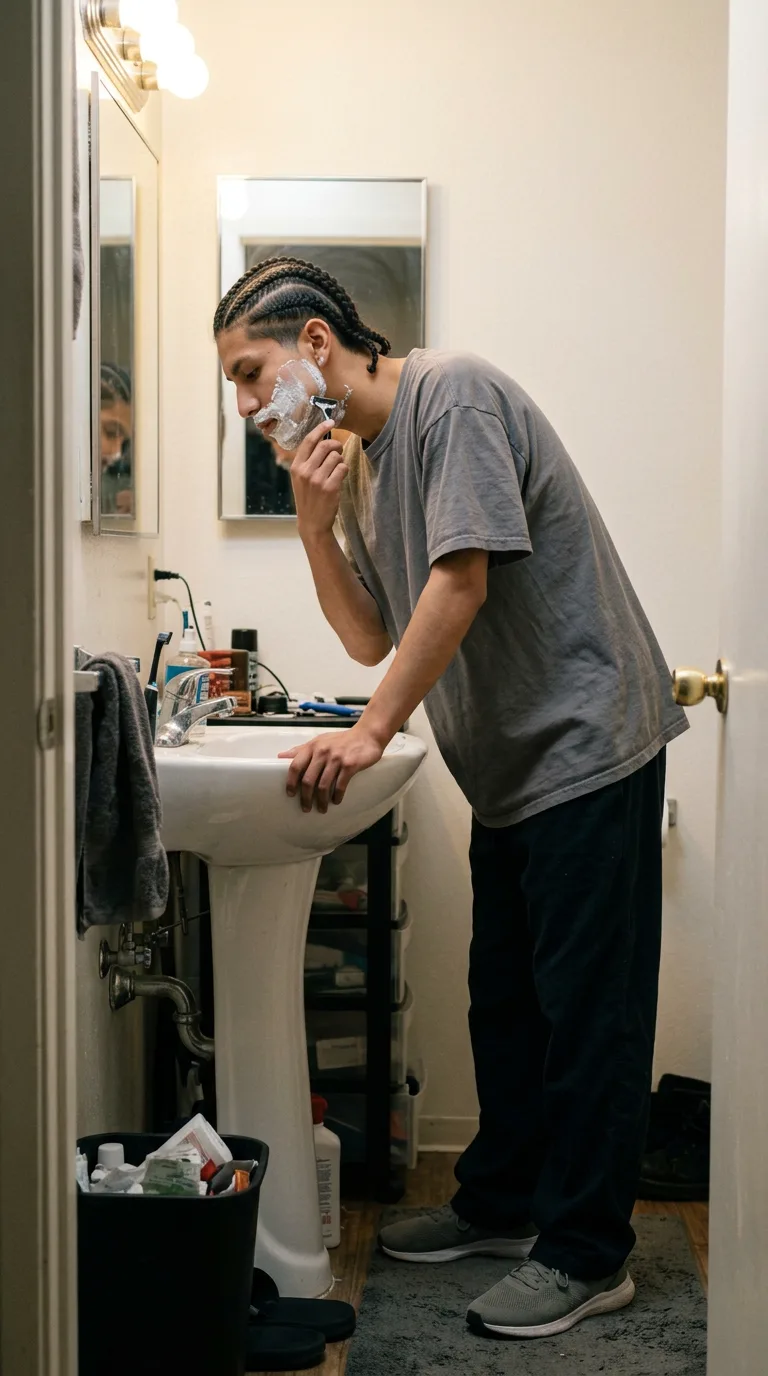
Rarest thing about him: Cornrows — epic, 1 in 265
Season 0seed 1248688077 · engine v10
Character card
lineage LJL8SV
His body-swap story
@marco.villagrana, wearing Daniel Fujita, rolled the wheel on and woke up as Isaías Marrufo
Three minutes in that Pittsburgh waiter's body and already the itch is back.
You feel it before you even name it: the ache in a knee that isn't yours, the smell of fryer oil baked into a polyester collar, the manager's voice still hanging in the air from a shift that hasn't started yet. Daniel Fujita — thirty-two, tired around the eyes even at thirty-two, six hours of standing between him and a closing shift he already dreads. You spun to get him ninety-two spins ago as somebody else, wanting an easy one, a body that could just get through a day, and it turns out easy is its own kind of nothing. He is fine. He is unbearable. There's a whole life sitting behind his ribs — a mother who calls too much, a lease he can't break, a tip jar that's never full enough — and none of it is yours to want, only his to carry, and you are so tired of carrying men's small burdens for the free feeling of not being anyone.
So you go back to the site, still wearing him, phone screen lighting up his kitchen at nine on a Friday night. vessel.cards. The wheel sits there the way it always sits there, patient, uncomplicated, honest in the only way it knows how to be honest — spin, pay, get a man. You do not think about who. You never do. That is most of the pleasure of it, the not-thinking, the free fall between one life and the next.
—
The water is running before you arrive, which is the first thing you notice — not the room, not the light, but sound, warm and steady, hitting porcelain. Then the sting: foam gone tacky and cooling at the jaw, half a face raw and shaved smooth already, half still masked. A razor, weightless and precise, held between two fingers that know exactly what they're doing. The hand does not stutter. It rises against the grain, up along the jaw, over the place where a mouth would flinch, and there is no flinch. It just finishes, fast, sure, like it had somewhere to be.
Afternoon light through a small window, thin and silver, Alaska light, not evening light at all — that wrongness registers somewhere underneath, a held note that doesn't resolve. The body is slight. Narrow shoulders, no weight to spare anywhere, and a face in the mirror with dimples cut into it even now, even blank, even mid-motion, ghosts of a smile that isn't being made on purpose.
—
The razor goes down into the sink first, and that's the first door: cold steel, a groove worn into the handle where a thumb has pressed a thousand mornings running, and something comes up out of it fast and total — a drugstore razor bought on sale, six for the price of four, because there was never money for the good kind. Isaías. The name arrives folded inside the memory like it was always going to.
Then the shirt against your back — no, not yet, this is still the undershirt, the soft gray cotton worn thin at the collar — and through it comes a whole morning: waking at eleven because the shift last night ran to seven a.m., the graveyard rotation on the med-surg floor, twelve hours of call lights and med passes and one code that went bad around four that he still hasn't put down all the way. Through the cotton comes the actual putting-on of it, sleeve first, right arm because the left shoulder is stiffer these days from hauling patients that are heavier than him, always heavier than him, and he laughs about it with the other aides because what else do you do. The shirt smells like the dryer sheet from the laundromat two blocks down, the one that's cheaper than the one in his own building.
The sink under his palm gives him the apartment: plywood siding out back, blue tarp cracking over a snowmobile he inherited from a roommate who moved to Fairbanks and never came back for it, the long gold light of Anchorage afternoons in October that makes everything look like it's already ending. Rent that eats almost everything. A little left over that mostly goes to the bottles under the sink two feet from where his hand is right now — Taku, cheap, always cheap, because shame doesn't care what it drinks. He knows it's a problem the way you know a leak in a roof is a problem, background noise until the ceiling gives. He's been to a counselor twice this year for the anxiety, has a bottle of sertraline in the cabinet behind the mirror he's looking into right now, takes it most days, some days. Spiritual on his own terms — talks to something bigger than the hospital ceiling on his lunch break, doesn't call it prayer.
The dimples come with a memory attached to nothing in particular: a patient, an old woman on nights, delirious and scared, calming down only because he smiled at her, and she said *you've got a good face, mijo*, and he'd carried that stupid sentence around for a week like a coin in his pocket.
He is alone. No one waiting on him, no one he's waiting on. Eighteen and already good at his hands — steady with a line, steady with a razor, steady with the weight of somebody else's failing body — and bad, so far, at being good to himself.
—
The water is still running. You lift your hand out of it and look — narrow wrist, brown skin, a thin white scar of soap drying at the knuckle — and it is not your hand, it was never going to be your hand again, and something in that fact still catches you every single time, ninety-three times now and still a small drop in the stomach like a stair that isn't there.
You look up into the mirror, into a face with foam only on the left side now, dimples sitting there uninvited even now, even scared.
"Okay," you say, to no one, to him, to the water. "Okay. Let's see what you've got."