Gregory Pantalone
Fictional. Generated by AI — not a real person, and no likeness of one is intended.
61, sales rep in New York · rolled by @colin.hasbrook · card — no film
History
who has worn him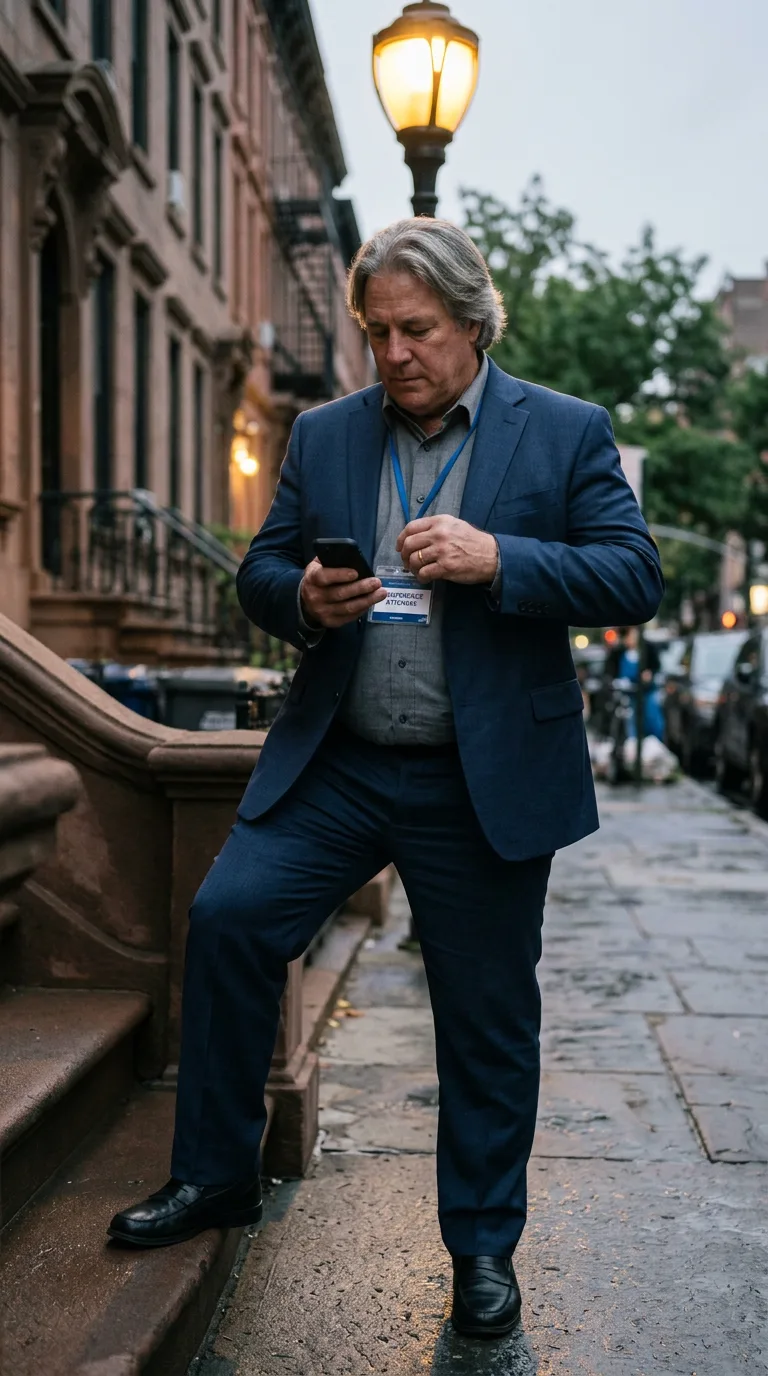
Rarest thing about him: Curtains, parted in the middle — rare, 1 in 84
Season 0seed 600571943 · engine v10
Character card
lineage 2NZHHJ
His body-swap story
@colin.hasbrook, wearing Curtis Owsley, rolled the wheel on and woke up as Gregory Pantalone, spent under a minute in him, then spun the wheel and woke up as Daniel Katsuyama
---
Curtis Owsley's hands smell like bar oil and cut pine even though you haven't touched a chainsaw in the minute you've worn him, and that's the thing about a new body — it keeps giving you its owner's residue long after its owner is gone. You're standing in his kitchen, sun coming in wrong for a Monday morning nobody should be awake for, and you already know you're not staying. Forty-six years old, average everything, freckles like a boy who never grew out of them. He was fine. He was nothing. That's the whole problem — six hundred and seven men behind you and this one barely left a mark going in, and you can feel the itch starting before the coffee's even cold, the specific boredom of a body that fits too easily, that asks nothing of you. You set his mug down on his own counter like you're doing him a favor. You open the laptop. The wheel is already loaded, spinning lazily in its idle animation, waiting.
You don't decide so much as notice your thumb has already clicked.
—
The toothpick is between your teeth and a phone is in your hand and one foot is up on a brownstone step that isn't yours, mid-afternoon light going amber-gray off wet stone, and for half a second the message you were typing gets a letter wrong, then wrong again, then you delete the whole line and start it slow, checking each key like a man relearning his own name. Nobody around you notices. Why would they. A man pausing on a stoop, thumb hovering, is just a man thinking.
You are heavier than Curtis was, thicker through the middle in a way that isn't fat exactly, more like sixty-one years of good dinners settled into muscle that used to be for something else. The lanyard against your chest swings once. Blue suit, gray shirt open at the collar, and under your shoe the stone step is slick enough that some other part of you — not you, him, already arriving — knows to roll the weight onto the heel first.
—
The phone in your hand is warm from his palm, and that's the first door: a text thread, his wife's name at the top — Donna — and above it, unanswered, a name you weren't given but understand instantly is trouble: Renata. The thread with Renata is six weeks old and mostly silence now, the silence of a thing he ended and still checks on, the way you check a bruise. There's an ache that comes with it that isn't pain exactly, more like a held breath he's had in his chest since March. You didn't ask for that feeling. It came anyway, riding in on the glass and the plastic case with his thumbprint worn into one corner.
The lanyard gives you the hotel — a Marriott two blocks from here, a badge that says CONFERENCE ATTENDEE in letters too cheerful for the man wearing it, and under that: a decade of these. Rooms that all have the same ice machine hum at 2 a.m., a rolling bag with a busted wheel he keeps meaning to replace, a sales pitch about polymer fittings he could deliver concussed. He is good at this job in the specific way of a man who stopped caring whether he was good at it around year eight and got better anyway, out of pure muscle memory, the way you shuffle a deck without looking.
The wedding band on your left hand is warm too, plain gold, and touching it with your thumb — a habit his hand does without you — brings back a kitchen in Bay Ridge, Donna in a housecoat forty pounds ago, both of them younger, a kid — one kid, a daughter, grown now, a wedding of her own last spring that cost more than his car — and under all of it, quieter, the year he almost left, and didn't, and never told anyone why he stayed. The shirt against your back gives you this morning specifically: him buttoning it in a hotel bathroom with the fan running, checking his blood pressure cuff reading twice because the number scared him a little, deciding not to mention it to Donna on the phone, deciding to have the cigarette anyway. A pack a day, the whole life of it — the taste is in your mouth before you've done anything, that dry want.
The toothpick between your teeth is older than any of that. It goes back to a boat, a father who chewed them too, sitting on a dock somewhere that smelled like diesel and lake water, forty years gone and still living in the muscle of your jaw. You didn't take him for the toothpick. Nobody ever does. It just came with the rest, unbilled.
You feel the wet stone under your shoes, the specific give of dress shoes that have walked a thousand hotel carpets and know exactly how much traction cheap Brooklyn cobblestone gives back. Your knees ache a little going up the step, both of them, the honest ache of sixty-one years carrying a frame that used to play something rougher than this — high school, maybe, a body that remembers being fast once and forgives itself for not being fast now. Your blood pumps a half-beat too hard just standing here; something in you already knows to sit down soon, to not skip the pill in the little case in your jacket pocket, though you don't yet know exactly where that pocket is.
—
You look at your hand — his hand — turning it slow under the streetlamp, the ring catching sodium-orange, the phone still lit in your palm with her name still sitting there unanswered.
"Renata," you say out loud, to no one, testing how his voice sits in your own chest, "I told you I wasn't gonna do this anymore."
And you don't know if you mean it as him or as the thing wearing him, and neither, for now, does the street.