Daniel Katsuyama
Fictional. Generated by AI — not a real person, and no likeness of one is intended.
41, musician in Phoenix · rolled by @colin.hasbrook · card — no film
History
who has worn him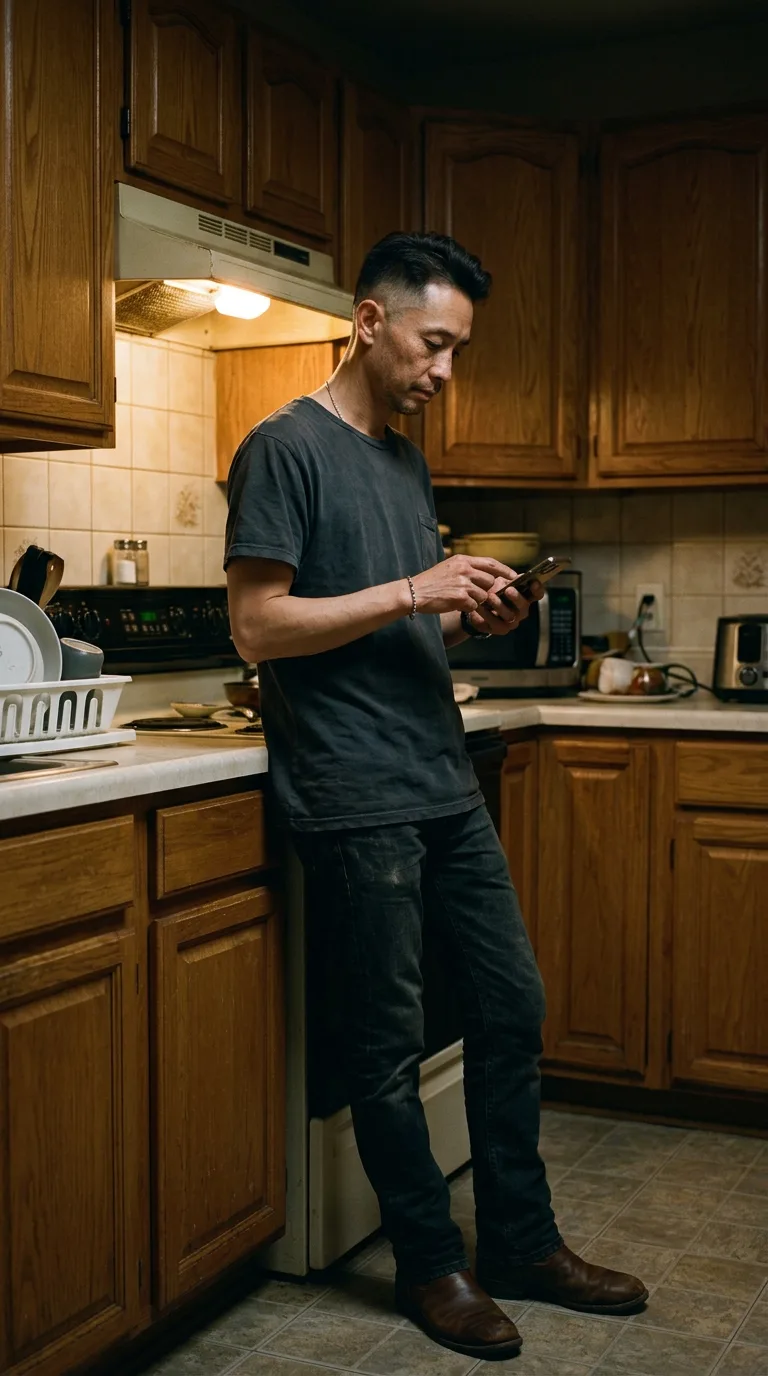
Rarest thing about him: Migraines — rare, 1 in 33
Season 0seed 2137797790 · engine v10
Character card
lineage 2NZHHJ
His body-swap story
@colin.hasbrook, wearing Gregory Pantalone, rolled the wheel on and woke up as Daniel Katsuyama, spent under a minute in him, then spun the wheel and woke up as Peter Galuszka
The sales floor at eleven on a Monday is dead quiet, and that's the problem. You've been this one nine days — sixty-one years old, gray going silver, a gut you didn't earn wearing well on a frame built for lifting things once. Sales rep, decent condo, decent commission checks, a body that doesn't hurt anywhere interesting. It should have been enough. But you spent the morning watching a kid half your age close a deal you should have closed, watching your own hand — thick-knuckled, a stranger's hand still after nine days — shake his, and something in you went stale like bread left out. Not hatred of him. Just the flat certainty that you already know how the rest of this one goes. You know how all of them go, eventually. That's the itch the wheel scratches: not escape, just the next unopened door. You tell the guy you're stepping out for lunch. You sit in the gray Buick in the parking garage, phone in your lap, and you open vessel.cards like a man checking a stock he's addicted to losing money on. You spin.
It lands in Phoenix, mid-morning there, and you arrive already leaning, already exhaling — his weight is a shock every time, thin where the last one was thick, a whole foot of him gone missing from what you'd gotten used to. A phone is warm under his — your — palm. The thumb has just lifted off the glass like it burned. The kitchen light is bad, yellow, buzzing faintly from the hood vent above a stove nobody's cooked on today. You feel the last thing he felt arrive a half-second behind you, the way sound trails light: a price on the screen, four digits past what rent costs, a watch he will never wear, and under that, the low arithmetic hum of shame that isn't yours but sits in the chest like it is.
Your hand — his hand — sets the phone face-down. Doesn't pick it back up.
And then it starts coming in through what he's wearing, because that's the only door in. The shirt against your back: a gray tee, thin from washing, and it gives you this morning, an hour ago in his time, him pulling it over his head in a bedroom with the blinds still down, careful not to wake her — her breathing, her shape under the sheet, a name that surfaces and slips before you can hold it, girlfriend, three years, the smell of her shampoo baked into the pillow. He'd stood in the closet doorway a second too long deciding between this shirt and the black one with SOUNDCHECK across the chest, because the black one smells like the club from Saturday and he hadn't done laundry, and today's just a load-in, not a show, so it doesn't matter. It mattered enough to stand there, though. Everything matters enough to stand there, lately.
The jeans give you less — just years, stacked. Different stages: black-box rooms with sticky floors, casino lounges where nobody looked up, a wedding gig in Scottsdale where the bride cried during a song he wrote for someone else entirely. The belt loop where his thumb hooks without thinking gives you the strap of a bass slung crosswise, the specific ache low in his back from carrying an amp up a flight of stairs with no elevator, twice a week, for eleven years, a soreness that never fully leaves and that you can feel right now, dull and familiar, resting in the lumbar like a tenant.
The boots — worn brown leather, scuffed white at the left toe from a pedal he kicks by habit — give you a floor. Not this floor. A stage, small, a few years back, sound guy waving him in for a level check, his own voice coming back at him thin through a wedge monitor, *one two, check*, and the particular satisfaction, almost holy, of a room's dead air filling up with something he made. He is not famous. He has never once thought he would be. That stopped mattering around thirty-five, when it became just the thing he does, the way another man's job is just the thing he does, except this one costs him money instead of paying him enough of it.
The chain at his throat — thin gold, a bar mitzvah gift, his mother's handwriting on the card long since lost — gives you a synagogue in Scottsdale, folding chairs, a cantor's voice cracking on a high note, his father's hand heavy and proud on the back of his neck. Gives you, too, the migraine that came on halfway through the reception after, white and total, the first one, the one that taught him at thirteen that pain could arrive without any warning at all and simply own the room behind his eyes for hours. He has learned to feel one coming the way other men feel weather. There isn't one now. Small mercy.
You feel how thin he is — five-nine and built like something whittled, no fat to spare anywhere, freckles scattered like the light through the window did it once and never stopped — and you feel, too, that this is not a body that resents being small. It's efficient. It knows exactly what it can carry and carries it anyway, twice a week, up stairs with no elevator.
You look down at the hand that isn't yours yet and somehow already is. You turn it over. Freckled knuckles, a callus low on the fingertips from forty years of strings, a thin white line of skin where a ring almost went once and then didn't, for reasons the shirt didn't give you and you don't chase.
You lift your eyes to the dark window over the sink, where the morning outside is too bright to look at directly, and you say, to no one, in his voice, testing it like an instrument:
"Okay. Not yet."